The Iran war risks reigniting after the United States attempted to force open the Strait of Hormuz for commercial shipping, firing on Iranian forces and sinking six small boats targeting merchant vessels. However, a ceasefire appeared to be holding on Tuesday, even after the United Arab Emirates reported that Iran had launched missiles and drones at its territory.
It remains unclear what will follow the American effort to end Iran's stranglehold on the strait by creating an 'enhanced security area.' A prominent Iranian official accused the U.S. of undermining regional security with this move and warned that Tehran would respond.
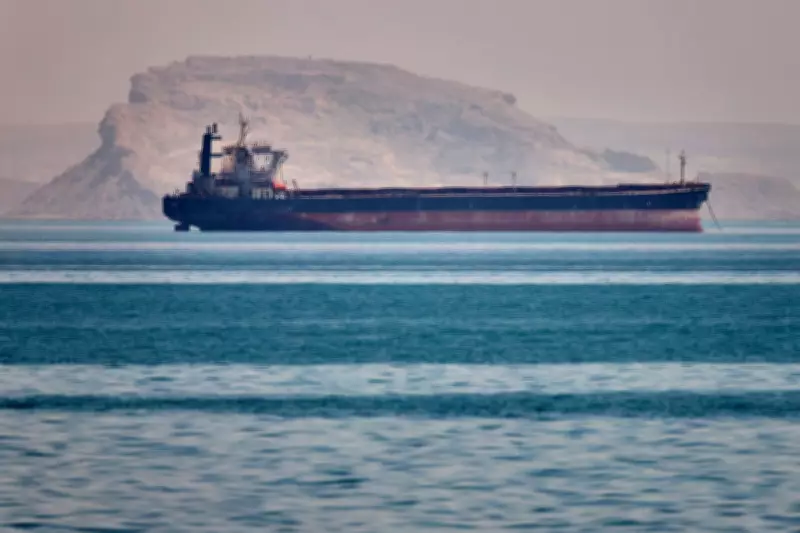
The U.S. military confirmed that two American-flagged merchant ships successfully transited the strait on Monday, but it was uncertain whether additional vessels would attempt the crossing on Tuesday. Ship tracking data showed a Panamanian-flagged crude oil tanker heading toward the center of the strait on Tuesday morning after leaving an anchorage in the Persian Gulf, though it was unclear if it would attempt to pass through. The tanker listed its destination as Singapore, according to the MarineTraffic tracking site.

Iran's effective closure of the strait, through which roughly one-fifth of the world's oil and natural gas trade typically flows, along with fertilizer and other petroleum-derived products, has sent fuel prices skyrocketing, rattled the global economy, and provided Tehran with a major strategic advantage in negotiations to end the war. Breaking that chokehold would ease global economic concerns and deny Iran a critical source of leverage. However, such efforts also risk reigniting the full-scale fighting that erupted when the U.S. and Israel first attacked Iran on February 28, prompting Tehran to close the waterway.
Iran Accuses US of Ceasefire Violation
Iran has stated that the new U.S. effort constitutes a violation of the fragile ceasefire that has held for more than three weeks. In a post on X on Tuesday, Iran's powerful parliamentary speaker and chief negotiator, Mohammad Bagher Qalibaf, accused Washington of undermining shipping security in the Strait of Hormuz. Qalibaf warned that a 'new equation' is taking shape in the strait, signaling that Tehran has yet to fully respond to the U.S. attempt to reopen the waterway. He stated, 'We know full well that the continuation of the status quo is intolerable for America; while we have not even begun yet.'
Trump Vows to Reopen the Strait
U.S. President Donald Trump warned on Sunday that Iranian efforts to halt passage through the strait 'will, unfortunately, have to be dealt with forcefully.' He stated that the U.S. effort, dubbed 'Project Freedom,' was intended to aid stranded seafarers on hundreds of ships stuck in the Persian Gulf since the war began. The U.S.-led Joint Maritime Information Center advised ships on Monday to cross the strait in Oman's waters, saying it had established an 'enhanced security area.' Admiral Brad Cooper, commander of U.S. Central Command, said American forces had successfully opened a passage free of Iranian mines. He reported that Iran launched multiple cruise missiles, drones, and small boats at civilian ships under U.S. military protection, and that U.S. military helicopters sank six of the small boats.
The UAE Bore the Brunt of Iran's Retaliation
The United Arab Emirates' Defense Ministry stated that its air defenses engaged 15 missiles and four drones fired by Iran. Authorities in the eastern emirate of Fujairah reported that one drone sparked a fire at a key oil facility, wounding three Indian nationals. The British military reported two cargo vessels ablaze off the UAE coast. Indian Prime Minister Narendra Modi condemned the attacks on Tuesday, describing the targeting of civilians and infrastructure as 'unacceptable.' In a statement on X, Modi expressed India's 'firm solidarity' with the UAE and emphasized the need for safe and uninterrupted shipping through the Strait of Hormuz, calling it 'vital for enduring regional peace, stability, and global energy security.'

Tehran did not confirm or deny the attacks, but early on Tuesday, Iran's Foreign Minister Abbas Araghchi stated on X that both the U.S. and the UAE 'should be wary of being dragged back into quagmire.' Pakistan, which has been mediating between the U.S. and Iran, and Saudi Arabia both condemned the strikes against the UAE. Saudi Arabia's foreign ministry called on Iran 'to cease these attacks, comply with the principles of international law and relevant United Nations Security Council resolutions, and respect the principles of good neighborliness.' The statement came despite increasingly strained relations between Saudi Arabia and the UAE. Pakistan's Prime Minister Shehbaz Sharif called for the ceasefire to be upheld and stated that Pakistan stands firmly with 'our Emirati brothers and sisters as well as with the government of the United Arab Emirates at this difficult time.'
Strait of Hormuz Closure Has Far-Reaching Consequences
The disruption of the waterway has squeezed countries in Europe and Asia that depend on Persian Gulf oil and gas, raising prices far beyond the region. The U.S. has meanwhile enforced a naval blockade on Iranian ports since April 13, turning back at least 49 commercial ships, according to Central Command. It has also warned shipping companies that they could face sanctions if they pay Iran for transit of the strait. The blockade has deprived Tehran of oil revenue needed to shore up its ailing economy. U.S. officials have expressed hope that the blockade will force Iran to make concessions in talks on its disputed nuclear program and other longstanding issues.
Negotiations Make Little Progress
Iran's latest proposal for ending the war calls for the U.S. to lift sanctions, end the blockade, withdraw forces from the region, and cease all hostilities, including Israel's operations in Lebanon, according to the semiofficial Nour News and Tasnim agencies, which have close ties to Iran's security apparatus. Iranian officials said they were reviewing the U.S. response, though Foreign Ministry spokesperson Esmail Baghaei told reporters on Monday that changing demands made diplomacy difficult. He did not provide details. Iran has claimed its proposal does not include its nuclear program and enriched uranium, which have long been a driving force in tensions with the U.S. and Israel. Iran wants other issues resolved within 30 days and aims to end the war rather than extend the ceasefire. President Trump expressed doubt over the weekend that the proposal would lead to a deal.