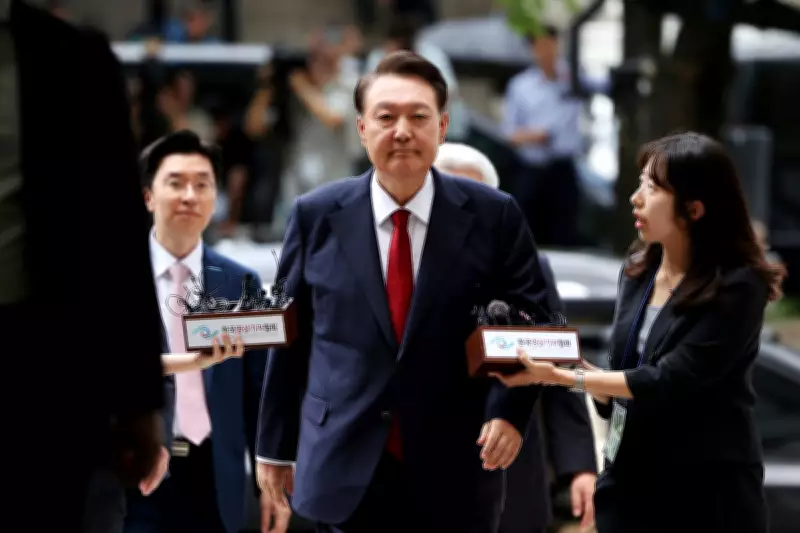
Ousted South Korean President Yoon Appeals Life Sentence for Martial Law Decree
South Korea's jailed former President Yoon Suk Yeol has formally appealed his life sentence for rebellion, a conviction stemming from his brief imposition of martial law in December 2024. His legal team confirmed the appeal on Tuesday, marking a significant development in the country's most severe political crisis in decades.
Defiance and Legal Challenges
The conservative leader, who faces multiple trials over his power grab, expressed defiance following his conviction at the Seoul Central District Court last week. He called the decision illogical, insisted his actions were "solely for the sake of the nation and our people," and accused the judge of bias against him.
In a text message, Yoon's lawyers stated they aim to address what they view as "errors in fact-finding and misinterpretations of the law" in last Thursday's ruling. The case will now proceed to a specialized panel at a Seoul High Court, established under a law passed in December to handle cases involving rebellion, treason, and foreign subversion.

"We will never be silent about what we view as an excessive indictment by a special prosecutor, the contradictory judgment rendered by the lower court based on that premise, and its political circumstances," Yoon's legal team asserted.
The Martial Law Decree and Its Aftermath
Yoon's martial law decree, announced late at night on December 3, 2024, lasted approximately six hours. It ended when a quorum of lawmakers broke through a blockade of heavily armed soldiers and police at the National Assembly, voting to overturn it and forcing his Cabinet to lift the measure.
Yoon was suspended from office on December 14, 2024, after being impeached by the liberal-led legislature and was formally removed by the Constitutional Court in April 2025. He was re-arrested in July and now faces eight criminal trials over the martial law debacle and other allegations, with the rebellion charge carrying the heaviest punishment.
Though brief, Yoon's martial law decree triggered widespread turmoil, paralyzing politics and high-level diplomacy while rattling financial markets. The crisis eased only after his liberal rival Lee Jae Myung won an early presidential election last June.
Contrasting Narratives and Historical Context
Yoon has claimed that his martial law decree was a legal and necessary act of governance against liberals controlling the legislature, whom he portrayed as "anti-state" forces paralyzing state affairs through impeachment of high-level officials, budget cuts, and obstruction of his agenda.
However, the Seoul Central District Court ruled that Yoon's actions amounted to orchestrating a rebellion, finding that he mobilized troops and police in an unlawful bid to seize the legislature, arrest political opponents, and establish unchecked rule for a "considerable time."
A special prosecutor who investigated Yoon's rebellion charges had sought the death penalty, arguing he deserved the harshest punishment under the law given the threat his actions posed to South Korea's democracy. Following last week's ruling, Jang Woo-sung, a member of the special prosecutor's investigation team, hinted at a potential appeal, citing unspecified "reservations" about some of the court's factual findings and the severity of the sentence.
South Korea has not executed a death-row inmate since 1997, in what is widely seen as a de facto moratorium on capital punishment amid popular calls for its abolition.
Yoon is the first former South Korean president to receive a life sentence since late military dictator Chun Doo-hwan, who was sentenced to death in 1996 for his 1979 coup, a bloody 1980 crackdown on pro-democracy protesters in Gwangju that left more than 200 people dead or missing, and corruption. The Supreme Court later reduced Chun's sentence to life imprisonment, and he was released in late 1997 under a special presidential pardon.