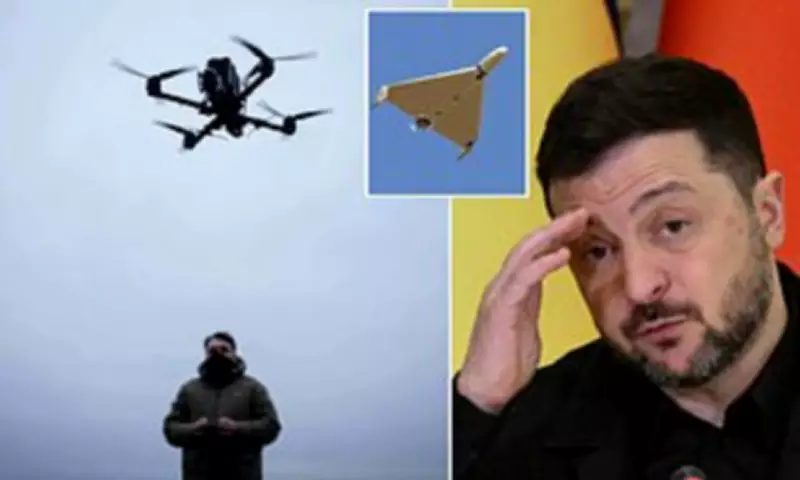
Ukrainian President Volodymyr Zelensky has issued a stark warning that Russian officials are actively advising their Iranian counterparts on how to utilise deadly mini drones to target United States assets across the Middle East. The President revealed on Monday that this collaboration involves the transfer of hard-won operational experience from Russia's invasion of Ukraine, specifically focusing on the deployment of short-range first-person-view (FPV) drone attacks.
Operational Expertise and Drone Evolution
Videos depicting these devastating drone strikes have become a grim hallmark of the brutal conflict in Ukraine. They frequently show soldiers or tanks on patrol being hunted by small unmanned aerial vehicles before the screens abruptly go black, signalling a detonation. Russia has recently unveiled a new first-person drone, the KVS, which reportedly boasts an extended range of up to 30 miles. This model was designed to address issues encountered by previous drones on shorter flights.
A History of Collaboration
Russia and Iran have maintained close military cooperation since 2022, notably in deploying the Iranian-made Shahed-136 drone against Ukrainian targets. Russian officials rebranded this weapon as the Geran-1. According to data from the Institute for Science and International Security, Russia launched an astonishing 55,000 Shahed-style drones at Ukraine in 2025 alone.

In response to relentless Russian assaults, Ukraine has been forced to rely on cheap, widely available drones, leading to the development of a world-class FPV drone weapons programme. This technology has proven so effective that the United States military has procured Ukrainian drone tech. President Zelensky confirmed to Axios that Russia is now instructing Iran on deploying these same short-range FPV drones against US and allied targets in the region.
Broader Intelligence Sharing and Strategic Motives
Beyond drone warfare tactics, Zelensky claimed that Russian officials have also shared satellite imagery of US and Gulf nation military bases with Iranian authorities. "I think Russia is supporting Iran directly, 100 percent. The same format of sharing satellite images like they did in the case of Ukraine," he stated in his interview.
Russia's Geopolitical Calculus
President Zelensky elaborated on Russia's strategic incentives, suggesting the Kremlin is keen for a protracted US-Iran conflict. He argued that a prolonged war would allow President Vladimir Putin's oil-reliant economy to sell crude at a premium, thereby generating funds to continue financing its hostilities in Ukraine. "I am sure Russia wants a long war. They have benefits: The U.S. is focusing on the Middle East and may decrease military help to Ukraine. Sanctions are partially lifted. I see only benefits for Russia from the war with Iran continuing," Zelensky explained.
Implications for Ukrainian Security
Another significant concern for Ukraine is the potential impact on its own weapons supply as the US-Iran conflict escalates. Zelensky expressed certainty that his country will face "challenges" due to US resources being reallocated to the Middle East theatre.
In a recent diplomatic effort, the Ukrainian President travelled to the Middle East to meet with leaders from Saudi Arabia, the United Arab Emirates, Qatar, and Jordan to discuss potential security agreements. Concurrently, Ukrainian military officials have been advising Gulf nations on counter-drone tactics, specifically how to intercept and shoot down Iran's Shahed drones.
Diplomatic Counsel from Kyiv
"They saw our system that combines different defensive systems so that you can secure your territory," Zelensky told Axios, referencing the advice shared with Gulf partners. He also conveyed Ukraine's broader diplomatic stance on the regional conflict: "Our advice, when they asked us, was to stop the war as soon as possible and sit for negotiations — even if they can't sit together with Iran — and find a diplomatic way to end the war. But it is up to the sides."
This revelation underscores the complex, interconnected nature of modern global conflicts, where battlefield expertise from one theatre is rapidly transferred to another, with profound implications for international security and alliance structures.