Nepal's Historic Election Unfolds Amid Political Turmoil and Youth Demands
Polls have opened across Nepal for the nation's first general election since unprecedented youth-led protests and the tragic deaths of 77 people forced the resignation of former Prime Minister K.P. Sharma Oli. This pivotal vote in the Himalayan country of 30 million people, strategically positioned between China and India, marks a critical juncture after decades of political instability that has severely hampered the largely agrarian economy and exacerbated unemployment rates.
Decades of Instability Culminate in Youth-Led Uprising
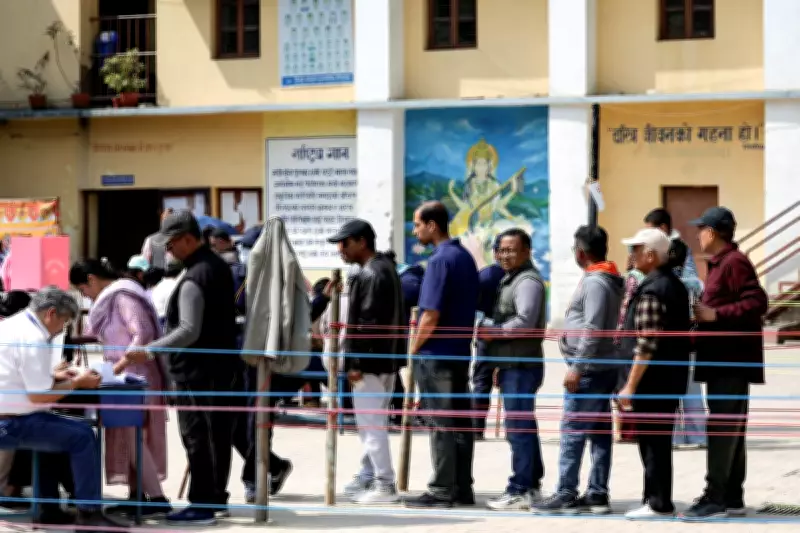
The long-festering political malaise erupted into widespread street demonstrations last September, initially triggered by a controversial social media ban. These protests brought thousands of citizens onto the streets, leading to violent clashes and fatalities that ultimately compelled Prime Minister Oli to step down from office. On Thursday, voters across Nepal flocked to schools, temples, and ancient courtyards converted into polling stations, with many braving the morning chill in the capital Kathmandu to cast their ballots early in the day.
Voting commenced at 7am local time and will continue until 5pm, with counting scheduled to begin shortly after polls close, according to official statements from Nepal's election commission. Authorities have deployed more than 300,000 security personnel, including military forces, to ensure peaceful voting across the country's extensive network of over 23,000 polling booths.

Political Landscape and Key Contenders
Former Prime Minister Oli, who leads the moderate Communist Party of Nepal (Unified Marxist-Leninist, UML), is once again contesting in this election alongside more than 3,400 other candidates representing 65 political parties. The electoral field includes the country's oldest political organization, the Nepali Congress led by 49-year-old Gagan Thapa, and the Nepali Communist Party (NCP) comprising former Maoist insurgents who transitioned into mainstream politics.
Together with UML, these established parties have dominated Nepali politics for the past three decades, despite the nation experiencing an astonishing 32 government changes within the last 35 years. However, the current frontrunner in these elections appears to be the three-year-old Rastriya Swatantra Party (RSP), which has fielded charismatic rapper-turned-politician Balendra Shah as its prime ministerial candidate.
Youth Appeal and Electoral Dynamics
The 35-year-old former mayor of Kathmandu is drawing substantial crowds and connecting with legions of young voters demanding change both on the ground and through digital platforms. Shah is directly challenging 74-year-old Oli on his home turf in the Jhapa constituency along the Indian border, symbolizing the generational shift occurring within Nepali politics.
Promises of employment opportunities, corruption reduction, and improved governance have dominated the election campaign, directly addressing the core demands raised during September's protests. Political analyst Puranjan Acharya emphasized that "the election is critical to address the aspirations of the youths expressed during the Gen Z protests" and warned that "if the newly elected leaders are seen as unfit to do so, there is a risk of further trouble."
Voter Concerns and Electoral Mechanics
In Jhapa, 70-year-old Menuka Chauhan, who stood in line for over 40 minutes at a polling booth, expressed deep concern about her son working as a security guard in Qatar amid escalating Middle East tensions. "I can’t sleep at night. I worry all the time. My son tells me bombs keep dropping there. I wish there were employment opportunities here," she lamented, highlighting the economic anxieties driving many voters.
Approximately 19 million eligible voters are casting ballots for 275 members of parliament through a mixed electoral system comprising 165 seats determined by direct first-past-the-post elections and 110 allocated through proportional representation. Early voting trends are expected to emerge by Friday, though complete results may require a week or more as proportional representation votes require extended counting periods.

Interim Prime Minister Sushila Karki, who assumed leadership following Oli's resignation, emphasized the election's significance in a public broadcast this week, stating: "Voting is not just about sending someone to victory. It's a decision you make about your future and that of your children." This historic election represents Nepal's opportunity to address systemic challenges and respond to the urgent demands of its youthful population.