Political Security Expenditure Quintuples as Violent Threats Escalate
Federal election campaigns and political committees dramatically increased their security spending during the 2023-2024 election cycle, allocating approximately five times more resources than during the comparable 2015-2016 period. A comprehensive new report reveals that roughly $41 million was dedicated to personal, event-related, and cybersecurity measures for federal candidates in the most recent general election.
Stark Increase in Security Investment
This substantial financial commitment marks a significant escalation from the estimated $8 million spent on security during the 2015-2016 election cycle. The data, compiled by the nonpartisan Public Service Alliance, which provides security resources and discounted third-party services to officials, underscores a growing concern for the safety of political figures.
The surge in security expenditure directly correlates with research indicating a sharp rise in violent rhetoric targeting public officials. According to findings from the Institute for Strategic Dialogue, such rhetoric increased by a staggering 241 percent between 2021 and 2025. Furthermore, federal charges involving threats to public officials rose by approximately 90 percent from 2016 to 2025.

High-Profile Incidents and Specific Security Measures
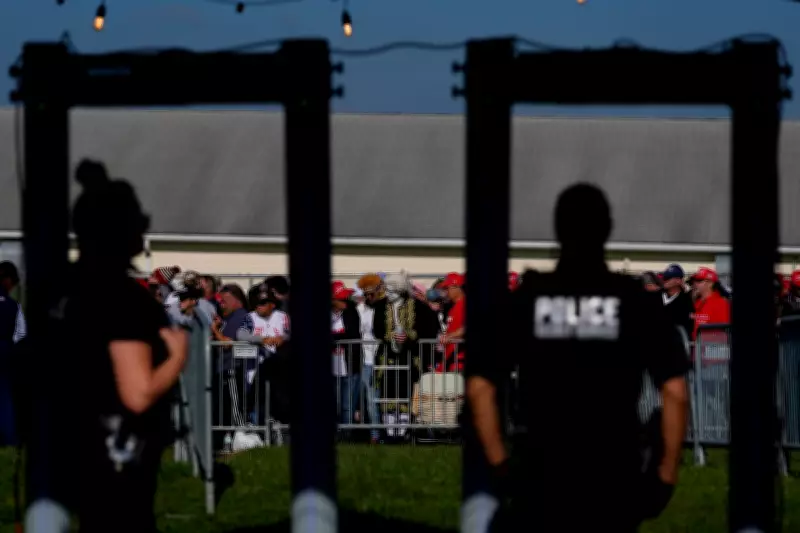
The 2024 election cycle was notably marked by two assassination attempts targeting President Donald Trump, one of which resulted in the death of a rally attendee and injuries to the president's ear. Consequently, security at political rallies was significantly enhanced, with event-related security spending reaching over $1.8 million, up from $570,000 a decade earlier.
President Trump's 2024 presidential campaign also faced cybersecurity attacks, allegedly perpetrated by foreign actors, leading to nearly $1 million being allocated to digital security during the election cycle. Additionally, approximately $305,400 was spent on home-related security for candidates and officials.
Polarization and Violent Rhetoric
Most Americans believe that violent rhetoric directed at politicians is intrinsically linked to the increasingly polarized political landscape in the United States, as highlighted by Pew Research. Both liberal and conservative ideologues frequently blame the opposing side for fostering extreme views that encourage radical actions.
Despite extensive research indicating that violent rhetoric often precipitates violent attacks, some politicians have continued to employ harsh language against their opponents. For instance, Virginia Attorney General Jay Jones, a Democrat, admitted to sending violent text messages that graphically called for his opponents' deaths. Similarly, Democratic lawmaker Jasmine Crockett faced criticism for urging rallygoers to "fight back" against the Trump administration and vowing to confront Elon Musk.
Violent Attacks and Bipartisan Condemnation
In 2025, several major political figures became victims of violent attacks that captured international attention, prompting a largely bipartisan campaign to condemn radical rhetoric from both sides of the political aisle. Pennsylvania Governor Josh Shapiro, a Democrat, and his family survived an assassination attempt after a perpetrator set their home on fire.
Melissa Hortman, the former Democratic speaker of the Minnesota House of Representatives, was assassinated alongside her husband at their residence. On the same night, Democratic Minnesota state senator John Hoffman and his wife survived an assassination attempt at their home.
The assassination of right-wing activist Charlie Kirk during a Turning Point USA event on a college campus further fueled nationwide outrage regarding violent rhetoric targeted at political figures. These incidents collectively underscore the critical need for enhanced security measures and a concerted effort to mitigate the dangerous escalation of political discourse in the United States.