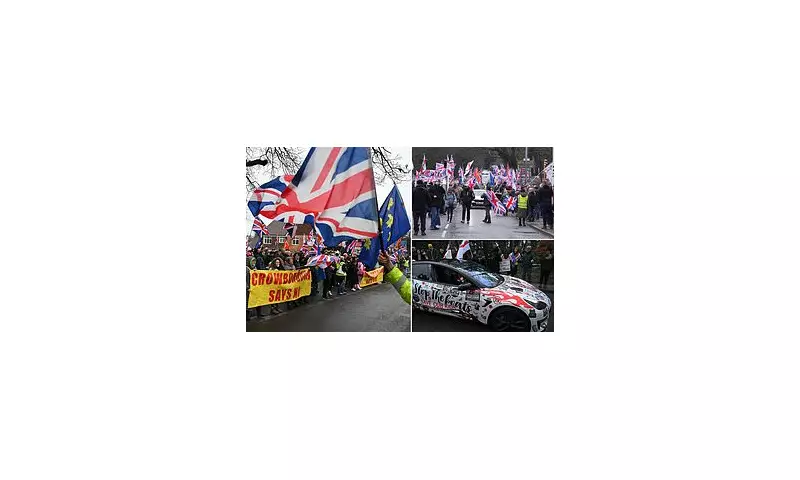
Thousands of demonstrators converged on the town of Crowborough in East Sussex this morning, voicing vehement opposition to the relocation of asylum seekers into the community's former army training camp. The protest marks the largest public outcry since the initial group of 27 individuals was moved into the barracks under cover of darkness on Thursday morning, with the site ultimately intended to accommodate up to 500 male asylum seekers who will have freedom of movement.
Scene of Unrest and Arrests
The day's events saw three individuals arrested following an incident where a vehicle was blocked from exiting the camp premises. Protesters began assembling at the gates of the facility around 10am, before marching into the town centre, where roads were filled with chanting crowds. Slogans such as "Keir Starmer's traitor" and "Who's town? Our town" echoed through the streets, reflecting deep-seated local frustrations.
Symbols and Slogans on Display
The demonstration was visually striking, with hundreds of flags waving in the crowd including Union Jacks, St George's Crosses, and the distinctive flag of Sussex. Protest signage carried messages like "We've been ignored and neglected so we're now at risk," while a prominently decorated van bore the phrases "Stop the boats" and "Crowborough says no." Some attendees distributed rape alarms and defensive sprays, citing concerns for personal protection.
Local Fears and Community Backlash
Residents expressed profound anxiety about the new arrivals, with many describing living in a state of fear and terror. Dennis Corby, a 75-year-old Crowborough local, voiced support for the protest while worrying about potential retaliation from migrants. Sarah Rogers, a 34-year-old mother of two, stated: "We're living in a state of complete fear and terror. It's appalling. We have not slept. It's awful."
A mother-of-three involved in organising the demonstration declared: "I won't let my children out alone in the town. They're scared. We all are. They are not welcome here. It's going to cause hell." These sentiments were echoed across social media and community forums, where the local Sussex Weald branch of Reform described the scene as "mental" with crowds continuing to grow.
Broader Participation and Security Measures
While most protesters were local residents, some travelled from further afield to show solidarity. Sean Cheney, 57, drove from Ashford in Kent with his car adorned in stickers including one supporting former US President Donald Trump and another reading "Save our kids." He explained his motivation: "I want to give Crowborough all the support I can."
A substantial security operation remains in place to maintain order, including drone surveillance overhead. The initial group of asylum seekers arrived at the Crowborough Army Camp around 3:30am on Thursday via a 16-seater minivan, with police officers stationed outside the facility since their arrival.
Healthcare and Education Concerns
The Home Office has stated that asylum seekers will be registered with an on-site medic, using external services only for additional treatment needs. Officials claim this approach will minimise strain on local GP services, though residents already grappling with appointment shortages remain sceptical. NHS Sussex currently ranks seventh among England's 42 trusts for patients waiting 28 days or more for GP appointments.
Educational concerns have also emerged, with local councillor Andrew Wilson reporting that some parents are withdrawing children from school because a bus route shared by pupils stops at the camp. Wilson, representing Crowborough East, highlighted that with each asylum seeker staying 70 to 90 days, nearly 2,800 unknown individuals could pass through the town annually. "As a parent, your responsibility first and foremost is to keep your children safe," he stated.
Broader Implications and Government Response
The controversy has exposed deeper tensions about transparency and community consultation. Resident Karen Creed, 62, expressed frustration: "We all feel totally hoodwinked. They brought people down here in the wee small hours, not expecting anybody to see." Her concerns about the exclusively male demographic and unknown backgrounds of arrivals were widely shared among protesters.
The community Facebook page has become a hub for complaints, with one woman detailing difficulties securing GP appointments and another reporting inability to see a doctor for three months despite calling at 8am. As the protest demonstrates, the asylum seeker relocation has ignited a fierce debate about local resources, security, and the government's approach to immigration management in small towns across Britain.