A seismic shift in United States immigration enforcement tactics is underway, potentially dismantling decades of established legal advice given to immigrant communities. An internal Immigration and Customs Enforcement (ICE) memorandum, obtained by The Associated Press, indicates that federal agents may now forcibly enter private residences without a judicial warrant, relying solely on administrative documents issued by immigration authorities.
A Foundational Right Under Threat
For over thirty years, a core principle has guided immigrant communities: do not open the door for ICE officers unless they present a warrant signed by an independent judge. This advice is rooted in the Fourth Amendment's protection against unreasonable searches and seizures, a constitutional safeguard long upheld by the Supreme Court. "The physical entry of the home is the chief evil against which the wording of the Fourth Amendment is directed," wrote Justice John Paul Stevens in a landmark 1980 ruling.
Fernando Perez, who arrived from Mexico three decades ago, embodies this cautious approach. Despite numerous visits from immigration officers to his home, he has never answered the door. "There are rules and I know them," Perez stated, reflecting a widespread understanding that has forced ICE to conduct arrests primarily in public spaces, often after lengthy and tedious surveillance operations.
The New Directive: From Knock-and-Wait to Forced Entry
The leaked memo authorises a dramatic departure from this status quo. It states that ICE officers can make a forced entry into a person's home using only an administrative warrant—a document issued by immigration officials, not a judge—if the individual has a final order of removal. Officers must first knock, announce their presence and purpose, and only operate between 6 a.m. and 10 p.m., giving occupants a "reasonable chance to act lawfully." If compliance is not forthcoming, the memo explicitly permits the use of force to gain entry.
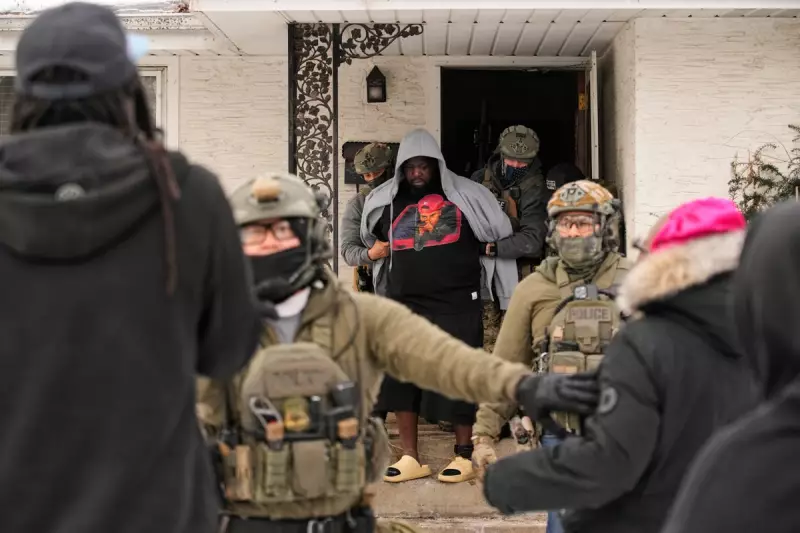
This policy shift aligns with the Trump administration's aggressive expansion of immigration arrests under its mass deportation campaign. The practical effect was witnessed by AP journalists in Minneapolis on January 11th, where ICE officers, clad in heavy tactical gear and with rifles drawn, rammed through the front door of a Liberian man's home while armed only with an administrative warrant.
Community Training Overturned
Since ICE's creation in 2003, advocacy groups, along with immigrant-friendly state and local governments, have diligently propagated know-your-rights training. This education has consistently emphasised the critical step of demanding to see a judge-signed warrant slid under the door before considering opening it. Ahilan Arulanantham, co-faculty director of the UCLA Law School's Center for Immigration Law and Policy, called the new memo "quite disturbing," noting this advice has been a foundational element of Fourth Amendment law for decades.
In communities like Santa Ana, California, this knowledge is deeply ingrained. Local schools have sent bulletins to parents instructing them not to answer the door or questions from ICE. Others have learned their rights through social media platforms like TikTok. However, former Trump border official Tom Homan has criticised these efforts, labelling them "how to escape arrest" rather than "know-your-rights."
Escalating Risks and Legal Concerns
Legal and law enforcement experts warn that authorising forced home entries significantly elevates risks for all parties involved. Ahilan Arulanantham highlighted the danger of confrontations, especially in states with stand-your-ground laws, where residents have the right to defend their homes against intruders. This could lead to officers being shot or agents opening fire on individuals armed with makeshift weapons in a moment of panic.
Furthermore, the potential for error is high. ICE records are known to contain incorrect addresses, raising the alarming prospect of agents forcibly entering the homes of U.S. citizens. Democratic Senator Richard Blumenthal of Connecticut has demanded congressional hearings, stating, "Every American should be terrified by this secret ICE policy authorising its agents to kick down your door and storm into your home."
The memo represents an escalation of tactics that began when the Supreme Court lifted restrictions on profiling-based stops in Los Angeles. "This would just be another step down that path," Arulanantham warned. "Obviously it will be more significant because it suggests you're not safe even in your own house." For individuals like Fernando Perez, the implications are profoundly personal. "If they are going to start coming into my home, where I am paying the rent—they are not paying the rent—that's the last straw," he said.