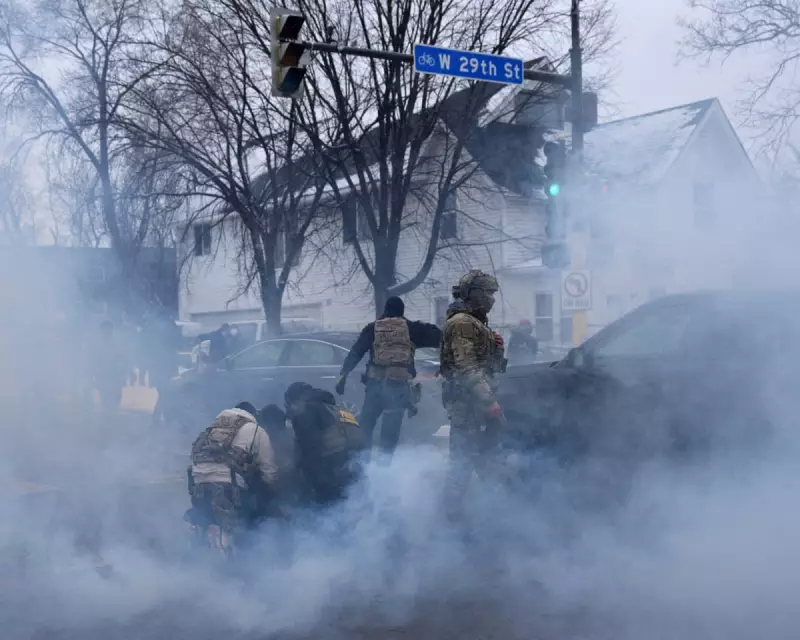
When fear becomes routine, it not only shapes individual behavior but also fundamentally reshapes trust and social cohesion, undermining the very foundations of community life. This phenomenon is starkly evident in the wake of recent immigration enforcement actions across the United States.
The Onset of Widespread Fear
On 15 June 2025, the Trump administration issued an official statement directing US Immigration and Customs Enforcement (ICE) to initiate what it described as "the largest mass deportation operation in American history." Major urban centres such as Los Angeles, Chicago, and New York were pinpointed as primary targets. The stated objective was to keep communities "safe and free from illegal alien crime, conflict, and chaos." Consequently, federal agents have rapidly become a pervasive presence in the everyday lives of many residents.
While no stable state can protect its borders and public order without immigration law and effective enforcement mechanisms, the critical issue extends beyond the state's right to enforce the law. It concerns how the manner of enforcement influences daily life, feelings of safety, and social trust. Do all forms of enforcement necessarily yield security, or do some inadvertently transform social fear into a lasting condition?
From Emergency to Everyday Management
Shortly after the announcement, a colleague from Georgetown University Law Center sent an urgent warning: ICE agents were expected to be widely active across Washington DC, with a high likelihood of detentions. The advice was straightforward: "Stay home. Don't go out." This was not an exaggerated or emotional alert but a professional, precautionary recommendation that has become increasingly routine for many in recent months.
This subtle shift—from exceptional emergencies to the everyday management of fear—marks the point where law enforcement transcends the legal domain and becomes a structuring force in daily existence. From a sociological perspective, fear is not merely a personal emotion; it is a social reality. When individuals alter their behavior based on the constant possibility of intervention rather than direct experience, fear becomes ingrained in the everyday fabric. In such a context, arrests need not occur daily; the mere knowledge that something might happen is sufficient to change how people act.
Beyond Geographic Borders
At this juncture, immigration enforcement extends beyond geographic borders. A knock on the door is no longer just a knock; contacting a government office is no longer an ordinary administrative act. For certain groups and in specific spaces, these signals acquire new meanings—meanings infused with caution, silence, and anxiety.
Migration studies have long described this condition as "living on alert": existing under the shadow of a perpetual possibility. The result is a series of small but ongoing behavioral adjustments: reduced outings, avoidance of public offices, decreased reporting of problems, and diminished participation in civic life. Individually, these changes may seem minor, but collectively, they gradually erode the social fabric.
Real-World Impacts on Families
Consider a family with a child in school. After hearing reports about immigration officers in the neighbourhood, parents may restrict their own movements or forbid their child from simple errands or trips to the park. Follow-ups on educational issues with the school might be delayed, and over time, the family's engagement in school and community activities declines. This example illustrates how fear tangibly shapes everyday behavior and social relationships.
The Psychological Toll on Children
Children of the Afghanistan diaspora in the United States are among the first to bear the psychological burden of heightened immigration scrutiny and the pervasive climate of fear. Deeply embedded in US schools and communities, they remain legally and emotionally connected to parents with uncertain immigration status, placing them at the forefront of family anxiety and instability.
According to the 2024 American Community Survey, approximately 46.6% of people in households from the Afghanistan diaspora in the US—nearly 100,000 individuals—are children, many born in the US or arriving at a very young age. For these children, fear does not stem solely from home or family; news about ICE activities and rumours of mass deportations quickly circulate among peers and within school settings.
Even without direct encounters with authorities, children absorb anxieties transmitted through classmates' conversations and school-based chatter. This leads to defensive behaviors such as speaking less, withdrawing from classroom participation, and attempting to remain invisible. These experiences manifest in sleep disturbances, irritability, difficulty concentrating, and declining academic performance, while also undermining trust in institutions and weakening their sense of social belonging. The normalization of fear in social and educational environments threatens both long-term social integration and the resilience of the next generation.
Fear Spreads Beyond Immigration Status
This pattern does not solely affect undocumented immigrants. Mixed-status families—where some members are citizens and others are not—demonstrate how fear propagates. Even a legally protected citizen may adjust their daily life with caution and self-censorship. Fear travels through social ties, not passports.
In recent months, friends from Afghanistan in the US have described how their American friends—individuals with no immigration concerns—have warned them to "be extra careful these days" or "call me immediately if the police stop you." These are not political statements or exaggerations but reflections of how fear has infiltrated the everyday language of care and solidarity. Here, fear evolves from an individual experience or legal condition into a shared social reality that reshapes human relationships.
Historical Context and Intensified Anxiety
For the Afghanistan diaspora and other Middle Eastern communities, fear has long been part of daily life, particularly due to ICE's presence and activities. Everyday routines, commuting, school participation, and even simple social interactions are quietly moulded by the possibility of encounters with immigration authorities.
When an Afghan immigrant was accused of shooting two US National Guard members—killing one—the incident did more than make headlines; it intensified collective anxiety and reinforced the everyday caution already driven by immigration enforcement. In the subsequent days and weeks, increased silence, hesitation, and worry were observed among diaspora members. Many feared that allegations against one individual could be unfairly generalised to the entire community, with concerns about being labelled a "security threat" resurfacing in everyday conversations.
It must be emphasised that this act of violence was unethical and inhumane. The Afghanistan diaspora comprises people who have endured war, displacement, and the loss of home and security. The actions of one person cannot and should not define the moral character of an entire community that has suffered profoundly.
Redefining Social Belonging
In this environment, daily life—accents, appearance, travel routes, even ordinary jokes—becomes a matter of calculation. Fear, amplified by the logic of generalisation and enforcement structures, turns everyday existence into a constant state of vigilance and anxiety.
A common misconception is to view the current situation merely as an "immigration issue." What is occurring is a quiet redefinition of social belonging. Social belonging refers to the sense that individuals are part of a community, living alongside others and entitled to participate in society without fear or discrimination. When certain people or groups are considered "suspicious" or "outside" by default, this sense of belonging gradually erodes.
In such a climate, the logic of unfair generalisation and labelling can extend to race, social class, accent, appearance, and even visible signs of poverty or difference. The question is no longer solely about who is at risk of deportation or restriction; it is about who is permitted to live an ordinary life with security and a sense of belonging.
The Broader Implications
The issue is not the existence of the law but how the law is experienced in society. Law enforcement is not merely an administrative or security process; it is a social practice that can either build trust or make fear permanent. When fear becomes routine, it not only shapes behavior but also reshapes trust and social cohesion, undermining the very foundations of community life.
This analysis deliberately avoids policy recommendations—not out of caution, but because until we clearly see and name the problem, any solution will remain shallow. The final question is simple, yet unsettling: does a society truly become safer when part of its population learns to live in constant fear and when that fear becomes an unspoken rule of everyday life?