Maine Governor Demands Transparency as Immigration Crackdown Sparks Fear
Maine's Democratic governor has issued a direct challenge to federal immigration authorities, demanding immediate access to arrest warrants, real-time enforcement data, and basic information about detainees. This confrontation comes amid a sweeping enforcement operation that has created widespread anxiety throughout the state's immigrant communities.
Governor Mills Challenges Federal Secrecy
Governor Janet Mills held a press conference on Thursday where she expressed deep frustration with the lack of transparency surrounding the ongoing immigration enforcement operation. "If they have warrants, show the warrants. In America, we don't believe in secret arrests or secret police," Mills declared, emphasizing that state officials remain unaware of where detainees are being held.
The governor revealed that her attempts to contact President Donald Trump's office regarding the operation launched this week have gone unanswered. Federal officials have stated that approximately 50 arrests occurred on the first day, with roughly 1,400 individuals targeted in the predominantly rural state of 1.4 million residents. Only about 4 percent of Maine's population is foreign-born, with an even smaller percentage residing in the country illegally.
Operation Sparks Community Anxiety
The enforcement activity has generated significant fear in Maine's largest urban centers, particularly Portland and Lewiston, which host substantial immigrant and refugee populations, many originating from African nations. Community leaders report that numerous families are remaining indoors, avoiding workplaces, and keeping children home from school due to apprehension about potential arrests.
Mills expressed particular concern about the operation's justification and scope, stating that the information vacuum has made it impossible for state officials to properly assess the situation. "I'd be curious to know more about their so-called target," she remarked. "Why Maine? Why now? What were the orders that came from above? Who's giving the orders? We've reached out, we've asked questions. We have no answers."
Questioning Federal Claims
The governor expressed skepticism about federal claims that such a large number of Maine residents have criminal charges against them. "Mostly we're hearing reports of people who have not been engaged in criminal activity," Mills stated. "If someone has evidence of criminal activity, we want to hear about it."
She emphasized that Maine respects federal law but questions what she described as an unnecessarily heavy-handed approach that appears disproportionate to the state's relatively small undocumented population.
Ripple Effects Across Communities
The enforcement surge has created tangible disruptions across multiple sectors of Maine society. School districts in Portland and Lewiston have gone "on alert," with some students absent from classes due to family fears. Portland Public Schools implemented brief "lockout" procedures at two schools this week to prevent entry during concerns about nearby enforcement activity, though officials confirmed no actual threat materialized.
Businesses that depend significantly on immigrant labor have reported operational disruptions. "People are being torn from their families and from young children, people who are part of the workforce here in Maine — the workforce we desperately need and desperately value," Mills lamented.
Federal Defense and Community Response
The Department of Homeland Security and Immigration and Customs Enforcement did not immediately respond to requests for updated arrest numbers, warrant information, or detainee location details on Thursday. DHS previously characterized the operation as targeting "the worst of the worst criminal illegal aliens," citing arrests involving convictions for aggravated assault, false imprisonment, and child endangerment.
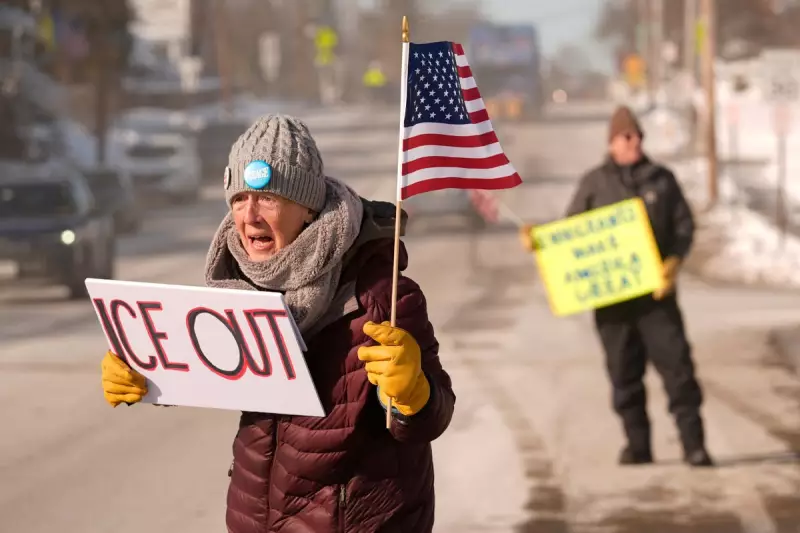
Meanwhile, a small group of demonstrators gathered outside an ICE field office in Scarborough on Thursday afternoon. College student Ava Gleason explained her participation: "Maine is one of those places where you look out for your neighbors. We're a community, and to see people come in and rip that apart is terrifying."
Constitutional Concerns Raised
In downtown Portland, resident Dave Cowie displayed a cardboard sign reading "Due Process" in red and blue lettering. He expressed concern about the enforcement operation's scope and questioned whether new ICE recruits receive adequate training. "People are being snatched off the street, taken to undisclosed locations," Cowie observed. "We're being told we have to prove our citizenship — not everyone walks around with a passport in their pocket."
Cowie referenced a recently disclosed internal ICE memo obtained by The Associated Press that authorizes agents, under certain circumstances, to forcibly enter homes without judicial warrants, relying instead on administrative warrants. "These agents are not well trained for crowd control, and they believe they have rights they do not," he argued. "It flies in the face of the Constitution."
Maine's top federal prosecutor has urged any demonstrations to remain peaceful while warning that individuals who interfere with federal agents could face prosecution. The governor emphasized that people retain the legal right to record law enforcement activity in public spaces, provided they do not interfere with officers' duties.
This confrontation in Maine occurs alongside continuing tensions between demonstrators and ICE agents in Minnesota, where the agency faces scrutiny following an agent's fatal shooting of Renee Good. The parallel situations highlight growing national concerns about immigration enforcement methods and transparency.