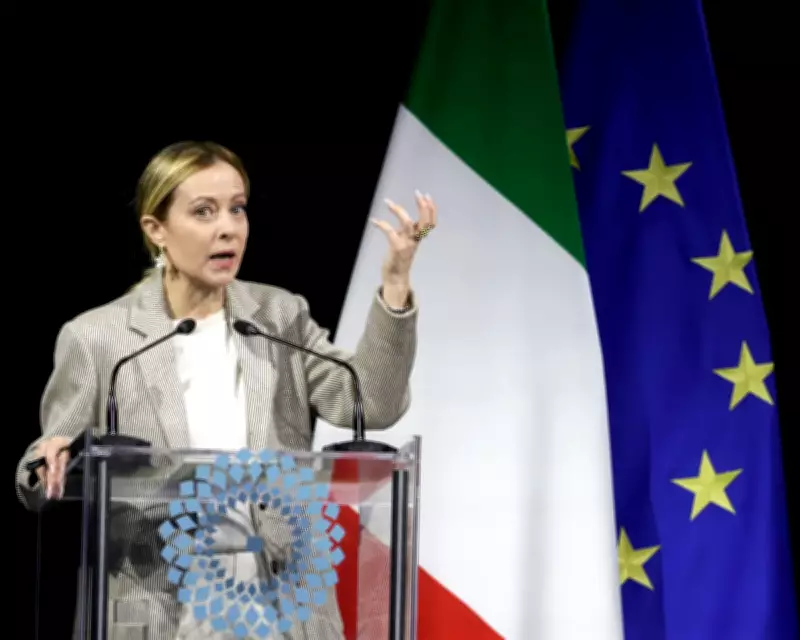
Italian Prime Minister Giorgia Meloni's far-right government is pushing forward with a highly contentious security bill that includes a provision offering financial bonuses to lawyers who successfully persuade their immigrant clients to accept voluntary repatriation. This incentive scheme, which has been likened to a "wild west-style bounty" by critics, is set for final approval in the lower house of parliament this week after passing the upper house following a heated debate.
Details of the Controversial Bonus Scheme
The proposed measure allocates €246,000 (£214,000) for the incentive programme this year, with funding projected to nearly double for 2027 and 2028. Lawyers would receive a bonus only after their client has actually returned to their country of origin, though the bill does not specify the exact amount. Italian press estimates suggest bonuses could reach approximately €615 per successful case.
Legal Community and Opposition Backlash
The bonus plan has ignited fierce opposition from Italy's legal establishment, coming just one month after Meloni's government suffered defeat in a referendum on judicial reform. Italy's national bar council issued a statement declaring it was never consulted about the measure and has called on parliament to reject it entirely.

The Union of Italian Criminal Lawyers (UCPI) condemned the proposal as "incompatible" with Italy's constitution, arguing that lawyers must not be financially incentivised to achieve outcomes desired by the state. They emphasised that legal professionals must assist their clients "in full freedom and independence" without such financial pressures.
The National Association of Magistrates (ANM) expressed dismay at the measure, warning that offering financial incentives tied to migrant repatriation outcomes risks undermining effective judicial protection and the integrity of legal proceedings.
Political Opposition Intensifies
Opposition parties have launched scathing attacks on the proposal. Riccardo Magi, leader of the leftwing Più Europa (More Europe) party, described the bonus as "basically a wild west-style bounty" where "rights are trampled on and those who should protect the rights of foreign citizens are financially incentivised not to do so." He compared the security decree to policies of "Trump's ICE," referencing the US Immigration and Customs Enforcement agency.
Debora Serracchiani of the Democratic party called the bonus scheme "disgraceful" and said it "undermines the very dignity of professionals." She criticised the broader security bill as "yet another decree that only serves to repress and strip away rights."
Valentina D'Orso of the Five Star Movement accused the government of attempting to "exploit lawyers by using them as a means to implement its immigration policies," highlighting concerns about professional independence.
Broader Immigration Crackdown Context
This measure represents the latest effort by Meloni's ruling coalition, which has been politically weakened by the recent referendum defeat, to intensify its crackdown on irregular immigration. The security bill also includes provisions removing access to state-funded legal aid for those challenging deportation orders, further restricting migrants' legal recourse.
In February, the government approved legislation authorising naval blockades to prevent migrant boats from reaching Italian shores during periods of "exceptional" migratory pressure, demonstrating a consistent pattern of restrictive immigration policies.
The combination of financial incentives for lawyers and reduced legal aid availability creates what critics describe as a dual assault on migrants' rights and legal protections, raising fundamental questions about the balance between immigration control and judicial integrity in contemporary Italy.