US Citizens and Legal Residents Report Surge in Racial Profiling by ICE
In recent weeks, numerous US citizens and lawful permanent residents have come forward with alarming accounts of racial profiling by US Immigration and Customs Enforcement (ICE) agents. These incidents, which have sparked widespread fear and distress, are linked to the Trump administration's intensified immigration crackdown across the nation.
Personal Encounters with ICE Agents
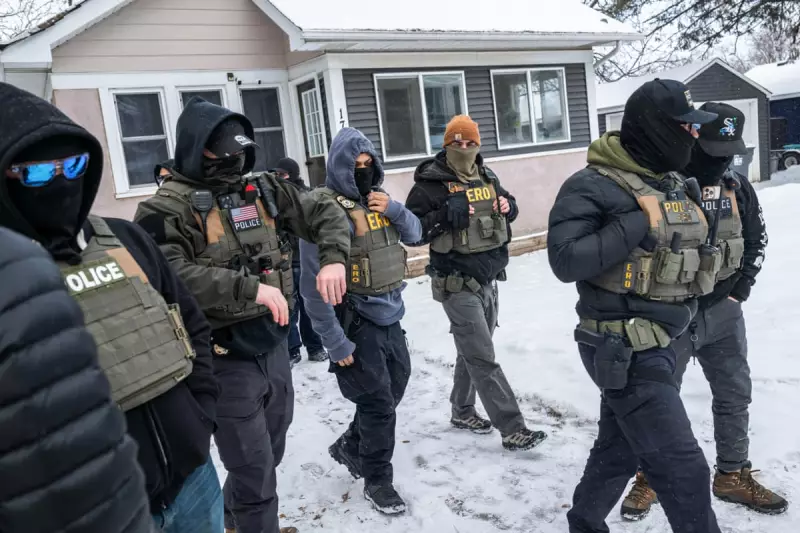
Mohamed, a lawful permanent resident from Somalia living in San Diego, California, experienced a terrifying encounter in mid-January. While exercising in Colina del Sol park, he was approached by four ICE agents wearing balaclavas and jackets emblazoned with the agency's logo. They demanded his green card and subjected him to a barrage of questions. "I was terrified," Mohamed said through a translator, noting that the ordeal has left him with high blood pressure and too scared to continue his daily exercises. He believes he was targeted based on his race.
Similarly, Fernando, a US citizen and veteran in Nebraska, was pulled over by ICE agents last month. They claimed he matched the description of a Hispanic male they were seeking. Despite providing his Real ID and military details, Fernando was thrown to the ground and restrained. "It feels like a slap in the face. I gave nine years of my life to a country for me to be racially profiled," he said, adding that he now travels only at night to avoid further targeting.
Community Impact and Response
Community organizers report that federal agents have focused on Black and brown neighbourhoods in states such as Minnesota, New York, Washington, California, and Illinois. Patrols have extended to locations like Home Depot stores, mosques, and construction sites. In response, organisations have ramped up efforts to support affected communities.
- Brighton Park Neighborhood Council in Chicago has hosted over 50 "know your rights" trainings since Trump took office.
- In Minnesota, volunteers in green vests monitor areas with large Somali populations, using whistles to alert residents when ICE agents are nearby.
- Businesses have been equipped with signs to deter ICE, and residents carry whistles for emergency alerts.
Suleiman Adan of CAIR Minnesota described the tactics as akin to hunting, saying, "It's like you're looking for game; who can I prey on today?"
Legal and Policy Context
The Trump administration has recently concentrated immigration enforcement on Somali communities. In the Minneapolis area, which hosts the largest Somali population in the US, around 2,000 ICE officers and 800 Customs and Border Protection agents have been deployed. Additionally, the administration announced the end of Somalia's temporary protected status designation in March, affecting work authorisation and deportation protections.
Thomas A Saenz of the Mexican American Legal Defense and Educational Fund highlighted that challenging racial profiling typically involves the Federal Tort Claims Act. However, a Supreme Court ruling in September 2025 complicated matters by allowing agents to consider perceived race or ethnicity as a factor in interrogations. Saenz criticised the administration's approach, stating, "Anytime you impose a target for arrests, you encourage unconstitutional shorthands like racial profiling."
ICE detention numbers have reached record highs, with 68,990 people held as of 8 January 2026. Tricia McLaughlin, a Department of Homeland Security spokesperson, denied allegations of racial profiling, asserting that enforcement is based on immigration status and reasonable suspicion under the Fourth Amendment.
Widespread Fear and Adaptation
The profiling incidents have led to significant psychological and practical consequences. Sara, a US-born citizen of Persian descent in Tampa, Florida, believed she was followed by ICE agents who mistook her for Latina. She carried her passport everywhere and slept with it due to fear. "I couldn't sleep or eat, and my hair began falling out," she said, expressing concern over the violent approach to enforcement.
In Maryland, Kate, a US citizen and guardian of four Guatemalan teens, altered her family's routine to protect the children. She walked her youngest to school daily, fearing he might be snatched off the street by agents. "Anybody could snatch him off the street," she said, reflecting ongoing anxieties despite some adjustments.
As communities grapple with these challenges, the debate over constitutional rights and enforcement practices continues to intensify, with many feeling powerless to hold agents accountable.