Confusing Roundabout Near US-Canada Border Traps Motorists in Immigration Nightmare
A notoriously confusing roundabout located near the border between the United States and Canada has been identified as a major culprit for landing unsuspecting drivers in jail, exacerbated by Donald Trump's stringent immigration crackdown. Situated in Buffalo, New York, this roundabout on the Peace Bridge features an easily missed turn-off that directs motorists straight into Canada, with no opportunity to reverse course.
Since its construction a decade ago, tens of thousands of drivers have fallen victim to this design flaw. However, in the current climate of heightened immigration scrutiny, what was once a minor inconvenience has escalated into a severe crisis, particularly for travelers on visas who face prolonged detentions when attempting to re-enter the US.
Personal Ordeal Highlights Systemic Failure
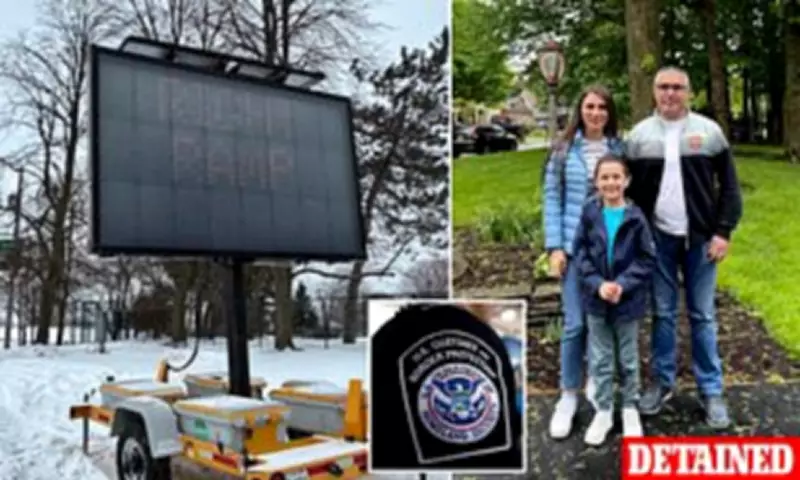
Shovgi Huseynov, a research scientist at the University of Buffalo, experienced this trap firsthand last month. A native of Azerbaijan with legal work authorization in the United States valid through 2029, Huseynov found himself detained for weeks after unsuccessfully trying to turn around before crossing the bridge. He was released in late January, expressing relief in an online video about reuniting with his children and noting that his release was possible because his documents were lawful.

His case has sparked further criticism of Trump's immigration policies. New York Governor Kathy Hochul, a longtime critic of the crackdown, condemned the situation at a news conference, stating, 'I am traumatized when I think about what is happening to families. This insanity has to stop.' In response, she ordered the State Department of Transportation to install temporary electronic signs at the roundabout entrance, which alternate between displaying 'Right Ramp' and 'To Canada Only' to warn drivers.
Design Flaws and Political Backlash
Officials from the Buffalo and Fort Erie Public Bridge Authority had warned about the roundabout's confusing design when it was created ten years ago. The construction eliminated a longstanding roadway that allowed drivers to turn around before reaching Canada. Assemblyman Jonathan Rivera and State Senator April Baskin highlighted these concerns in a letter to New York transportation officials, noting that the 'irregular design' would create functional and safety problems and that the Bridge Authority explicitly recommended against its construction.
They emphasized that in today's political climate, an unintended border crossing can have life-altering consequences, citing another case where a Colombian immigrant was detained for weeks after GPS navigation led him across the bridge. Despite the temporary signs, Buffalo's new mayor, Sean Ryan, argues that a more permanent solution is necessary, as the current setup fails to adequately prevent wrong turns.
Search for Long-Term Solutions
Finding a fix is complicated by the multiple agencies overseeing the Peace Bridge and border crossing. Glenn Blain, assistant communications director for the Transportation Department, stated that New York State is working with local authorities to alert drivers, but long-term changes require coordination. Suggestions include removing orange barrels that block turnarounds near customs booths and allowing travelers to exit through a gate on the US side.
Thomas Boyle, Chief Executive of the Bridge Authority, urged officials to address the root cause in the roundabout, while Rivera criticized current efforts for prioritizing government convenience over traveler safety. US Customs and Border Protection affirmed its commitment to safe processing at the Peace Bridge but noted that traffic pattern adjustments involve collaborative efforts with the Bridge Authority.
As incidents continue to occur daily—with a Canadian border agent reporting at least 20 wrong turns per day—the urgency for a comprehensive solution grows, highlighting the intersection of infrastructure design and immigration enforcement in a politically charged era.