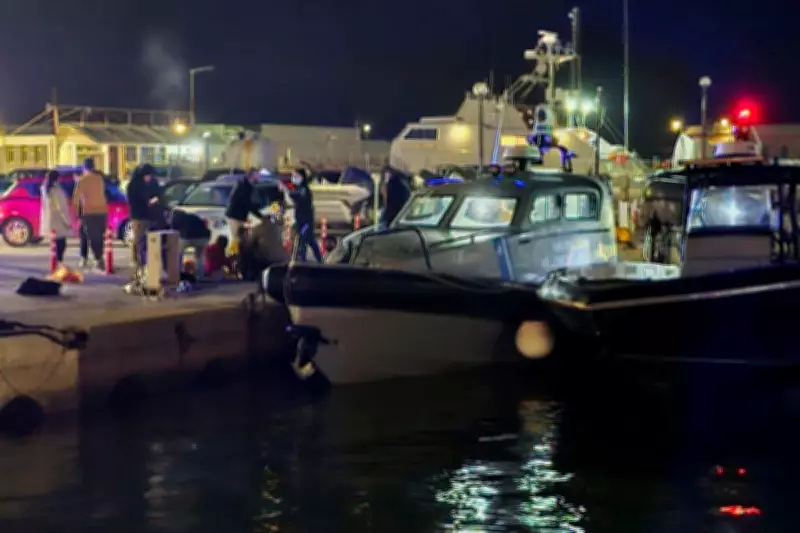
Diver Details Severe Head Injuries in Greek Migrant Boat Collision
A diver who assisted in recovering bodies from a fatal collision between a migrant vessel and a Greek coast guard patrol boat has revealed that the majority of the fifteen fatalities sustained severe head injuries. This grim disclosure emerged on Friday, February 6, 2026, as mounting questions surround the incident's circumstances off the eastern Aegean island of Chios.
Search Continues Amidst Rising Casualty Toll
A search and rescue operation remained active three days post-collision, scouring for potentially missing individuals. The tragedy has resulted in fifteen deaths and twenty-six injuries, including eleven children and two coast guard officers. The exact passenger count on the small speedboat remains undetermined, fueling concerns over the collision's mechanics. Judicial authorities have initiated an official inquiry to investigate the event.
Evaggelos Kirithras, the diver who participated in body recovery that night, described to The Associated Press encountering twelve bodies inside a partially submerged inflatable speedboat that had not capsized. "Most of them had head injuries. I can't describe how bad the head injuries were," Kirithras stated, likening the trauma to the impact of striking a wall. He noted that while he has engaged in previous rescue operations with the coast guard, this was the first instance he witnessed such force. Greek media reported that a coroner's report, prepared by four examiners, confirmed severe injuries, though it has not been publicly released.

Conflicting Accounts and Official Scrutiny
The precise circumstances of the collision are still unclear. Initially, the coast guard asserted that its patrol boat encountered the speedboat approaching Chios without navigation lights. According to their statement, the migrant boat ignored sound and light signals to halt, abruptly changed direction, and collided with the patrol vessel, causing it to capsize. Photos released by the coast guard displayed abrasion marks on the patrol boat's right side, though this account lacks independent verification.
Kostas Arvanitis, a left-wing member of the European Parliament, commented, "The pursuit, the collision, the injuries testify to a very violent incident," demanding the release of any footage from cameras onboard the patrol vessel. However, authorities clarified that the camera was not recording at the time. Maritime Affairs Minister Vassilis Kikilias explained in parliament that the captain opted not to activate the camera because the migrant boat was already nearby, and the long-range thermal imaging camera would have been ineffective. "As I have been informed... the (camera's) function is infrared and long-distance, so even if it had been switched on, it would not have had clear recordings of the collision event," Kikilias reiterated, welcoming judicial and administrative investigations.
Broader Context of Migration and Safety Concerns
All but one of the surviving passengers on the roughly 8-meter speedboat have been identified as Afghans, with one Moroccan national among the injured arrested on suspicion of migrant smuggling. Greece serves as a primary entry point into the European Union for individuals fleeing conflict and poverty in regions like the Middle East, Africa, and Asia. Fatal accidents during these crossings are frequent, with many attempting the short but hazardous journey from the Turkish coast to nearby Greek islands in the eastern Aegean. Increased patrols and allegations of pushbacks—summary deportations without asylum applications—by Greek authorities have reportedly reduced crossing attempts, yet safety risks persist.