

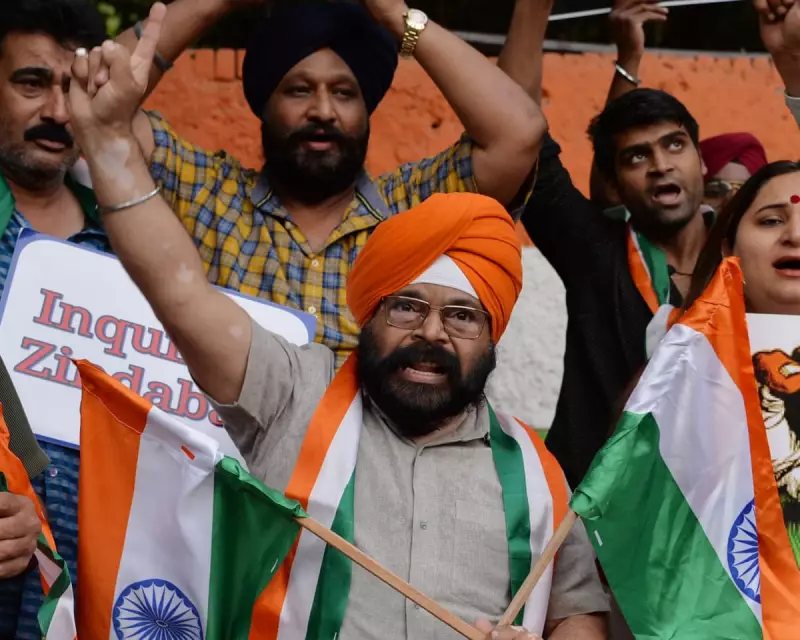
Police in the United Kingdom have instructed a prominent Sikh activist to significantly enhance his personal security, citing intelligence about threats originating from Hindu nationalist groups.
Police Advice and Alleged Transnational Repression
Paramjeet Singh Pamma, a 52-year-old figure within the pro-Khalistan movement, confirmed that officers visited his home and verbally advised him to install security cameras and reinforce his door locks. Pamma asserts that these threats are connected to the Indian government, and he has criticised UK ministers for not taking what he describes as "relentless" transnational repression by India seriously.
The Indian government, which designates the Khalistan movement as a terrorist threat to national security, declined to comment through its embassy. This incident occurs against a backdrop of deepening UK-India relations, including a major post-Brexit trade deal finalised in May 2023, as Britain seeks to partner with Narendra Modi's government to counterbalance China.

A Pattern of Intimidation and International Incidents
Pamma claims the police only began to treat his complaints with urgency following the 2023 killing of Sikh activist Hardeep Singh Nijjar in Canada. Canadian Prime Minister Justin Trudeau publicly suggested Indian government agents were involved. In the same year, US prosecutors accused an Indian government agent of plotting to assassinate American citizen Gurpatwant Singh Pannun on US soil.
Pamma, who now lives separately from his family for safety, detailed a history of intimidation since moving to the UK after receiving political asylum in 2000. He reports incidents including threatening phone calls, a daytime visit by armed men to his home, and an attack on his wife's car while his children watched. A member of the Sikh community allegedly told Pamma he was offered £300,000 to kill him.
Broader Concerns and Government Response
Pamma is one of two UK-based Sikh nationalists who have told The Guardian they received security advice. Another activist, Gurcharan Singh in Slough, has a private security team and is visited by police almost every two months. Singh was warned not to attend a protest against the Indian foreign minister's London visit in March for his own safety.
The context for these warnings is outlined in official reports. MI5 states that foreign governments are increasingly targeting dissidents in the UK, with investigations into state threats rising by 48% since 2022. The parliamentary Joint Committee on Human Rights' 2024-25 report on transnational repression lists India as a country of concern alongside China and Russia.
A Home Office spokesperson said they do not comment on individual cases but affirmed that the safety of British Sikhs, who make an "immense contribution" to society, is a top priority. The Indian High Commission in London did not respond to a request for comment.
Pamma, who denies Indian media reports linking him to the banned Babbar Khalsa International group, has a fraught history with Indian authorities. He says his elder brother was killed by police in 1991 and that he was tortured before fleeing India. He was arrested in the UK in 2010 and detained in Portugal in 2015 on Indian warrants, but no evidence was found and extradition attempts failed.
"I always feel that [the UK government] is not doing enough," Pamma said, contrasting the UK's response with actions taken by Canadian and US authorities. "If people like us are being threatened and quietened to this degree... this idea that they can seek British interest through diplomatic channels is fundamentally flawed."






