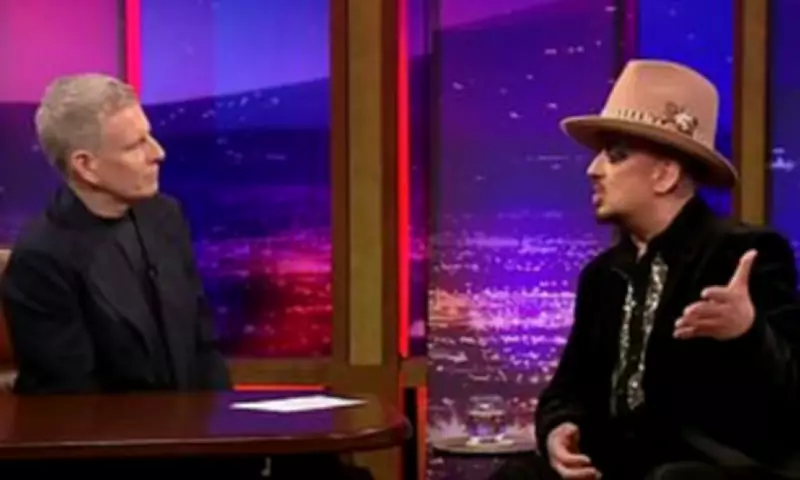
Patrick Kielty has found himself at the centre of an anti-Semitism controversy after he connected the Golders Green attack to the 'horrors in Gaza' during an interview with Boy George on RTÉ's Late Late Show. The Irish broadcaster, 55, made the remarks while discussing the stabbings of two Jewish men in north London with the pop star on Friday night.
The attack occurred days earlier in Golders Green, where Somali-born British national Essa Suleiman, 45, allegedly knifed Shloime Rand, 34, and Moshe Shine, 76. Suleiman appeared in court on Friday charged with attempted murder for both attacks, as well as for trying to kill a friend of 20 years in Southwark earlier the same day. Boy George, who was in the area at the time, said he was left 'in tears' after witnessing the aftermath.
During the interview, Boy George revealed that he had received online abuse for his support of the Jewish community following the attack. He said: 'For me personally, growing up I have had so many beautiful Jewish friends and I still have. Being asked to turn against the whole race of people is not acceptable to me and I am getting a lot of abuse for it but I don't really care.'

Kielty responded: 'You have attacks on the Jewish community and the backdrop of that obviously is the horrors in Gaza and this is a complex thing. I know you have always spoken out that violence is never the answer.' Boy George then asked the audience if they knew any Jewish people, prompting a silence in the studio.
Holocaust Awareness Ireland condemned the interview as 'extraordinary', accusing RTÉ of being 'disturbingly unbalanced' in its coverage of Jewish people. In a post on X, a spokesperson wrote: 'The two defining moments come when [Boy George] asked the audience if they know any Jewish people and is met by stone cold silence. The silence represents a combination of fear that admitting such relationships publicly might cause difficulty and the reality that most Irish people don't know any Jews. The second incredulous aspect of the interview is [Patrick Kielty's] singular lack of empathy when speaking about Jews.'
The group highlighted Kielty's personal history, noting that his father was shot dead by loyalist paramilitaries in 1988 in Dundrum, County Down. 'Here is a public figure who has been rightly applauded for his brave public confrontation with the tragic sectarian murder of his father and the manner in which he has engaged with the loyalist community in the North. How is it that a man capable of extraordinary courage is blind to the persecution of another minority in the city of London where he calls home?'
A Campaign Against Antisemitism spokesman also criticised Kielty, saying: 'Boy George has been a steadfast supporter of the Jewish community in this difficult period, enduring online abuse for daring to stand up for this embattled minority. We are enormously grateful for his lonely voice standing up for Jews. What a contrast to Patrick Kielty, whose first reaction when Jews are stabbed on the streets of Britain is to reference Gaza.'
In a statement, RTÉ defended the interview, saying: 'On Friday's Late Late Show Patrick Kielty addressed the Golders Green attack with his guest Boy George, who had witnessed the aftermath, as part of a wide-ranging interview. Patrick stated clearly, without qualification, that these attacks were 'horrific'. He also said that the attacks took place against the backdrop of the horrors in Gaza. At no point did he say, nor would anyone reasonably infer, that there was any justification for the attacks whatsoever. As someone who lost his father to a terrorist attack, Patrick has always been empathic, measured and sensitive on such matters, which he was again on this particular show.'