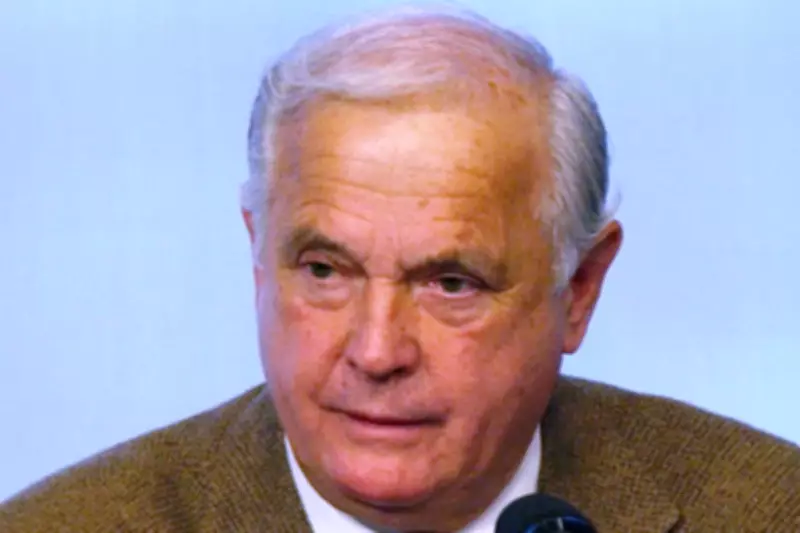
Alexander Butterfield, Key Figure in Watergate Scandal, Passes Away at 99
The death of Alexander Butterfield, the former White House aide whose disclosure of President Richard Nixon's secret Oval Office recording system dramatically accelerated the Watergate scandal and Nixon's eventual resignation, has been confirmed. He was 99 years old.
A Fateful Revelation That Changed American Politics
Butterfield's wife, Kim, and former Nixon White House counsel John Dean confirmed his passing to The Associated Press. Dean, who alongside Butterfield helped expose the presidential wrongdoing, stated, "He had the heavy responsibility of revealing something he was sworn to secrecy on, which is the installation of the Nixon taping system. He stood up and told the truth."
As a deputy assistant to President Nixon from 1969 to 1973, Butterfield oversaw a covert, voice-activated taping system installed in four key locations, including the Oval Office, the Cabinet Room, Nixon's Executive Office Building office, and the Camp David presidential retreat. He later asserted that, apart from himself and Nixon, only White House chief of staff H.R. Haldeman, a Haldeman assistant, and a few Secret Service agents were aware of its existence.
The Senate Testimony That Unraveled a Presidency
Butterfield's pivotal role emerged on July 13, 1973, when Senate committee staffers, investigating the 1972 Watergate break-in at Democratic Party headquarters, privately questioned him. A routine inquiry about potential recordings, prompted by John Dean's earlier testimony, led Butterfield to acknowledge the system's reality. He was swiftly brought before a public hearing of the Senate Select Committee on Presidential Campaign Activities.
The public revelation on July 16, 1973, that Nixon had systematically recorded all his conversations stunned the nation. Butterfield testified under oath, "Everything was taped ... as long as the president was in attendance." These tapes promised investigators conclusive evidence regarding Nixon's knowledge of the break-in and the subsequent cover-up.
Legal Battles and Historic Resignation
The discovery ignited a yearlong legal struggle, culminating in a unanimous July 1974 Supreme Court ruling ordering Nixon to surrender the tapes. The recordings, now held by the National Archives, exposed Nixon's involvement in the cover-up, revealing his temper, vulgar language, and prejudiced views. Facing imminent impeachment by the House of Representatives, Nixon resigned on August 9, 1974.
Reflecting on his impact, Butterfield stated in a 2008 oral history for the Nixon Presidential Library, "I didn't like to be the cause of that, but I felt that I was, in a lot of ways." He admitted he hadn't foreseen Nixon's forced exit but knew the tapes were "dynamite." On the day of the resignation, he found himself "cheering ... because justice had prevailed."
Later Life and Lasting Legacy
Butterfield, an Air Force veteran who retired as a colonel after 20 years of service, left the White House in 1973 to become Administrator of the Federal Aviation Administration. He believed President Gerald Ford dismissed him in 1975 due to his Senate testimony. Subsequently, he worked as a business executive in California, earning a master's degree from UC San Diego in 1994.
In later years, Butterfield was candid in his criticism, calling Nixon "a crook" and "not an honest man," asserting Nixon had prior knowledge of the Watergate break-in and orchestrated the cover-up. Despite acknowledging Nixon's foreign policy achievements, he viewed him as the scandal's "ringleader."
Born Alexander Porter Butterfield on April 6, 1926, in Pensacola, Florida, he was a UCLA friend of H.R. Haldeman, which led to his White House role. His testimony remains a cornerstone of American political history, underscoring the profound consequences of truth-telling in the face of power.