'So Shameful': Backlash as US National Monuments Conform to Trump's Rewrite of History
From Pennsylvania to Montana, the White House's war on 'woke' has targeted US monuments that address critical topics like racism and Indigenous history, leading to widespread controversy and legal challenges.
Blank Spaces Replace Slavery Panels in Philadelphia
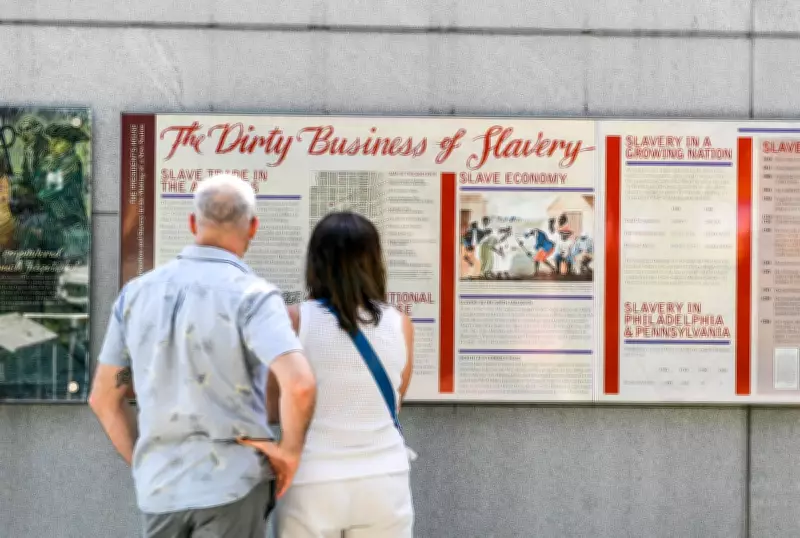
Blank spaces now exist where a series of panels about enslavement once appeared on the walls of the President's House in Philadelphia, Pennsylvania. This site, which honors the home of George Washington and John Adams, is a major landmark that bore artwork and informational signs for over a decade. However, on 22 January, National Park Service workers used hand tools to pry off 34 panels to comply with a presidential executive order designed to reframe the national narrative. The panels, which highlighted the lives of people enslaved by George Washington when Philadelphia served as the US capital in the 1790s, are now in storage.
Nationwide Removal of Historical Exhibits
The removal in Philadelphia is part of a broader trend across the nation, as NPS staff aim to conform with Trump's executive order 'Restoring Truth and Sanity to American History' issued on 27 March 2025. Public markers, monuments, and statues that the Trump administration considers disparaging to past or current Americans have been flagged at more than a dozen parks. For instance, two exhibits at Montana's Little Bighorn battlefield national monument that discuss Indigenous history and the Battle of the Little Bighorn have been targeted and deemed noncompliant. Additionally, signage about climate change at Muir Woods national monument in California and visitor brochures at Medgar and Myrlie Evers Home national monument in Mississippi, which referred to Medgar Evers's killer as racist, were also removed.

Critics Decry Damage to Historical Integrity
Critics argue that the federal government's actions have severely damaged the National Park Service's credibility in telling the truth about history. Ed Stierli of the National Parks Conservation Association stated that it will now be more difficult for the public to access a well-rounded accounting of the nation's founding. 'The National Park Service has made tremendous strides in recent decades in teaching the facts, the truth about difficult topics like slavery,' Stierli said. 'By removing this exhibit and removing signs, not just from this exhibit, but from parks around the country, visitors are going to miss out on the full picture of our nation's history that deserves to be told in national parks.'
Legal Action and Government Response
Following the removal of the panels and associated videos, the city of Philadelphia filed a lawsuit against the federal government in the US district court for the eastern district of Pennsylvania to reinstate the exhibit. The city also sought an injunction to prevent further damage to the site or the panels. On 2 February, Judge Cynthia M Rufe blocked the government from making additional changes to the President's House until further notice.
A Department of Interior spokesperson responded in an email, 'Following completion of the required review, the National Park Service is now taking appropriate action in accordance with the Order. We encourage the City of Philadelphia to focus on getting their jobless rates down and ending their reckless cashless bail policy instead of filing frivolous lawsuits in the hopes of demeaning our brave Founding Fathers who set the brilliant road map for the greatest country in the world – the United States of America.'
Impact on Park Service Morale and Public Access
As visitors flock to national parks ahead of the US's 250th birthday on 4 July, Stierli expressed that he finds the government's action 'so shameful and unfortunate at a time when we should be acknowledging and celebrating our history, while acknowledging the good parts and the bad.' He added that NPS staff have been forced to eliminate historical information to retain their jobs, further harming morale at a time when staffing levels are near historic lows. 'We're also worried about the storytellers ... their world has been rocked too, because essentially, they're having to reinterpret a narrative, in many cases, against their own will.'

Indigenous Perspectives and Historical Erasure
The flagging of signage at Little Bighorn battlefield national monument is particularly poignant for historian Dr Leo K Killsback, a Northern Cheyenne descendent of Chief Dull Knife. Killsback, who completed research and designed panels about the Cheyenne at the monument in 2014, views the executive order as divisive, contrasting with the monument's theme of 'peace through unity.' He stated, 'When done correctly, history is based on facts, supported by evidence, and presented objectively without an agenda or as propaganda. Native voices have been ignored, marginalized or devalued for so long. I think the removal of well-researched facts is desperate and unintelligent and it destroys the hard work of dedicated scholars.'
Killsback emphasized that erasing history is an affront to human progress and an assault on Indigenous human rights, echoing past forms of discrimination and cultural genocide. Dr Rasul Mowatt, a sociology professor at North Carolina State University, noted that Indigenous and Black American histories have only recently begun to be acknowledged, making their erasure all the more significant. 'The United States has a long history of either no memorialization, late memorialization, contested memorialization or even memorialization removal,' Mowatt said.
The Power of Place in Historical Education
Stierli highlighted that the absence of the panels and videos in Philadelphia has made history more inaccessible to the public. The exhibit's location near the entrance of the Liberty Bell Center allowed it to receive significant traffic. 'There's a particular power that comes with learning about these stories in the place that they happened, in the place where it was,' Stierli said. 'And it's just a completely different experience than what it would be if you're reading it on your phone, on a website or in a book.' This underscores the ongoing debate over how history is presented and preserved in national monuments across the United States.