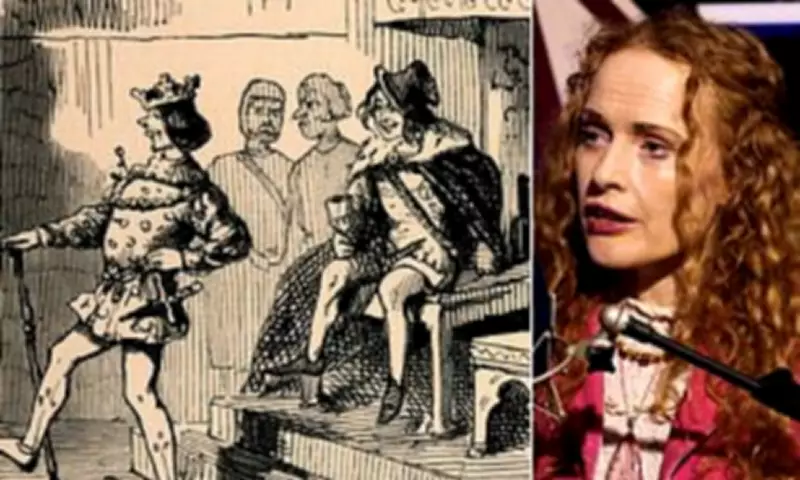
The Tragic Reign of Edward II: Unpacking the Gaveston Affair
In the latest episode of the Daily Mail's Queens, Kings and Dastardly Things podcast, historians Robert Hardman and Kate Williams delve into the complex and tragic reign of Edward II, a medieval monarch whose story is shrouded in myth and scandal. Edward, who became England's first Prince of Wales, ascended to the throne in 1307 following the sudden death of his father, Edward I, during military campaigns in Scotland.
The Controversial Friendship That Shook a Kingdom
One of Edward II's earliest and most controversial acts as king was to recall Piers Gaveston, a handsome young knight, to court. Gaveston had previously been exiled to France by Edward I after influential barons expressed concerns about his close relationship with the then-heir to the throne. The two had been introduced at age fifteen, with Gaveston brought to court to serve as a positive influence on the meek Edward, thanks to his reputation for athleticism and martial prowess.
Upon Gaveston's return, Edward II bestowed upon him an earldom and arranged his marriage to the king's own niece. This rapid accumulation of wealth and power angered not only the barons who had orchestrated his initial exile but also Edward's new queen, Isabella of France. Isabella, daughter of the powerful Philip IV of France, leveraged her father's influence to pressure Edward into removing Gaveston from court.

A Five-Year Battle of Wills and Political Turmoil
What followed was a protracted five-year struggle, during which Edward was repeatedly forced to exile Gaveston, only to recall him months later each time. Tensions reached a breaking point when barons took matters into their own hands. Upon Gaveston's return from his third exile, he was swiftly captured and executed by a group of nobles on fabricated charges of treason.
Gaveston's death set in motion Edward II's own downfall. Consumed by a desire for revenge, the king turned against his barons and queen, who eventually united to depose him. After a series of military defeats and political scandals, Isabella allied with the powerful earl Roger Mortimer to overthrow Edward. With little resistance, Edward was defeated and imprisoned at Berkeley Castle in Gloucestershire, where he died in September 1327.
Debunking the Gruesome Execution Myth
Edward II is infamous for the legend surrounding his execution, which claims he died after a red-hot poker was thrust into his rectum. On the podcast, historian Kate Williams argues that this story is likely a myth rooted in homophobia, invented to punish Edward for his rumoured relationship with Gaveston.
"We had done a lot of awful deaths on our podcast, but I think death by hot poker is the one I would like the least," Williams remarked. She explains that the tale began circulating among chroniclers in the 14th century and was popularised in Christopher Marlowe's play, Edward II. "This is a play in which there is, what we might call now, homophobic attitudes towards the King and Gaveston," Williams notes. "Marlowe was trying to say that with this gruesome death - the shocking state of a King having a gay relationship is totally purged. That heterosexuality's greatness has been restored."
Most modern historians dismiss the poker story as medieval propaganda, questioning why Edward's captors would use such an easily detectable method. The narrative only emerged after 1330, likely spread to tarnish Roger Mortimer's reputation following his rule as regent. "The poker story melts away when you look at the evidence," Williams concludes.
To explore the full story of King Edward II and Piers Gaveston, listeners can search for Queens, Kings and Dastardly Things on YouTube or wherever podcasts are available.