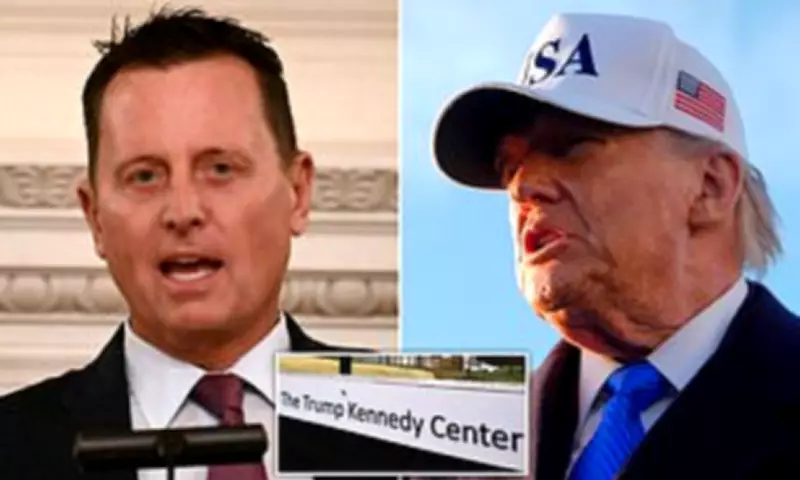
Richard Grenell Steps Down as Kennedy Center President After Tumultuous Year
MAGA firebrand Richard Grenell will step down as president of the Kennedy Center following a tumultuous year in charge, marked by significant controversy and a major rebranding of the iconic institution. Former President Donald Trump announced the leadership change in a post to his Truth Social account on Friday, praising Grenell's work during a transitional period.
Trump Announces Leadership Transition
In his social media post, Trump wrote: 'Ric Grenell has done an excellent job in helping to coordinate various elements of the Center during the transition period, and I want to thank him for the outstanding work he has done.' The former president added: 'THE TRUMP KENNEDY CENTER will be, at its completion, the finest facility of its kind anywhere in the World!'
Trump announced that Matt Floca, who currently manages the Kennedy Center's facilities operations, will succeed Grenell as president. The Daily Mail has reportedly reached out to Grenell for comment regarding his departure.
A Year of Controversial Changes
Grenell's departure comes as the Kennedy Center prepares to close this summer for an extensive two-year renovation project. The former ambassador was a central player in Trump's push to dramatically overhaul the Kennedy Center following the former president's return to office.
After largely ignoring the center during his first term, Trump made it a focal point in his cultural battles during his second administration. He ousted the Kennedy Center's previous leadership and replaced it with a hand-picked board of trustees who voted to rename the facility the Trump Kennedy Center—a change that scholars and lawmakers argue must be initiated by Congress.
More recently, Trump's name was physically added to the building's iconic facade, sparking immediate backlash from the arts community.
Artistic Boycotts and Community Backlash
The fallout from these changes was swift and intense. Prominent musical productions, including the acclaimed 'Hamilton,' canceled performances at the venue. Actor Issa Rae and author Louise Penny withdrew from scheduled appearances, while consultants such as musician Ben Folds and singer Renée Fleming resigned from their positions.
Last week, the executive director of the National Symphony Orchestra, Jean Davidson, left to head the Los Angeles-based Wallis Annenberg Center for the Performing Arts. These departures represent a significant shift for an institution that was long considered one of the few places in Washington where political differences were routinely set aside.
The Kennedy Center, perhaps best known for its annual honors program, once hosted Supreme Court Justices Antonin Scalia and Ruth Bader Ginsburg—ideological opposites—who famously attended the opera there together. However, during Trump's second term, the venue became something of an extension of the White House.
Political Events and Programming Shifts
Trump was instrumental in convincing FIFA President Gianni Infantino to hold the World Cup draw at the Kennedy Center in December. Just days later, Trump himself hosted the Kennedy Center honors—the first president to do so. Since then, Trump has addressed House Republicans at the venue, and the documentary about first lady Melania Trump premiered there.
Grenell, a longtime Republican foreign policy adviser who served as U.S. ambassador to Germany and acting director of national intelligence during Trump's first term, emphasized what he called 'common sense' programming at the Kennedy Center. He aimed to steer the venue toward events that appealed to broad audiences and avoided financial losses.
However, his approach prompted criticism from many Democrats on Capitol Hill. Senator Sheldon Whitehouse, the top Democrat on the Environment and Public Works Committee, released documents in November showing the Kennedy Center entered into an agreement giving FIFA 'exclusive' use of the facility from November 24 through December 12 at no cost. Whitehouse argued the venue risked losing millions in potential revenue through this arrangement.
Financial Controversies and Impending Closure
The Kennedy Center told the Associated Press at the time that it was being paid $7.4 million to host the draw, including a $2.4 million donation from FIFA, plus sponsorship opportunities and expenses. In response to Whitehouse, Grenell claimed he raised $117 million last year.
Despite these financial claims, the wave of cancellations proved difficult to sustain. Without specifically mentioning the abandoned performances, Trump announced in February that he would close the Kennedy Center for two years after this summer's July Fourth celebrations to repair what he described as a dilapidated building.
Ahead of the closure, Grenell warned staff about impending cuts that would leave 'skeletal teams' operating at the institution.
The Successor's Background
According to Floca's LinkedIn profile, he joined the Kennedy Center in January 2024, during the Biden administration. A center press release from that time describes him as 'an experienced facilities management professional with a construction management background and an appreciation for whole building design principles.'
Floca's previous experience includes several positions with the District of Columbia government, among them associate director of sustainability and energy and director of facilities management. He graduated from Louisiana State University in 2009 with a Bachelor of Science degree in construction management.
The leadership changes are expected to be finalized at a board meeting scheduled for Monday at the White House, according to a person familiar with the matter who requested anonymity to discuss plans that are not yet public.