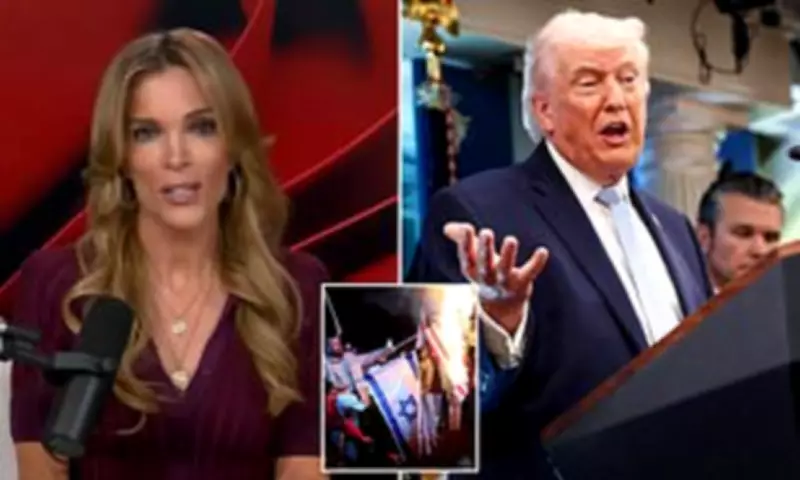
Megyn Kelly delivered a blistering critique of President Donald Trump's recently announced ceasefire agreement with Iranian officials, calling the arrangement "amazing" for Tehran while questioning its practical implementation. The former Fox News anchor's comments came after Trump revealed late Tuesday that American, Israeli, and Iranian authorities had agreed to a temporary two-week ceasefire intended to reopen the vital Strait of Hormuz to maritime traffic.
Ceasefire Collapses Within Hours
Shortly after the ceasefire took effect, Iran's semi-official Fars news agency reported that passage through the strategic Strait of Hormuz was once again halted "simultaneous with Israel's attacks on Lebanon." This development prompted Kelly to question the agreement's viability during her Wednesday broadcast, noting that the waterway's reopening appeared temporary at best.
"It's as if we didn't bomb them to smithereens," Kelly stated emphatically. "It's as if we didn't start a war and bomb Iran for the past 38 days, and that cannot be undone with a sunny tweet or Truth Social post, because already things are going south on this ceasefire."

Iranian Threats and Demands
The Iranian regime has imposed additional conditions that complicate the situation, threatening to destroy oil tankers attempting to traverse the Strait without permission while demanding tolls of up to $2 million per vessel. These actions occur alongside Tehran's presentation of a comprehensive ten-point peace plan that critics argue concedes excessive power to the Islamic Republic.
Kelly specifically addressed the proposed framework, which demands American acceptance of Iran's continued control over the Strait of Hormuz, recognition of Tehran's right to uranium enrichment, complete sanctions relief, financial compensation, and withdrawal of all U.S. troops from the region. "The ten-point plan would be amazing, it would be amazing for Iran," Kelly explained, suggesting the administration's willingness to consider such terms stemmed from political pressures.
Confusion Over Lebanese Inclusion
A significant point of contention emerged regarding whether the ceasefire applied to hostilities between Israel and Lebanon. Kelly detailed the confusion, noting that "at first it appeared we thought the part of the ceasefire was Israel would stop bombing Lebanon." However, Israeli authorities subsequently clarified they had not agreed to this provision and continued military operations against Hezbollah positions.
"And now here we are at 12:04 on Wednesday, with the Strait closed again because our good friend and special ally Israel is f***ing up the ceasefire within twelve hours of it being struck," Kelly declared, suggesting Israeli Prime Minister Benjamin Netanyahu faces domestic political pressures that complicate the peace process.
Broader Political Criticism
Kelly's criticism extended beyond the ceasefire details to Trump's earlier social media rhetoric, where the president warned that "a whole civilization will die tonight" if the Strait of Hormuz remained closed. She characterized these remarks as "completely irresponsible and disgusting," drawing parallels to her own experiences with Trump's social media attacks during the 2015-2016 election cycle.
"I don't care that it's a negotiation tactic... to kill an entire country full of civilians - men, women, and children - an American president, so that the Strait of Hormuz will be opened? It's just wrong," Kelly asserted during her Tuesday program, comparing Trump's approach to that of Genghis Khan.
Republican Concerns and White House Response
The ceasefire agreement has drawn skepticism from across the political spectrum, including some of Trump's traditional allies. Republican Representative Don Bacon of Nebraska acknowledged "significant victories" but expressed reservations about negotiating from a position of perceived weakness. "They will work with Russia and China as soon as they can to start rebuilding their military," Bacon warned CNN, suggesting Iran would remain a long-term threat.

Republican Senator Lindsey Graham demanded that Vice President JD Vance appear before Congress to explain the agreement's terms, posting on social media that "the supposed negotiating document, in my view, has some troubling aspects." Meanwhile, pro-Israel commentator Mark Levin, while expressing trust in Trump's "instincts," cautioned that Iran cannot be trusted as a negotiating partner.
Administration's Nuclear Assurance
In response to mounting criticism, President Trump insisted Wednesday that any peace plan would not involve uranium enrichment, claiming "the United States will, working with Iran, dig up and remove all of the deeply buried nuclear 'dust.'" The White House confirmed the safety of nuclear materials had been verified before the ceasefire agreement, with Trump asserting that "nothing has been touched from the date of attack" and that sites have been closely monitored since bombing operations.
The administration has indicated that tariff and sanctions relief remain under discussion as part of broader peace negotiations, with Trump claiming "many" points have already been agreed upon. However, ambiguity persists regarding whether the president referenced June's bombing of Iranian nuclear facilities or more recent strikes during the ongoing conflict.
As diplomatic efforts continue with planned meetings in Islamabad on Friday to establish a more permanent resolution, the immediate closure of the Strait of Hormuz underscores the fragile nature of the temporary ceasefire and the complex geopolitical challenges facing all parties involved in the conflict.