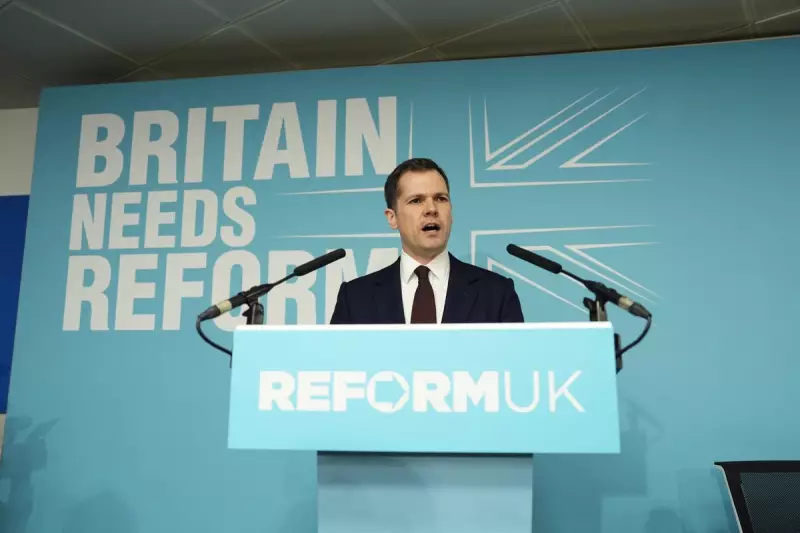
In a stunning political realignment, former Conservative minister Robert Jenrick has crossed the floor to join Nigel Farage's Reform UK. The move, confirmed on Saturday 17 January 2026, sets the stage for a significant internal power struggle within the populist party and marks a major headache for Prime Minister Kemi Badenoch.
A Defection Built on Contradictions
The defection is remarkable given the recent and very public animosity between the two men. Only days before the announcement, an audio recording leaked to the press captured Jenrick dismissing Reform as "not a serious party" and deriding Farage's leadership abilities, claiming he "couldn't run a five-a-side team." For his part, Farage has previously been highly critical of Jenrick. Yet, at a joint press conference this week, both men performed a striking volte-face, with Farage praising his new recruit and Jenrick declaring Reform the "only conceivable choice for Britain."
Jenrick's departure from the Conservatives was messy. He was sacked from the shadow cabinet by Kemi Badenoch, who then publicly labelled him a "duplicitous snake." Observers note that Badenoch's decisive handling of his impending treachery ultimately strengthened her position, contrasting with Jenrick's bungled exit.

What Does 'Jenrickism' Actually Bring to Reform?
Following the defection, commentators have scrambled to define "Jenrickism" – a supposed philosophical framework intended to give substance to Farage's populism. In practice, it appears to be a blend of hardline immigration rhetoric and a desire to roll back the political legacy of Britain since the fall of Margaret Thatcher. This is politically awkward, as it implicitly condemns the 21 years of Conservative government, a decade of which Jenrick served as an MP and minister, actively supporting the very policies he now criticises.
The value of his defection is hotly debated. One school of thought suggests that Reform is accumulating former Tories to gain a veneer of governmental experience. The irony is that this experience stems from the administrations Reform blames for the country's current woes. The other argument posits that defections like Jenrick's create a perception of "momentum," branding Reform as a serious party for serious times. Some have drawn a flawed parallel with the mould-breaking formation of the Social Democratic Party in 1981.
The Inevitable Clash for the Crown
Unlike other senior Tories who have defected to Reform – such as Nadhim Zahawi or Nadine Dorries – Robert Jenrick retains clear and burning ambitions for the highest office. This sets up an almost inevitable future collision with Nigel Farage, who is notoriously possessive of his leadership role and has a "positively Italian Renaissance way" of dealing with rivals.
Farage's offer for other Conservatives to defect now, warning that the door may shut after May's local elections, is seen by many as a cynical, time-limited marketing ploy. The reality is that Reform will likely welcome most defectors at any time, provided they are not extreme figures like Tommy Robinson or politically toxic like Liz Truss.
The immediate beneficiary of this drama is Kemi Badenoch, who emerges looking strong and decisive. Meanwhile, the clock is now ticking on a future internal Reform battle. The countdown to the Farage versus Jenrick welterweight fight has well and truly begun.