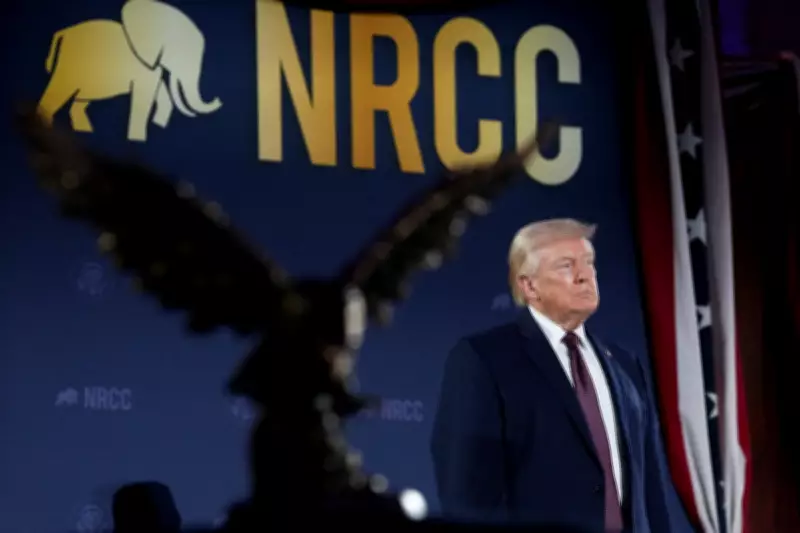
Former President Donald Trump was honoured with the inaugural "America First Award" during a lengthy and discursive address at the National Republican Congressional Committee's annual fundraising dinner in Washington, D.C. on Wednesday night. The event, which stretched for over an hour, saw Trump launch familiar broadsides against political opponents while touching on contentious issues like election integrity and foreign policy.
A Golden Honour for a 'Golden Era'
House Speaker Mike Johnson introduced Trump to the assembled donors and revealed the new award, describing it as a "beautiful golden statue" that he deemed "appropriate for the new golden era in America." The prize, represented by an eagle statue displayed on stage, was presented to the former president amid applause from the Republican faithful.
Familiar Insults and Political Divisions
Trump quickly pivoted to his signature rhetorical style, lambasting his perceived foes. He targeted former Presidents Joe Biden and Barack Obama with harsh criticism. "If you go back to Obama, he was a great divider. He divided this nation," Trump asserted. "He was a lousy president. The worst president in history was Biden. But Obama was a terrible president."

The speech then veered into electoral matters, with Trump condemning Democrats for opposing the Republican-backed SAVE America Act. This legislation would mandate photo identification and proof of citizenship at polling stations, measures that many Democrats argue could disenfranchise millions of voters. "You have those Democrats, they stick together. Think of it — they vote against voter ID, they vote against proof of citizenship. They vote against it," he declared.
Contradictions on Mail-In Ballots
In a notable contradiction, Trump expressed his disdain for mail-in voting, stating he's "a fan of no mail-in ballots." This remark came despite reports that he himself voted by mail in a recent Florida special election, highlighting a recurring tension in his public statements on electoral processes.
Foreign Policy Musings on Iran
Earlier in his address, Trump turned to international affairs, specifically discussing the ongoing tensions with Iran. He claimed that Tehran is eager to negotiate a deal but is constrained by internal and external fears. "Nobody has ever seen anything like we're doing in the Middle East with Iran. And they are negotiating, by the way, and they want to make a deal so badly, but they're afraid to say it, because they figure they'll be killed by their own people," Trump said.
He added, "They're also afraid they'll be killed by us. There's never been a head of a country that wanted that job less than being the head of Iran." These comments reflect his characteristic blend of boastfulness and speculation on complex geopolitical dynamics.
Tangential Rants and Rallying Cries
At one point, Trump digressed into a rant about societal norms, complaining that he can't compliment a waitress without facing political repercussions. "Because if you call her beautiful, that's the end of your political career," he remarked, illustrating the meandering nature of his delivery.
He concluded with a fervent call to action for Republicans, echoing his iconic campaign slogans. "We will make America strong again. We will make America proud again. We will make America safe again, and most importantly, we will make America great again," Trump proclaimed. "Thank you very much Republicans, go out and win the midterms!"
Context of Rambling Remarks
This speech, during which Trump was noted to slur his words at times, follows similar instances of discursive rhetoric. Just a day earlier, during the swearing-in ceremony for Department of Homeland Security Secretary Markwayne Mullin, Trump delivered rambling remarks that also covered voter ID and mail-in ballots, among other topics. Observers have pointed to a pattern of lengthy, unfocused addresses from the former president in recent public appearances.
The fundraiser, held in the nation's capital, underscores Trump's continued influence within the Republican Party as he remains a central figure in its fundraising and electoral strategies. The "America First Award" serves as a symbolic reinforcement of his political legacy, even as his speeches continue to draw attention for their sprawling content and delivery.