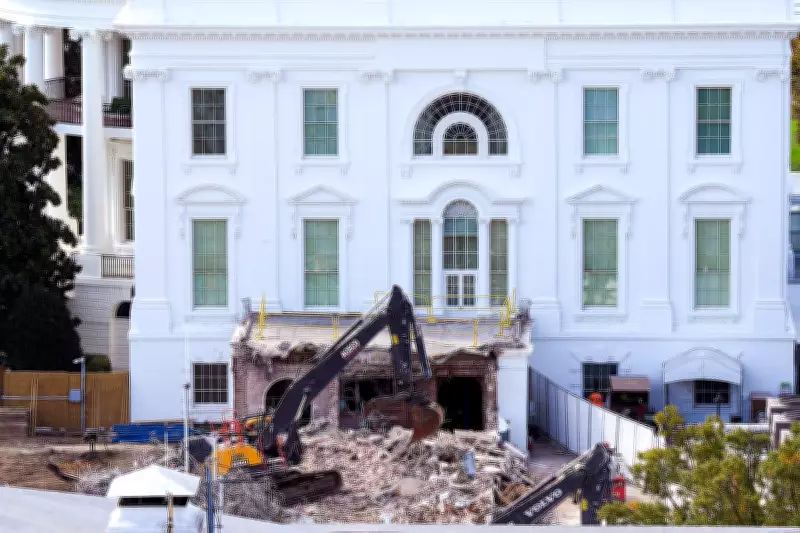
Trump's $400 Million Ballroom Project Faces Legal Threat Over Donor Funding
President Donald Trump's ambitious plan to construct a lavish $400 million ballroom at the White House using private donations is now under serious legal scrutiny. A federal judge is poised to rule this month on whether the administration can proceed with this controversial funding model, which bypasses congressional approval and relies on corporate contributions.
Legal Challenge and Transparency Concerns
U.S. District Judge Ricard Leon is considering a lawsuit filed by the National Trust for Historic Preservation in December that seeks to halt construction of the ballroom. During a January hearing, Judge Leon expressed significant reservations about the project proceeding without explicit congressional oversight. He questioned whether President Trump possesses the statutory authority to dismantle the East Wing and replace it with a ballroom without proper authorization from Congress.
The Trump administration has argued that using private donations keeps the financial burden off taxpayers. However, critics including Democratic lawmakers and watchdog groups have raised serious concerns about transparency and potential conflicts of interest. The funding arrangement routes donations through a nonprofit intermediary that collects management fees of 2 to 2.5 percent on each contribution, generating substantial profits from the project.
Corporate Donors and Disclosure Issues
The administration has secured commitments from numerous high-profile corporations including technology giants Amazon, Apple, Google, HP, and Microsoft. Other notable donors include Coinbase, Lockheed Martin, Palantir Technologies, and T-Mobile. Most of these companies have declined to disclose the specific amounts they've contributed to the project.
According to the watchdog group Citizens for Responsibility and Ethics in Washington (CREW), at least 22 companies involved in the project failed to disclose their donations in required lobbying filings. This lack of transparency has fueled criticism that the arrangement allows corporations to potentially influence the administration while avoiding public scrutiny of their financial contributions.
Project Details and Controversial Demolition
The ballroom project has doubled in cost from its initial $200 million estimate last summer, though the White House has declined to specify exactly how much money has been raised. The planned 90,000-square-foot ballroom would be part of a larger "New East Wing" complex that includes a new office for the First Lady, a movie theater, and a commercial kitchen.
Soon after plans were announced, demolition of the East Wing began without any extensive public review process. This rapid action prompted the National Trust for Historic Preservation to argue in their lawsuit that "no president is legally allowed to tear down portions of the White House without any review whatsoever."
National Security Arguments and Political Context
The Trump administration has mounted a vigorous defense of the project, with the Department of Justice filing arguments that halting construction would create national security risks. In court filings, the administration claims that leaving the project incomplete would "imperil the President and others who live and work in the White House" according to Secret Service assessments.
The project has unfolded against a politically charged backdrop. In October, Trump hosted an opulent gala dinner for sponsors in the White House East Room during the longest government shutdown in U.S. history, which lasted 43 days. Senator Elizabeth Warren has called on the Trust for the National Mall, the nonprofit managing donations, to clarify its role and disclose information about contributions received.
White House spokesman Davis Ingle has defended the project, stating that "President Trump is generously donating his time and resources to build a beautiful White House ballroom, a project which past presidents only dreamed about." He added that the administration has received numerous offers from "generous Americans and American companies wishing to contribute."
Despite the administration's arguments, Judge Leon has made clear his skepticism about using private donations to fund the ballroom's construction. His impending decision could determine whether this controversial $400 million project moves forward or becomes another chapter in the ongoing debate about presidential authority, transparency, and the appropriate use of private funding for public projects.