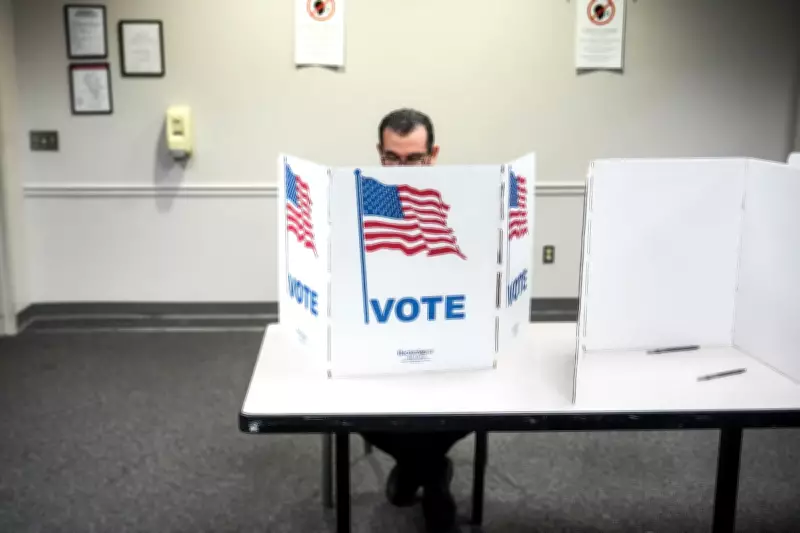
Virginia's Redistricting Plan Approved, Potentially Securing Four More House Seats for Democrats
Virginia voters have decisively approved a mid-decade redistricting plan, a strategic move that could significantly bolster the Democratic Party's prospects of securing four additional U.S. House seats in the upcoming November midterm elections. These critical elections are poised to determine control of a narrowly divided Congress, with both parties vying for every possible advantage.
Constitutional Amendment and Legal Challenges
The constitutional amendment, endorsed by the electorate, effectively circumvents a bipartisan redistricting commission. Instead, it permits the immediate implementation of new congressional districts drawn by Virginia's Democratic-led General Assembly. However, this public mandate may not represent the final word on the matter, as the state Supreme Court is currently reviewing the plan's legality. A ruling against the plan could potentially render the referendum results null and void.
A Setback for Trump's National Redistricting Push
This Virginia redistricting referendum also marks a notable setback for former President Donald Trump, who initiated a concerted national redistricting effort last year. Trump urged Republican officials in Texas to redraw districts, aiming to help the GOP gain more seats in the November elections and retain a slim House majority. This strategy was particularly focused on countering political headwinds that typically favor the party out of power during midterm cycles.

The Texas gambit sparked a burst of redistricting activity nationwide. Republicans currently believe they can secure up to nine more House seats in newly redrawn districts across Texas, Missouri, North Carolina, and Ohio. Conversely, Democrats anticipate gaining up to five more seats in California, where voters approved a similar mid-decade redistricting effort last November, and one additional seat under new court-imposed districts in Utah.
Democrats' Strategic Gains in Virginia
Democrats hope to offset potential Republican gains through the Virginia plan, building on their decisive victories last year when they flipped 13 seats in the state House and reclaimed the governor's office. Under the current districts, imposed by the state Supreme Court in 2021 after a bipartisan commission failed to agree on a map, Democrats hold six of Virginia's 11 U.S. House seats.
The new redistricting plan could potentially help Democrats win as many as 10 seats. Key elements include:
- Five seats anchored in the Democratic stronghold of northern Virginia, with one district strategically extending to incorporate Republican-leaning rural areas.
- Revisions to four other districts across Richmond, southern Virginia, and Hampton Roads that dilute the voting power of conservative blocs.
- A reshaped district in western Virginia that lumps together three Democratic-leaning college towns to offset Republican voters elsewhere.
Political Rhetoric and Campaign Efforts
Democrats have portrayed the Virginia redistricting as a direct response to Trump's national efforts. Democratic Governor Abigail Spanberger emphasized during an online rally last week that the plan represents "pushing back against what other states have done in trying to stack the deck for Donald Trump in those congressional elections."
Campaign ads for the "yes to redistricting" initiative, featuring former President Barack Obama, flooded airwaves across the state. Interestingly, opponents of the redistricting also distributed campaign materials citing past statements from both Obama and Spanberger, who had previously criticized gerrymandering practices.
Historical Context and Procedural Controversy
Congressional redistricting is typically conducted once a decade following each national census. In 2020, Virginia voters approved a constitutional amendment designed to diminish political gamesmanship by shifting redistricting responsibilities away from the legislature. However, lawmakers endorsed a new constitutional amendment allowing mid-decade redistricting last fall, passing it again in January as part of a required two-step process that includes an intervening election before an amendment can appear on the ballot.

This measure permits lawmakers to redistrict until the task returns to a bipartisan commission after the 2030 census. In February, they passed a new U.S. House map to take effect pending the outcome of the redistricting referendum.
Ongoing Legal Battles and Future Implications
Republicans have filed multiple legal challenges against the redistricting effort. A Tazewell County judge ruled the push illegal for several reasons, including lawmakers' failure to follow their own rules for adding the amendment to a special session. Circuit Court Judge Jack Hurley Jr. determined that their initial vote did not occur before the public began casting ballots in last year's general election, thus invalidating it for the two-step process. He also ruled that the state failed to publish the amendment three months before that election, as required by law.
If the state Supreme Court upholds the lower court's decision, the referendum results could be rendered moot, throwing the redistricting process into further uncertainty. Meanwhile, the back-and-forth battle continues in Florida, where the Republican-led Legislature is scheduled to convene on April 28 for a special session that could result in more favorable congressional districts for Republicans.