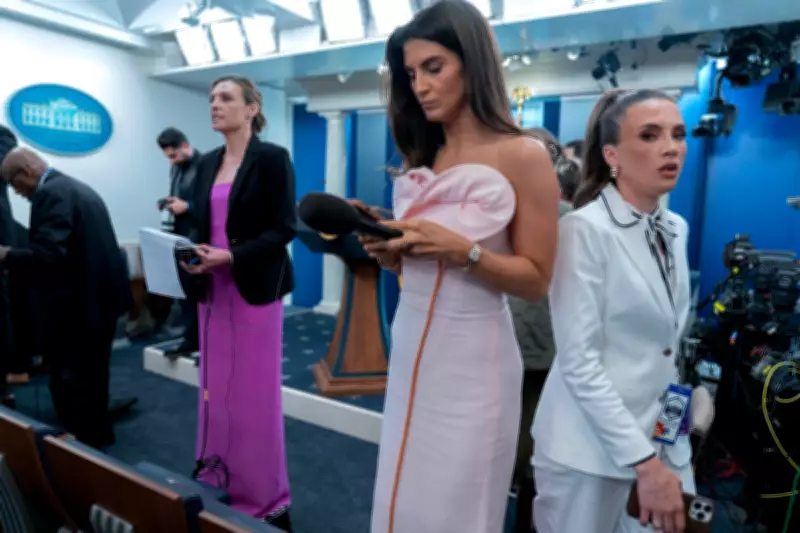
White House reporters became the story themselves as the annual Correspondents' Dinner turned into breaking news on Saturday night. Hundreds of journalists gathered for the event, where President Donald Trump was set to speak, were thrown into chaos by an attempted gunman breach.
Chaos and Instinctive Reporting
In the aftermath, the line between personal safety and professional duty blurred. Many of the nation's most powerful reporters and editors, dressed in tuxedos and gowns, instinctively ducked for cover. "We were under the table before we knew what was happening," wrote Missy Ryan, Matt Viser, and Michael Scherer of The Atlantic. Emerging from cover, their mobile phones became essential tools to capture images, record interviews, and maintain open lines to describe the scene to off-site colleagues.
Susan Zirinsky, former CBS News president, said: "For many people who have either been in a war zone or in the midst of a crisis, I don't think there was any fear. It was get it, find it, shoot it, report it. But it was very frustrating not getting a signal out of the room."

Struggling to Transmit News
Cellphone service at the Washington Hilton was notoriously spotty, which proved key for Associated Press photographer Alex Brandon. He captured one of the night's most memorable images: suspect Cole Tomas Allen on the ground and in custody outside the ballroom. Brandon, attending as a guest without his usual gear, stood up after hearing the shooting and trained his mobile phone camera on Trump, capturing photos as Secret Service agents surrounded and escorted him off the dais. Knowing he had significant photos, he rushed to a doorway and spotted the suspect on the ground, beginning to take more pictures. "Frankly, it was muscle memory," he said. "The whole thing was muscle memory."
CNN's Wolf Blitzer got uncomfortably close to the shooter before he was in custody, when returning from a bathroom break. A police officer threw him to the ground and later hustled him into the men's room for safekeeping. "I happened to be a few feet away from him as he was shooting and the first thing that went through my mind was, 'Is he trying to shoot me?'" said Blitzer. "It was very, very scary but I'm OK now."
Journalists Cover the Story
Because the room was full of journalists, "most of the crowd immediately began to cover the story," wrote The Washington Post's Maura Judkis. "Print journalists interviewed eyewitnesses. Television reporters shot selfie-style video. Non-reporters reached for wine to steady their nerves." After diving under her table, Judkis sent a Slack message: "shots fired." In retrospect, she noted she should have clarified those reports were unconfirmed.
Getting news out fast while ensuring accuracy is a journalist's biggest test. At one point, CNN's Kaitlan Collins reported the alleged shooter "is confirmed dead," citing a security official. However, that information was wrong.
Change in Attitude?
Hours earlier, the biggest concern for journalists was whether they would face a tongue-lashing from Trump, whose animus for the press has been a hallmark of his second term. White House press secretary Karoline Leavitt previewed the president's speech on the red carpet: "It will be funny. It will be entertaining. There will be some shots fired in the room." The speech never came. Trump and correspondents have expressed interest in rescheduling, though logistics are daunting.
Trump later remarked at the White House: "I saw a tremendous amount of love and coming together after the shooting. This was an event dedicated to freedom of speech that was supposed to bring together both parties with the press, and in a certain way it did." He praised CBS News' Weijia Jiang, president of the correspondents' association, for a "fantastic job."
Not all were generous. Kari Lake wrote on social media that she berated CNN's Jake Tapper: "These reporters have spent a decade spreading absolute lies about President Trump. They share some of the blame." But CBS' Zirinsky sensed a new respect from Trump. "I felt it. Is this a change?" she asked.