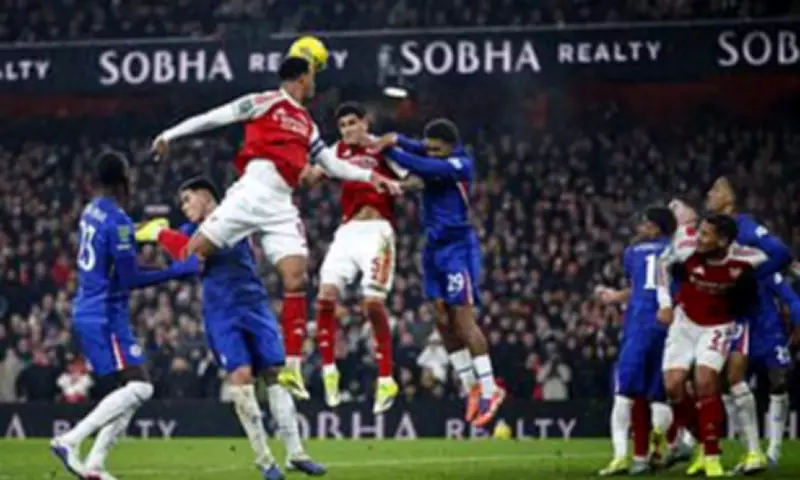
Chelsea's Unconventional Corner Defence Stuns Arsenal
Chelsea employed a daring and fearless tactical approach while defending corners during their Carabao Cup semi-final clash with Arsenal on Tuesday night, leaving the Gunners visibly perplexed. This innovative strategy has sparked debate among fans and pundits alike, raising the question: have the Blues inadvertently discovered a method to counteract Arsenal's renowned prowess from set-piece situations?
A Refreshing Twist Amid Criticism
The bold move provided a refreshing twist on an evening where Chelsea faced criticism for what was described as a cautious overall performance. Former Arsenal midfielder Paul Merson notably claimed the Blues 'went out with a whimper' following their 1-0 defeat on the night, which resulted in a 4-2 aggregate loss, with Kai Havertz scoring the decisive goal.
The Tactical Trick Revealed
So, what was Chelsea's trick? Instead of the traditional approach of marking Arsenal attackers inside the penalty area, manager Liam Rosenior instructed three players—Malo Gusto, Liam Delap, and Jorrel Hato—to position themselves on or near the half-way line as Arsenal prepared to take corners. This forced an immediate and unexpected tactical dilemma upon the hosts.

Arsenal were granted only two corners throughout the match, making the sample size small, but the ploy certainly provided substantial food for thought. For the first corner in the 17th minute, Chelsea waited until Arsenal had assembled their attacking formation before suddenly dispatching their three-man forward line.
Arsenal's Tactical Dilemma
This left Arsenal with a critical decision: should they overload the box by leaving attackers forward to exploit their numerical advantage, or should they send more players back to neutralise the threat of a rapid Chelsea counter-attack? Defender Jurrien Timber took charge, barking instructions to his teammates. Arsenal opted to match Chelsea's numbers, with Martin Zubimendi, Eberechi Eze, and Declan Rice all remaining in defensive positions.
Zubimendi and Rice were tasked with monitoring Gusto and Delap around the half-way line, while Eze positioned himself near Hato on Chelsea's left flank, approximately two-thirds of the way up the pitch. The element of surprise clearly disoriented Arsenal; it took Noni Madueke a mere 31 seconds to deliver his corner kick after the Chelsea players made their forward dash.
Expert Analysis and On-Field Consequences
'I quite like that,' remarked Gary Neville in his commentary. 'It's like an ambush. They don't half look like they've not got a lot of defenders in there though.'
With Arsenal's primary aerial threats, William Saliba and Gabriel Magalhaes, expected to stay forward, it was notable that the Gunners also committed their defensive players—Timber and Piero Hincapie—to the attack. This left Mikel Arteta reliant on his midfield trio to handle any potential counter-attack.
Ironically, the extra space in the box nearly allowed Arsenal to punish Chelsea. Madueke's delivery found Hincapie, whose header rebounded off Wesley Fofana, resulting in another corner. Chelsea repeated their unconventional routine for this second set-piece, with Trevoh Chalobah eventually heading the ball clear after a couple of attempts.
Missed Counter-Attack Opportunities
This clearance presented Chelsea with a chance to launch a counter-attack, but Arsenal effectively stifled it. Eze, demonstrating anticipation, won a crucial race on the left flank against Hato to reach the loose ball. Had Chalobah managed a more powerful, long-range clearance beyond the half-way line, Hato might have been first to it.
Following Eze's intervention, Arsenal worked the ball to Hincapie, who forced a save from Robert Sanchez with a curling left-footed effort towards the far corner. The rebound fell to Gabriel, but the centre-back's clumsy first touch allowed the ball to roll out for a goal kick.

Assessing the Tactical Experiment
Given that these were Arsenal's only two corners in the match, it is challenging to draw definitive conclusions. Chelsea reverted to a more conventional approach when defending free-kicks. Both corners led to scoring opportunities—the first directly and the second indirectly—suggesting that Chelsea's swashbuckling enterprise did not entirely pay off in this instance.
However, the tactic undeniably disoriented Arsenal and exposed them to potential counter-attacks. This innovative strategy offers valuable insights and considerations for other teams looking to neutralise Arsenal's set-piece dominance in future encounters.