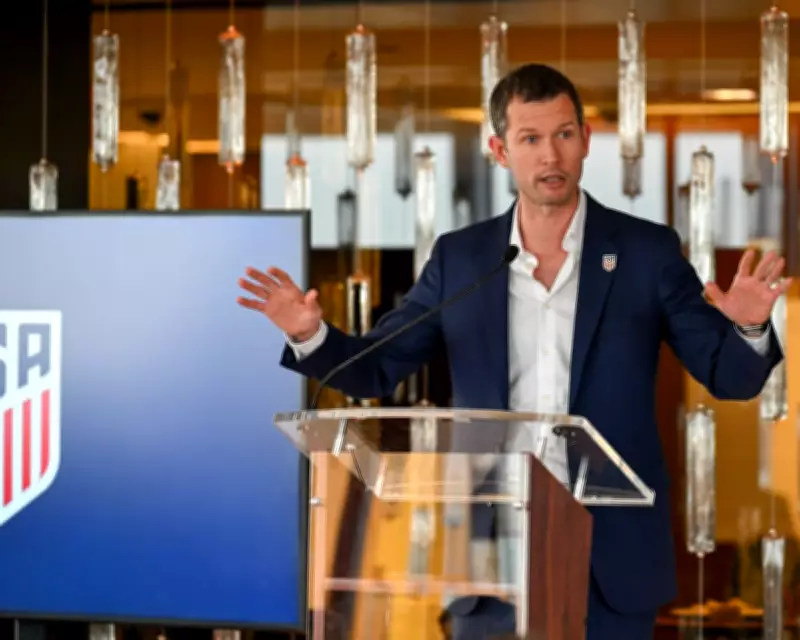
US Soccer chief executive JT Batson has expressed unwavering optimism about the US Men's National Team's (USMNT) prospects in the upcoming World Cup, despite a challenging March window that saw disappointing results. In an exclusive interview, Batson revealed ambitious targets for both the men's and women's national teams to ascend as America's favourite sports entities, capitalising on a surge of funding and heightened interest surrounding the home World Cup.
Ambitious Goals for National Teams
Batson has set a bold vision for the USMNT and US Women's National Team (USWNT) to become the most followed and beloved teams across all American sports. This objective adds to US Soccer's existing goals, which include establishing soccer as the primary participation sport in every community nationwide. Currently, a YouGov tracker ranks the USWNT 14th among America's most popular sports teams, with the USMNT positioned at 43rd. However, after winning Olympic gold at Paris 2024, the women's team climbed to fifth place, while the men's team reached 11th following the appointment of head coach Mauricio Pochettino.
Transformative Opportunities Ahead
Batson highlighted a series of upcoming events that could propel both teams to new heights of popularity. The men's World Cup this summer, followed by the Women's World Cup in Brazil next year, the LA Olympics in 2028, and the co-hosted World Cup in 2031, present unparalleled opportunities to boost fandom and engagement. "We have an opportunity with this summer, the Women's World Cup next year, the LA Olympics, and then the 2031 World Cup to really propel the men's and women's national teams to be the top teams in America in any sport," Batson stated.

Financial Growth and Infrastructure
Despite recent losses to Belgium and Portugal, Batson remains optimistic, pointing to significant financial and infrastructural developments. The match against Portugal drew a crowd of 72,297 at the Mercedes-Benz Stadium, making it the highest-grossing event in US Soccer history. This success coincides with the opening of a $250 million National Training Center in Atlanta, which will serve as the base for 27 US teams.
Commercial partnerships with major brands like Nike, Coca-Cola, and Bank of America, alongside philanthropic contributions from figures such as Arthur Blank and Michele Kang, have bolstered US Soccer's financial outlook. The federation projects revenues of $300 million this year, a 16% increase from the previous period. Additionally, US Soccer anticipates receiving approximately $100 million from FIFA's tournament profits, funds earmarked for reinvestment into grassroots initiatives.
Grassroots and Legacy Programs
To support its growth ambitions, US Soccer has launched the Soccer Forward legacy program, aimed at ensuring soccer is accessible to all. A new Pathway Strategy has also been introduced to create clear routes from recreational play to competitive matches and professional levels. "We have ambitions to grow quickly, at scale, and want soccer to be the number one played sport in every community in this country," Batson emphasised. "To do that it has to be accessible. We want soccer to be in every school, to put soccer within reach of every kid in America who wants to go and play."
Player Perspectives and Expectations
Batson referenced Christian Pulisic's recent comments on pressure being a privilege, echoing a quote from Billie Jean King. He expressed confidence in the players' ability to thrive under the spotlight of large stadiums and passionate fans. "These are great players who play at great clubs around the world. This is what you dream of," Batson said. He defined success not solely by victories but by whether fans feel a deep connection and pride in the teams. "I actually think success will be, 'do the fans believe? Are they proud? And do they feel this is a team that represents their passion, their hopes and their dreams?'"
With high expectations despite recent setbacks, Batson believes that a successful World Cup campaign could catalyse soccer's rise as America's premier sport, fulfilling the legacy of the 1994 World Cup that birthed Major League Soccer. The focus remains on building a sustainable future where soccer is ingrained in every aspect of American life, from youth participation to elite competition.