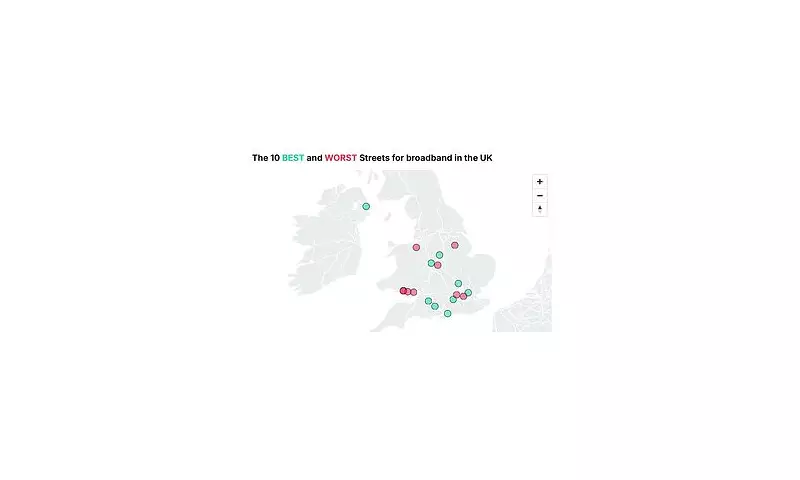
New research has pinpointed the specific neighbourhoods across the United Kingdom suffering from the most painfully slow internet connections, revealing a stark digital divide that leaves some residents unable to stream basic content.
The UK's Slowest Streets for Broadband
The study, conducted by Broadband Genie, analysed more than 145,000 user speed tests to compile a list of Britain's worst-connected streets. The dubious honour of the slowest street in the UK goes to Heol-Y-Fedw in Port Talbot, Wales, where residents endure average download speeds of just 0.81 megabytes per second (Mb/s).
At this glacial pace, essential online activities become virtually impossible. Streaming services like Netflix or Disney+ require a minimum speed that is significantly higher. To illustrate, downloading a standard movie such as Aladdin would take someone on this street over 15 and a half hours.

The contrast with the nation's fastest street is staggering. Residents of Inglewood Avenue in Derby enjoy speeds that are a colossal 1,449 times faster than those in Heol-Y-Fedw.
Urban and Rural Areas Both Affected
While the national rollout of faster connections continues, with gigabit-capable broadband now available to 87% of UK homes and full fibre to 78%, the research highlights persistent blackspots. An estimated 44,000 premises still cannot achieve a download speed of 10 Mb/s, the government's benchmark for a 'decent' connection.
Although rural areas are often highlighted for poor connectivity, the data shows that some of the very worst streets are located in and around cities. Following Heol-Y-Fedw, the second slowest street is Turnberry Crescent in Aberdeen, Scotland, with speeds of 1.06 Mb/s. Completing the top three is Wesley Street in Maesteg, Wales, at 1.45 Mb/s.
Perhaps surprisingly, the capital city also features on the list of shame. Those living on Rossiter Road in Balham, London, experience peak speeds of just 1.74 Mb/s, placing it among the ten worst in the country.
The Full List of the 10 Slowest Streets
- Heol–Y–Fedw, Port Talbot: 0.81 Mb/s
- Turnberry Crescent, Aberdeen: 1.06 Mb/s
- Wesley Street, Maesteg: 1.45 Mb/s
- Occupation Lane, Lincoln: 1.63 Mb/s
- Rossiter Road, London: 1.74 Mb/s
- Quarry Close, Chester: 2.23 Mb/s
- Langley Street, Langley: 2.23 Mb/s
- Jessop Road, Newport: 2.62 Mb/s
- Wakefield Close, Atherstone: 2.66 Mb/s
- Rheolau Terrace, Pontypridd: 2.80 Mb/s
Hope for an Upgrade
Broadband expert Alex Tofts from Broadband Genie emphasised the severity of the situation: 'No one should have to put up with sluggish broadband, it’s an essential utility we rely on for essential services, work, education, social interaction and much more.'
However, the research offers a glimmer of hope. Analysis indicates that all ten of the slowest streets have access to a 'Fibre to the Cabinet' (FTTC) connection, which should theoretically deliver speeds around 35 Mb/s. Furthermore, seven can access Ultrafast broadband (100 Mb/s), and four even have full fibre available.
This suggests that the problem for many residents may not be a complete lack of infrastructure, but potentially being stuck on an outdated plan with their current provider. 'Our analysis found many people on the slowest streets can upgrade their broadband,' said Mr Tofts. He encourages frustrated users to check for better options using comparison tools.
What to Do If Your Broadband Is Slow
If you're experiencing slow speeds, experts recommend several steps. First, test your actual connection speed using a reliable online tool to compare it with what your provider promises. If speeds are consistently lower, try optimising your home setup.

Reposition your WiFi router to a central location, away from walls and other electronics. Switch your router's frequency band from 2.4 GHz to the faster 5 GHz option if available. It is also crucial to check for unknown devices on your network, as neighbours in terraced houses or flats might be inadvertently using your connection, slowing it down for everyone.
Finally, with the cost of living crisis ongoing, it is always worth comparing broadband, TV, and phone deals. Customers often remain on outdated, expensive contracts for years, and switching could secure you a faster, more reliable service for less money each month.