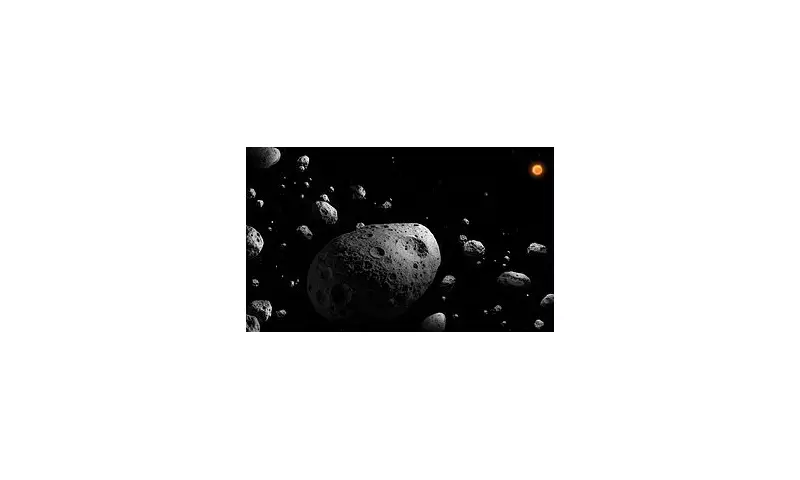
Astronomers have identified a celestial record-breaker hurtling through the depths of our solar system. Nestled within the main asteroid belt between Mars and Jupiter, a newly discovered asteroid is spinning at a rate never before seen for an object of its size.
A Celestial Whirlwind Defying Expectations
The asteroid, designated 2025 MN45, measures a colossal 710 metres in diameter – roughly equivalent to seven football pitches. Its most astonishing feature, however, is its rotational speed. This space rock completes a full spin on its axis every 1.88 minutes, making it the fastest-rotating asteroid over 500 metres ever found.
This extreme velocity has presented a puzzle for scientists. "Clearly, this asteroid must be made of material that has very high strength in order to keep it in one piece as it spins so rapidly," explained Dr. Sarah Greenstreet, who leads a working group at the Rubin Observatory's Solar System Science Collaboration. The team calculates it would need a cohesive strength similar to solid rock.

This composition is surprising, as the prevailing theory suggests most asteroids are "rubble piles" – loose aggregations of rock and debris held together by gravity. The integrity of 2025 MN45 under such centrifugal force strongly indicates a monolithic, solid structure.
A Landmark Discovery from a New Era of Observation
The sighting of this extraordinary asteroid was part of a much broader haul. Using the Rubin Observatory's LSST Camera – the world's largest digital camera – during seven nights in April and May last year, researchers detected 1,900 previously unknown asteroids. Among these were 19 classified as super or ultra-fast rotators, with 2025 MN45 claiming the top spot.
"Discoveries like this exceptionally fast-rotating asteroid are a direct result of the observatory's unique capability to provide high-resolution, time-domain astronomical data, pushing the boundaries of what was previously observable," said Regina Rameika of the US Department of Energy.
The spin rate of an asteroid is a critical clue to its history and makeup. A rapid rotation could indicate it was sped up by a past collision, suggesting it might be a fragment of a larger, original body. Furthermore, to avoid fragmentation, an asteroid spinning faster than the 2.2-hour limit for rubble piles must possess significant internal strength.
Understanding the Threat and Expanding Our Knowledge
While 2025 MN45 currently resides safely hundreds of millions of kilometres away in the main belt, the study underscores a broader dynamic. "Sometimes, asteroids and comets are nudged into Earth’s neighbourhood by the gravity of nearby planets," notes NASA. However, the space agency stresses it is highly unlikely a large, damaging asteroid will impact Earth within the next century.
This research, published in The Astrophysical Journal Letters, fundamentally advances our understanding of the solar system's building blocks. By analysing these spin rates, scientists can infer conditions from billions of years ago and trace the evolutionary paths of these ancient rocks. The discovery of 2025 MN45, a solid rock spinning against the odds, challenges assumptions and highlights the diverse nature of objects lurking in our cosmic backyard.