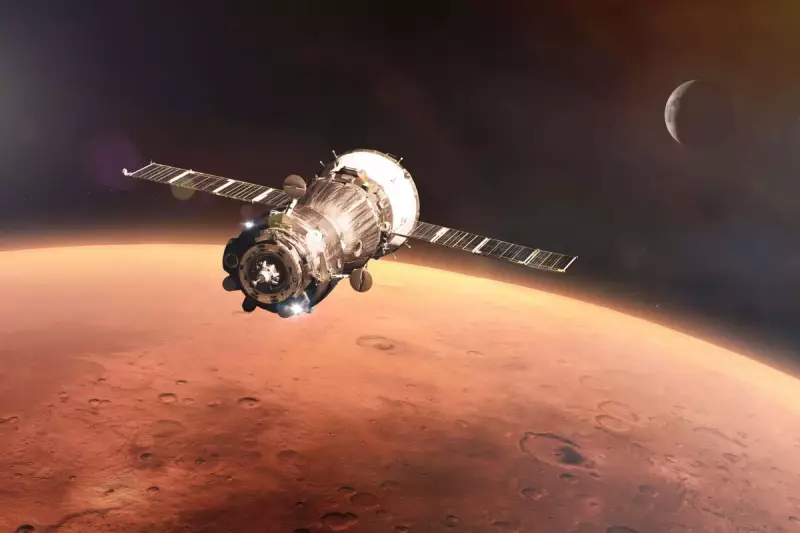
Mars's Gravitational Influence on Earth's Climate Uncovered in New Study
In a groundbreaking discovery, researchers have revealed that Mars, despite its smaller size and considerable distance from Earth, plays a significant role in shaping our planet's long-term climate patterns, including the conditions that initiate and conclude ice ages.
Professor Stephen Kane's Research Project
Professor Stephen Kane from the University of California spearheaded a research project aimed at investigating the gravitational influence of Mars on Earth's climate. Initially, the assumption was that this influence would be minimal, given the vast separation between the two planets.
Instead of relying on traditional methods such as analysing deep-sea sediment layers, Kane's team conducted extensive computer simulations. These simulations modelled the solar system's behaviour over long periods, focusing on variations in Earth's orbit and tilt.

Key Findings on Milankovitch Cycles
The simulations demonstrated that Mars's gravitational pull is crucial in shaping Earth's Milankovitch cycles. These cycles are fundamental to understanding the onset and conclusion of ice ages, as they describe periodic changes in Earth's orbit and axial tilt that affect climate.
Specifically, the computer models identified Mars's influence on shorter climate cycles. These include cycles lasting approximately 100,000 years and 2.3 million years, which impact the fluctuating ice levels within major ice ages.
This research challenges previous notions about the minimal impact of Mars on Earth, highlighting the interconnectedness of celestial bodies in our solar system and their role in long-term climate dynamics.