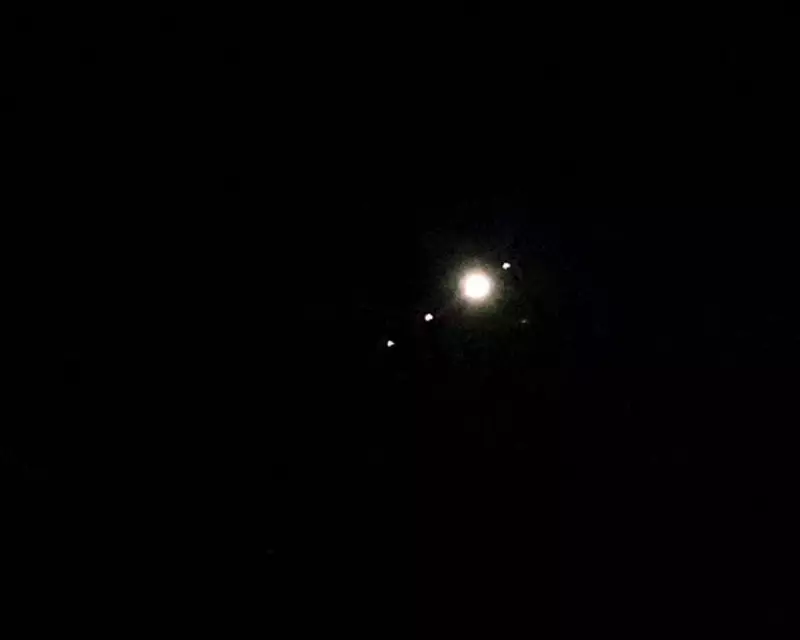
As the brilliant spectacle of January's Wolf Moon begins to fade, a new celestial highlight takes centre stage in the eastern evening sky. Stargazers across the UK are in for a treat as the planet Jupiter reaches its most dazzling appearance of the year.
A Planetary King in Opposition
This evening, Jupiter, named for the Roman king of the gods, will be at its biggest and brightest from our vantage point on Earth. This peak visibility occurs because the planet has reached a point in its orbit called opposition. This means Earth is positioned directly between Jupiter and the Sun, allowing the giant planet to be fully illuminated and visible all night long.
Rising in the east after sunset, Jupiter will outshine every star in the heavens, with the sole exception of the brilliant Sirius. For anyone who has ever considered taking up stargazing, astronomers agree that tonight presents the perfect opportunity to begin.

The Colossal Scale of a Gas Giant
Jupiter is a world of almost incomprehensible scale and ferocity. It is a true titan, with a volume equal to 1,300 Earths. Its atmosphere is a swirling, turbulent layer about 1,000 kilometres thick, beneath which lies a vast, 20,000-kilometre-deep sea of liquid metallic hydrogen.
The planet spins at a breathtaking speed, completing a full rotation in under ten hours. This rapid motion fuels immense atmospheric storms, with winds screaming at nearly 1,450 kilometres per hour. These forces create the planet's distinctive coloured bands and colossal, long-lived storms, most famously the Great Red Spot. This hurricane-like storm is so vast that three Earths could fit side-by-side within it, and it can be glimpsed with a good pair of binoculars.
Moons, Myths, and a Celestial Dance
Those same binoculars will also reveal Jupiter's four largest moons, first observed by Galileo Galilei in 1610. Known as the Galilean moons, they are named Io, Europa, Ganymede, and Callisto after figures from Greek mythology associated with Zeus.
Each is a fascinating world in its own right. Io, roughly the size of our Moon, is considered the most volcanically active body in the entire solar system, its surface constantly remodelled by erupting lava. As you observe, the backdrop to Jupiter includes the twin stars Castor and Pollux, the leading lights of the Gemini constellation.
This winter spectacle is a powerful reminder of the unseen forces that govern our universe. From the silent gravitational tug between the Earth and the waning Wolf Moon—which drives our ocean tides—to the far-flung orbital dance of planets and stars, every motion is connected. On a clear, crisp January night, there is no finer free show than the one unfolding overhead.
Under the Changing Skies: The Best of the Guardian’s Country Diary, 2018-2024 is published by Guardian Faber.