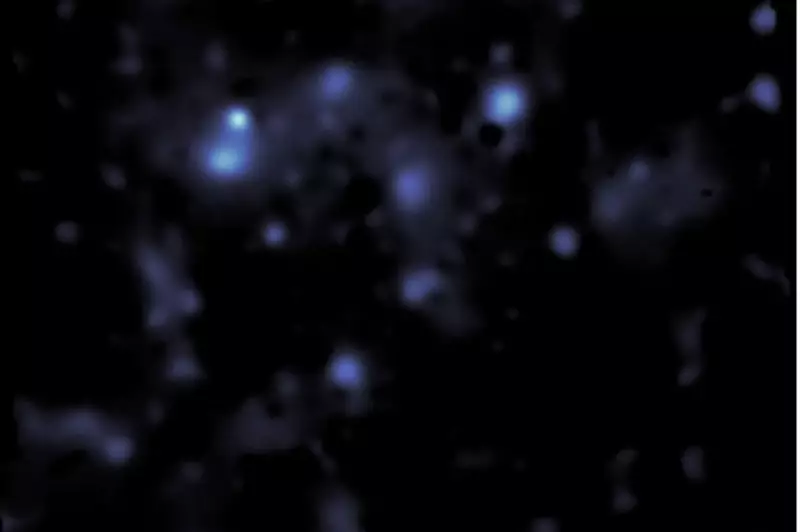
Astronomers have achieved a groundbreaking milestone in cosmic exploration by creating the most detailed map of dark matter ever produced. This remarkable achievement, made possible by data from NASA's James Webb Space Telescope, offers unprecedented insights into the invisible substance that shapes our universe.
Unveiling the Universe's Invisible Architecture
The new map represents a significant leap forward in our understanding of dark matter's role in cosmic evolution. Researchers from the COSMOS-Webb collaboration, including scientists from the University of Durham, have meticulously analysed data collected during 255 hours of observations targeting 800,000 galaxies.
This extensive survey covers a region of sky approximately 2.5 times larger than the full Moon, providing an exceptionally comprehensive view of dark matter distribution. The resulting map offers resolution twice as sharp as any previous dark matter mapping efforts from other observatories.

The Crucial Role of Dark Matter
Dark matter constitutes approximately 85% of the universe's total matter, yet remains invisible to conventional detection methods because light does not interact with it. Despite its elusive nature, dark matter's gravitational influence is fundamental to cosmic structure formation.
"By revealing dark matter with unprecedented precision, our map shows how an invisible component of the Universe has structured visible matter to the point of enabling the emergence of galaxies, stars, and ultimately life itself," explained Dr Gavin Leroy from the University of Durham, who co-led the research.
The findings confirm existing theories about dark matter's role while suggesting new relationships between dark matter and normal matter. According to current understanding, both dark and normal matter were thinly distributed after the Big Bang before dark matter began clumping together, gravitationally attracting normal matter to form stars and galaxies.
Observational Breakthrough
The James Webb Space Telescope's exceptional capabilities have enabled this observational breakthrough. By studying how dark matter's gravity distorts light from distant galaxies through gravitational lensing, astronomers can map its distribution despite its invisibility.
"This is the largest dark matter map we've made with Webb, and it's twice as sharp as any dark matter map made by other observatories," stated Diana Scognamiglio from NASA. "Previously, we were looking at a blurry picture of dark matter. Now we're seeing the invisible scaffolding of the Universe in stunning detail, thanks to Webb's incredible resolution."
Implications for Cosmic Understanding
The detailed mapping reveals how dark matter acts as the universe's fundamental architectural framework. Professor Richard Massey, also from Durham University, emphasised dark matter's pervasive presence: "Wherever you find normal matter in the Universe today, you also find dark matter. Billions of dark matter particles pass through your body every second."
He further explained dark matter's gravitational significance: "The whole swirling cloud of dark matter around the Milky Way has enough gravity to hold our entire galaxy together. Without dark matter, the Milky Way would spin itself apart."
The research, published in the journal Nature Astronomy under the title 'An ultra-high-resolution map of (dark) matter', represents a major advancement in astrophysics. Scientists hope this detailed mapping will help resolve fundamental questions about dark matter's nature and its relationship with normal matter, potentially leading to new discoveries about cosmic evolution and the conditions that enabled life to emerge.