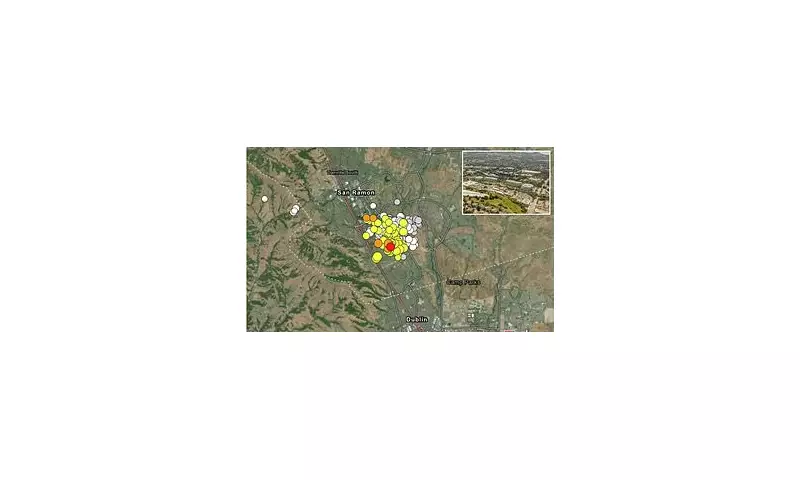
A relentless series of more than 300 minor earthquakes has shaken the San Ramon area in California's East Bay over the past month, sparking significant concern among residents about the potential for a major seismic event.
A Persistent Seismic Swarm
The tremors began on November 9 with a magnitude 3.8 quake and have continued unabated, with the most recent registering a magnitude 2.7. The epicentre of this intense activity is the town of San Ramon, which sits directly atop the Calaveras Fault. This fault is an active branch of the larger San Andreas Fault system and is itself capable of generating a powerful magnitude 6.7 earthquake.
Sarah Minson, a research geophysicist with the US Geological Survey (USGS), acknowledged the strain on locals, stating, 'This is a lot of shaking for the people in the San Ramon area to deal with. It's quite understandable that this can be incredibly scary and emotionally impactful.'

Expert Analysis and Reassurance
Despite the alarming frequency, scientists are quick to offer reassurance. Both Minson and fellow USGS geophysicist Annemarie Baltay emphasise that these swarms do not signal an imminent major earthquake. 'Given the magnitude and locations of the earthquakes that have happened so far, there is no significant risk of something happening on one of the major faults,' Minson explained.
The leading theory points to the movement of underground fluids. As water or gas forces its way through tiny cracks in the bedrock, it can weaken the rock and trigger clusters of small quakes. 'We think that what's going on... is that there are a lot of fluids migrating through the rocks and opening up little cracks to make a bunch of little earthquakes,' Minson told SFGATE.
This phenomenon is not unprecedented for the region. The USGS has records of similar seismic swarms in 1970, 1976, 2002, 2003, 2015 and 2018, none of which led to a catastrophic event.
The Long-Term 'Big One' Risk
While the current swarm is not a precursor, the underlying threat remains stark. The USGS estimates a 72 percent chance of a magnitude 6.7 or larger earthquake striking the broader San Francisco Bay Area by the year 2043. A quake of that size on the Calaveras Fault would be a major disaster, impacting millions.
For context, the devastating 1989 Loma Prieta earthquake was a magnitude 6.9. The 6.7 threshold is used by scientists when discussing the long-term probability of the region's feared 'Big One'.
The complexity of the fault system under San Ramon, where the Calaveras Fault ends and movement may transfer to others like the Concord-Green Valley Fault, contributes to these swarm events. Research into the 2015 swarm revealed the area is crisscrossed by many small, interacting faults rather than dominated by a single large one.
The ultimate message from seismologists is one of vigilance, not panic. As Annemarie Baltay advised, 'We live in earthquake country, so we should always be prepared for a large event.' The recent tremors serve as a potent reminder of the dynamic and unpredictable geology beneath one of America's most populous regions.