The Met Office has issued a series of severe weather warnings as Storm Chandra prepares to batter the United Kingdom with a potent mix of strong winds, heavy rain and disruptive snow. The newly named storm is forecast to bring widespread chaos from Tuesday, prompting amber alerts for specific regions and less severe yellow warnings across much of the country.
Amber and Yellow Warnings in Force
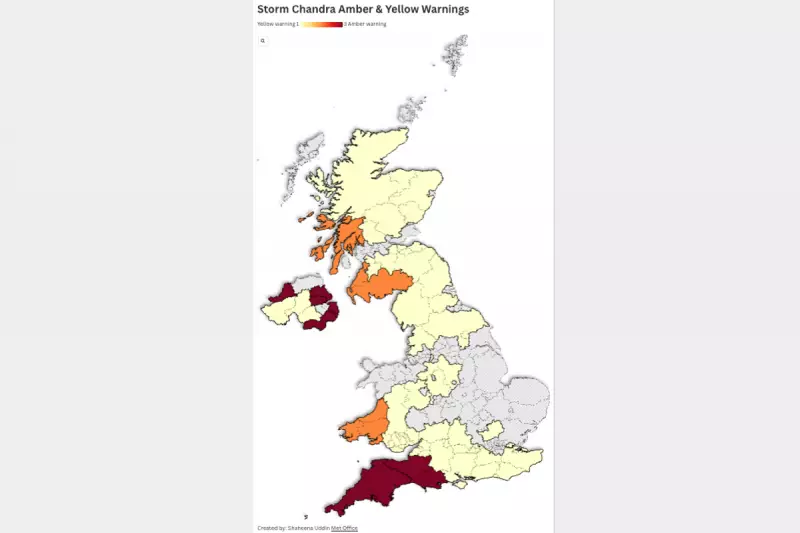
Several weather warnings have been activated by the Met Office, including significant amber warnings. These are in place for south-west England due to expected heavy rainfall and for the eastern coast of Northern Ireland because of very strong winds. These amber alerts indicate a heightened risk of damage to buildings, with potential for tiles to be blown from roofs and flying debris that could cause life-threatening injuries.
Additionally, less severe yellow weather warnings cover all of Northern Ireland, a more extensive area of south-west England, and parts of northern England and Scotland. These warnings highlight the broader impact of Storm Chandra, with risks including travel disruption and hazardous conditions.

Regions Most Affected
The worst affected regions under amber alert include parts of Northern Ireland, specifically Derry, Down and Antrim, as well as south-west England covering Cornwall, Somerset, Devon and Dorset. Residents in these areas are urged to take immediate precautions due to the severe conditions forecast.
Other regions are subject to two yellow warnings for a combination of rain, snow and wind. These areas include Argyll and Bute, South Ayrshire, Dumfries and Galloway in Scotland, along with Ceredigion, Pembrokeshire, Carmarthenshire and Swansea in Wales. The overlapping nature of these warnings underscores the multifaceted threat posed by Storm Chandra.
Detailed Forecast and Hazards
The Met Office has provided specific details on the expected weather patterns. Easterly winds are predicted to increase early on Tuesday morning, bringing gusts of 60-70 mph to eastern and northern parts of Northern Ireland, with a few coastal locations potentially experiencing gusts up to 75 mph. Heavy rain will accompany these winds, adding to the hazards.
"Winds may ease a little early in the afternoon, before increasing to similar speeds once more from a south-easterly direction late afternoon and early evening," stated the Met Office. This pattern suggests a prolonged period of dangerous conditions, particularly in coastal areas.
Coastal Dangers and Safety Advice
In coastal regions, large waves are expected to throw beach material onto nearby roads, sea fronts and properties, posing a "danger to life". The Met Office advises staying safe during stormy weather by being acutely aware of large waves, noting that even from the shore, large breaking waves can sweep individuals off their feet and out to sea.
Coastal residents are also warned to take extra care if walking near cliffs, ensuring they know their route and keep dogs on a lead. In case of emergency, the public is advised to call 999 and ask for the Coastguard. These precautions are vital given the predicted severity of the storm.
Travel Disruption and Public Guidance
Storm Chandra is expected to cause significant travel disruption across the UK. Longer journey times and cancellations are likely to impact road, rail, air and ferry services, with some roads and bridges potentially closing due to the adverse conditions. Driving in these dangerous conditions is strongly discouraged.
Forecasters recommend staying indoors as much as possible to avoid vulnerability to injury from high winds and other storm-related hazards. The public is encouraged to monitor updates from the Met Office and local authorities as the situation develops.
With Storm Chandra set to unleash its fury, the UK braces for a challenging week of weather, highlighting the importance of heeding official warnings and taking necessary safety measures to protect life and property.