The Frosty Morning That Changed American History
On a particularly cold Monday morning in late January 1979, frost covered the ground in San Carlos, a pleasant suburb of San Diego, California. Nine-year-old Monica Selvig arrived at Cleveland Elementary School, unaware that she was about to become part of a tragic national first. Suddenly, without warning, Monica felt a sharp pain in her left side and was thrown to the ground. She had been struck by a bullet. Moments later, another bullet hit eight-year-old Mary Clark in her stomach as she walked up the school path, passing straight through her body and bloodying her white top.
Chaos and Confusion on the School Grounds
Incredibly shy, Mary did not want to cause a fuss, so she made her way into school and was eventually herded to safety with other students. At the same time, eight-year-old Greg Verner was about to climb the steps to his classroom when a bullet pierced his green Toughskins jeans and struck his pelvic bone. The small popping sounds in the air were not immediately recognizable as gunfire, and with the source of danger unclear, some children instinctively ran for cover behind parked cars or ducked into the office. Others remained stranded in the open, waiting for instructions.
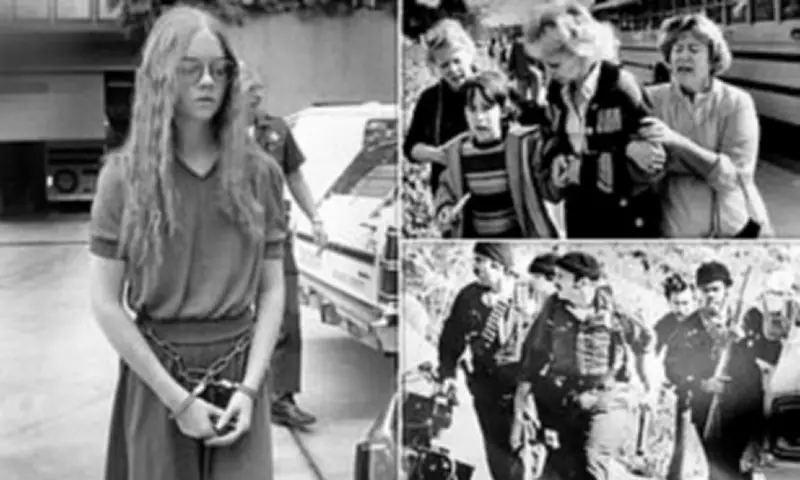
Ricocheting bullets echoed through the covered walkway that ran through the middle of the school, but these shots could not be heard by those still waiting at the gates to enter. Cleveland Elementary School was, in January 1979, the site of the first murderous school shoot-up in US history, perpetrated by a 16-year-old girl named Brenda Spencer.

A Rapid Escalation of Violence
In fewer than three minutes, five children had been shot. Meanwhile, more pupils continued to arrive, completely unaware of the threat. Ten-year-old Crystal Hardy had just been dropped off by her mother when she heard shots, initially thinking they were firecrackers. As she looked around curiously, she was struck through her right wrist, falling to her knees with blood pouring from her arm.
Seven-year-old Audrey Stites was walking up the school driveway with her older sister Madeline when she snatched at her right arm after being struck. They both stopped and saw Monica and Greg on the ground. Audrey had been hit from behind through her bright puffy green ski jacket and into her right elbow. She ran crying and bleeding to her classroom, not noticing that a second bullet had burned the inside of each thigh. Madeline avoided injury only because bullets passed through her coat pocket and were stopped by her binder and pencil case.
The Heroic Response and Tragic Losses
It was still unclear where the shots were coming from, but it was apparent they were not from within the school grounds. The shooter was outside, targeting pupils as they walked in. Principal Burton Wragg, in his first year at Cleveland, was having coffee with teacher Daryl Barnes in the office when they saw Monica and Greg on the ground and heard bullets hitting the ivy outside the window. Realizing a sniper was firing on the school, Wragg dashed outside, making a beeline for the first child on the ground.
The pair ran directly into the view of the shooter. 'Duck, you guys! Crystal, run!' were Wragg's last words as he was shot twice in the chest, falling into an ivy patch. Barnes, coming up behind him, could see the principal was dead. With more shots ringing around him, Barnes continued down the drive, picking up wounded pupils Monica and Greg before turning his back on the shooter and carrying them to safety.
School janitor Mike Suchar, affectionately known as Mr Mike, saw what was happening and darted out to help wounded children lying on the ground. A sturdy US Navy veteran who served in World War Two and Korea, he was a popular figure seen as a protector. As Mike was lowering a blanket over Wragg's body, he was knocked to the ground by two bullets, crying out, 'My God, I've been hit!' as he fell into shrubbery.
The Shooter Revealed
School secretary Mary Smith, whose desk faced the school's front window, had seen the carnage unfolding and was already calling 911. She could also see where the shots were coming from – a house directly across the road from the school. Meanwhile, at the offices of the San Diego Evening Tribune, rookie reporter Steve Wiegand was told to start calling houses near the school to track down witnesses.

The first number Wiegand called was the house from where the shots were being fired. A young girl answered, identifying herself as Brenda. Wiegand asked if she had heard the shooting or knew anything about it. 'Yes, I saw the whole thing,' she replied. What Wiegand could not know was that this was the sniper, 16-year-old Brenda Spencer, who had paused her shooting to answer the phone.
Brenda told him she started shooting around 8:30am as school started, using a .22-caliber rifle her father had given her for Christmas. 'I just started shooting. That's it. I just did it for the fun of it,' she continued. 'I just don't like Mondays. Do you like Mondays? I did this because it's a way to cheer up the day. Nobody likes Mondays.'
The Aftermath and Cultural Impact
When Wiegand told her she might have shot three or four innocent people, she responded with disappointment, 'Is that all? I saw lots of feathers fly.' She was sure she had hit more. In total, two people were killed – Principal Burton Wragg and janitor Mike Suchar – and nine others were wounded, including seven children and a police officer. The shooting sparked an armed stand-off, with Brenda holed up in her house while a SWAT team assembled outside.
The incident gained further notoriety when, on the morning of the shooting, Bob Geldof and Johnnie Fingers from Irish band The Boomtown Rats were driving in Los Angeles. Hearing news of the shooting on local radio, they hastily penned the song 'I Don't Like Mondays,' which would top the UK charts for four weeks. The song sparked considerable controversy in the US, particularly in San Diego, where many radio stations refused to play it out of respect for the victims.
Brenda Spencer's attack on Cleveland Elementary School marked a tragic first in American history, setting a pattern that would unfortunately be repeated many times in the decades to follow. Her chilling explanation – 'I don't like Mondays' – became etched in cultural memory, a haunting reminder of that frosty January morning when American innocence was shattered by gunfire.