London Bridge Hero's Haunting Memories and Remarkable BBC Portrait Journey
London Bridge Hero's Haunting Memories and BBC Portrait

London Bridge Hero Darryn Frost Reflects on Trauma and BBC Portrait Experience

Seven years after the harrowing London Bridge terror attack, Darryn Frost, famously known as the "narwhal tusk hero," continues to grapple with the haunting memories of that fateful day. In a candid interview, he reveals how the event irrevocably altered his life, leading to a diagnosis of Post-Traumatic Stress Disorder (PTSD) and a journey of recovery that has now intersected with a remarkable BBC television series.

The Day That Changed Everything

In November 2019, Darryn Frost, then a communications manager for the Ministry of Justice, attended a prisoner education event at Fishmongers' Hall near London Bridge. What began as a routine work assignment swiftly descended into chaos when convicted terrorist Usman Khan, armed with two eight-inch kitchen knives taped to his hands and claiming to have a suicide bomb, launched a brutal attack. Khan fatally stabbed Cambridge University graduates Jack Merritt, 25, and Saskia Jones, 23, before turning his violence towards others.

Darryn recalls the moment he realized something was terribly wrong. "Halfway through the day, we heard shouting and screaming," he says. "At first, people thought it was skateboarders or children playing, but the guy next to me said, 'That's not the cry of children playing.' That was my call to action."

Wide Pickt banner — collaborative shopping lists app for Telegram, phone mockup with grocery list

A Desperate Fight for Survival

Upon investigating, Darryn encountered a horrific scene: a bleeding victim on the stairs. His immediate instinct was to find something to protect her. He initially headed for the dining room to grab a ladle and lid but spotted two-metre-long narwhal tusks mounted on the wall. Without hesitation, he seized one and rushed back.

"I opened the door and was presented with two horrific things," Darryn recounts. "First was this guy dressed all in black, wearing protective gloves with two eight-inch kitchen knives taped to his hands. Behind him, on the brilliant white marble floor, was a girl lying motionless, clearly injured. I can still see that to this day."

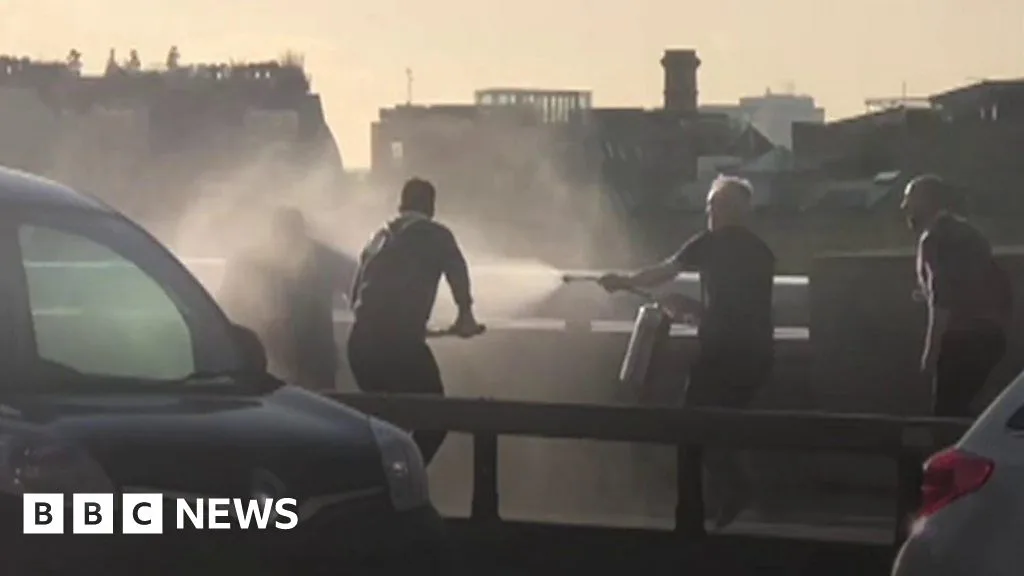
Darryn handed the tusk to former prisoner Steve Gallant, who was attempting to fend off Khan with a chair, then retrieved a second tusk. Together with others, including John Crilly armed with a fire extinguisher, they chased Khan onto London Bridge. In a chaotic confrontation, Darryn managed to stab Khan with the tusk, and the group subdued him until police arrived and shot the attacker.

The Aftermath: PTSD and Personal Struggles

Despite being hailed as a hero by the media, Darryn's ordeal was far from over. In the years following the attack, he suffered from severe nightmares, memory problems, anger issues, and depression. He turned to alcohol to cope and eventually retired from his job due to ill health. After receiving counselling, he was diagnosed with PTSD.

"I had survivor's guilt," Darryn admits. "When I heard Jack and Saskia's stories, I thought, 'They sounded incredible. Why do I get to survive, when they don't?'" The attack also strained his relationship, as his girlfriend became his carer, helping him through periods of confusion and fear, including an aversion to knives.

Finding Purpose Through Charity and Art

Determined to focus on the positive, Darryn co-founded the charity Own Merit in 2021 with Steve Gallant. The organization provides housing and support for recently released prisoners, helping them reintegrate into society. "If it hadn't happened, I don't think I would have been brave enough to do what I'm doing now," he says, referencing the concept of post-traumatic growth.

This resilience led Darryn to participate in the BBC series Extraordinary Portraits with Bill Bailey, where he was paired with sculptor Nick Elphick. Initially sceptical about being portrayed as a hero, Darryn appreciated Elphick's approach to capturing his humanity and trauma. "Nick really got into my psyche," Darryn notes. "He listened to me, so the statue portrays my mood and how I was feeling in those dark days."

Pickt after-article banner — collaborative shopping lists app with family illustration

A Sculpture That Tells a Deeper Story

Nick Elphick, known for creating a bronze bust of the Queen, spent three months crafting Darryn's statue using marble powder, polythene resins, and glass fibre. The artwork aims to depict Darryn's strength and the weight of his experiences, rather than glorifying his actions. "I made him look strong, but I wanted to portray the weight on his shoulders," Elphick explains.

The finished sculpture, part of the new series of Extraordinary Portraits, will be displayed at Bradford's Loading Bay gallery. Darryn, who was awarded the Queen's Gallantry Medal, reflects, "It's not a happy sculpture, but I'm actually glad about that. Because although people celebrate my actions, I do not celebrate what happened on that day. It is the day that ended two amazing lives."

Through his ongoing journey, Darryn Frost continues to honour the memories of Jack Merritt and Saskia Jones while advocating for mental health awareness and prisoner rehabilitation, proving that even in the darkest moments, hope and growth can emerge.