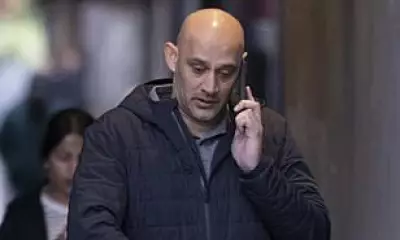
In a disturbing incident that lays bare the fracturing state of American civic life, renowned British columnist Peter Hitchens found himself an accidental witness to a violent street shooting. The event, which he captured on video, has prompted a stark and urgent warning about the pervasive culture of violence and the role of the state.
A Terrifying Encounter on a Washington Street
The confrontation unfolded on a public street in Washington D.C. on a Tuesday afternoon. Peter Hitchens, who was in the city, observed a man and a woman engaged in a heated argument. The situation escalated rapidly when the man, identified as Renee Good, produced a handgun and fired a shot.
Remarkably, the bullet did not strike the woman he was arguing with. Instead, it hit an entirely innocent bystander—a man who happened to be walking past the scene. This random victim was shot in the leg, a shocking illustration of how public violence indiscriminately endangers all citizens.

Hitchens, acting with notable presence of mind, recorded the immediate aftermath on his mobile phone. His footage shows the chaotic and distressing moments following the gunshot, providing raw evidence of the incident's brutality.
The Aftermath and a Broader Warning
Following the shooting, Renee Good was arrested and now faces serious criminal charges. The specific charges include assault with a dangerous weapon. This legal response, however, forms just one part of the story Hitchens is driven to tell.
For Hitchens, this random act of violence is not an isolated event but a symptom of a much deeper and more worrying societal sickness. He draws a direct and provocative line between the brazen lawlessness displayed on the street and the actions of governments themselves.
"The most worrying violence is the violence of the state," Hitchens argues. He contends that when citizens see powerful institutions and governments employing force, coercion, and intimidation to achieve their goals, it legitimises and encourages violence at every level of society. The message becomes that might makes right, a principle that then plays out on street corners and in personal disputes.
What Does This Mean for Society?
The incident forces a uncomfortable reflection on the nature of modern conflict and safety. Hitchens's experience underscores several critical points:
- The erosion of public safety: The fact that a lethal argument can erupt in broad daylight, endangering passers-by, points to a breakdown in communal security and respect for the law.
- The normalisation of violence: When violence is routinely used as a tool by authorities, it risks becoming a standard method for resolving disagreements among the populace.
- The role of the citizen witness: Hitchens's decision to film the event highlights how ordinary people are now often the first documentarians of crime, a heavy burden in traumatic situations.
This episode in Washington D.C. serves as a powerful, real-world case study. It moves the debate from abstract policy discussions to the very concrete reality of a bullet striking an uninvolved man on an ordinary afternoon. Peter Hitchens's warning is clear: a society that tolerates or promotes violence at the top cannot be surprised when it flourishes at the bottom. The distress caused by such street-level brutality is both a tragedy in itself and a stark indicator of a wider cultural and political failure.