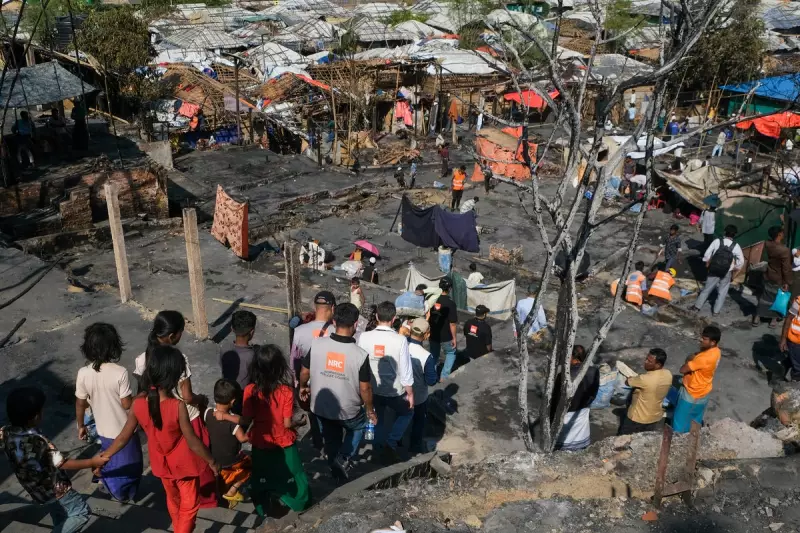
Devastating Blaze Ravages Rohingya Refugee Settlement in Bangladesh
A catastrophic fire has torn through a Rohingya refugee camp in Cox's Bazar, Bangladesh, this week, reducing hundreds of makeshift homes to ashes and forcing more than 2,000 people to flee. The inferno, which erupted in the early hours of Tuesday morning within Camp 16, represents yet another severe blow to a community already enduring profound hardship.
Immediate Impact and Humanitarian Response
The blaze, which took firefighters approximately three hours to contain, completely destroyed 335 shelters and caused significant damage to a further 72 structures. While thankfully there were no reported fatalities and only minor injuries, the destruction has been extensive. Vital camp infrastructure, including water and sanitation points, eleven learning centres, and numerous pathways, has been severely compromised.
In the aftermath, relief agencies including the International Organization for Migration (IOM) and the Norwegian Refugee Council have mobilised emergency aid efforts. These initiatives are focused on providing displaced families with essential items such as blankets, mosquito nets, cooking supplies, hygiene kits, and solar lighting to address their most pressing needs.

A Community Living in Constant Peril
The fire underscores the extreme vulnerability of the Rohingya population living in the world's largest refugee settlement. Camp 16 is one of over thirty camps in the Cox's Bazar district, which collectively house more than one million Rohingya who have fled persecution in neighbouring Myanmar.
Lance Bonneau, IOM Chief of Mission in Bangladesh, emphasised the profound consequences of such disasters, stating, "When fires strike in overcrowded camp settings, the impact extends far beyond damaged infrastructure. Families lose shelter, essential belongings, and access to basic services, increasing immediate protection risks."
The Norwegian Refugee Council reported that many affected individuals have lost all their possessions, including crucial identity documents and other important papers, compounding their displacement with a loss of personal records.
Chronic Fire Risks and Funding Shortfalls
This incident highlights a persistent and deadly threat within the camps. The shelters, typically constructed from bamboo and covered with tarpaulin or plastic, are densely packed together and highly flammable. Originally intended as temporary structures lasting six to twelve months, they have become long-term homes for a population with nowhere else to go.
According to one report cited by aid organisations, between May 2018 and December 2025, there have been a staggering 2,425 fires across the Cox's Bazar camps. These blazes have affected over 100,000 people, damaged more than 20,000 shelters, and resulted in significant loss of life.
A critical factor exacerbating this risk is a severe global shortfall in humanitarian funding. The Norwegian Refugee Council revealed that plans to construct 50,000 safer, semi-permanent shelters had to be shelved following international aid cuts announced in January 2025. These cuts were part of broader reductions, including a decision by former U.S. President Donald Trump to slash more than 90% of USAID's foreign aid contracts and $60 billion in overall global assistance, coupled with similar cuts from several European nations.
The funding crisis is acute. In 2025, only about half of the necessary funds for the Rohingya response were received, creating a deficit of $466.6 million. Aid agencies are now issuing urgent appeals. "Funding now needs to be urgently stepped up so we can resume construction of the 50,000 approved semi-permanent shelters," stated the Norwegian Refugee Council, which has already begun constructing new temporary homes after this latest fire. "Without immediate action, fires like this one in Camp 16 in Cox's Bazar, will continue to threaten lives and force families to rebuild from nothing again and again."

Broader Context of Displacement and Conflict
The tragedy occurs against the backdrop of the Rohingya's ongoing plight. More than 700,000 Rohingya fled to Bangladesh in 2017 following a brutal military crackdown in Myanmar's Rakhine State. The scale and ferocity of that operation led to accusations of ethnic cleansing and genocide from the international community, including the United Nations. A case is currently being heard at the International Court of Justice in The Hague, accusing Myanmar of violating the Genocide Convention.
Ongoing conflict in Rakhine between government forces and groups opposing the military leadership has since driven tens of thousands more Rohingya across the border into Bangladesh, further straining resources in the already overcrowded camps.
Beyond shelter, the Norwegian Refugee Council has identified other critical needs for the fire's victims, including emergency food assistance, warm clothing, the restoration of water and sanitation services, and basic household items. The international community now faces a critical test of its commitment to protecting one of the world's most vulnerable refugee populations.