Zelensky's Scathing Davos Address Shakes European Complacency
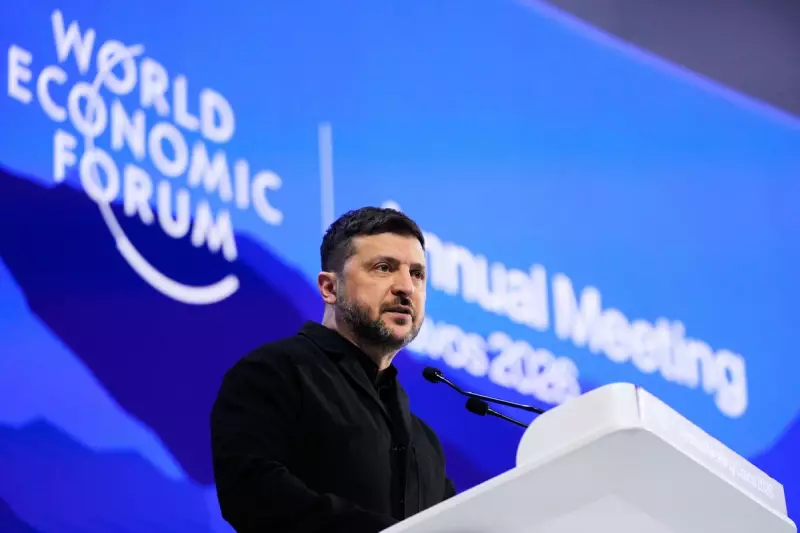
Ukrainian President Volodymyr Zelensky has delivered a seismic wake-up call to European leaders, employing vivid language and stark home truths to challenge the continent's perceived weakness on the global stage. In an emotionally charged speech at the World Economic Forum in Davos, the wartime leader painted a picture of a Europe failing to live up to its potential while his nation fights for survival.
'A Salad of Small Powers': Zelensky's Stinging Metaphor
"We should not accept that Europe is just a salad of small and middle powers, seasoned with enemies of Europe," President Zelensky declared to a hushed audience of global leaders, business titans, and European bureaucrats. His choice of metaphor - reducing the continent to a fragmented mixture - landed with particular force, highlighting what he sees as a failure of collective ambition and unity.
The Ukrainian president's rhetoric was unsparing as he marked nearly five years since Russia's full-scale invasion began, and twelve years since Ukraine first began defending itself against Russian aggression. "We are living in Groundhog Day," he observed, suggesting a frustrating cycle of European promises without decisive action.

Contrasting Global Responses: Venezuela vs. Ukraine
Zelensky drew pointed comparisons between different international crises to underscore his argument about inconsistent Western responses. He highlighted how former US President Donald Trump had authorised an operation in Venezuela that led to Nicolás Maduro's arrest and trial in New York.
"Sorry, but Putin is not on trial. And this is the fourth year of the biggest war in Europe since World War II," Zelensky noted, creating a stark juxtaposition between swift action in one theatre and prolonged conflict in another. This comparison served to question the international community's priorities and commitment to confronting aggression.
The 'Spineless Europe' Critique
Beyond the vivid metaphors, Zelensky's address contained a systematic critique of European political culture. He suggested that "some European leaders are from Europe, but not always for Europe," implying that national interests frequently trump continental solidarity.
The Ukrainian leader argued that Europe remains "more like geography, history, a tradition, not a real political force, not a great power." He particularly criticised what he characterised as a tendency for European leaders to call for strength while hoping "someone else will do it for them," especially when facing difficult decisions that might extend beyond electoral cycles.
A Shifting Narrative on Ukraine's War Prospects
Zelensky's powerful address came amid what observers noted as a marked shift in expert understanding of the conflict. Military analysts and Davos delegates increasingly challenged the narrative that Ukraine cannot win, with figures including Canada's Prime Minister Mark Carney and Finland's President Alexander Stubb joining calls for greater European support.
Keith Kellogg, until recently Trump's special envoy to Kyiv, was among those arguing that Russia cannot ultimately prevail. This emerging consensus provided crucial context for Zelensky's appeal, framing it not as a desperate plea but as a strategic call to secure a winning position.
The Vision: Europe as a Genuine Global Power
At its core, Zelensky's speech presented a vision for what Europe could become. He urged the continent to recognise that, alongside the UK and Canada, it could form a powerful bloc in its own right, particularly as America's focus appears to shift elsewhere under the Trump administration.
"Instead of becoming a truly global power, Europe remains a beautiful but fragmented kaleidoscope," he lamented, suggesting the continent was missing its historic opportunity to lead in defending freedom worldwide. His message carried particular weight coming from a leader whose soldiers continue to defend European territory while enduring freezing temperatures at home.

Zelensky's Davos intervention represented more than just another diplomatic speech. It was the impassioned appeal of an underdog shaking Europe by the scruff of its neck, demanding it awaken to both its responsibilities and its potential. With an eye on Ukraine's future place within European structures, the address served as both a rebuke and a roadmap for a continent at a geopolitical crossroads.