David Harding: Sculptor and Educator Who Redefined Public Art
The sculptor and educator David Harding, who has died at the age of 88, was a pioneering figure who insisted that art should stand in the same weather as everyone else. His profound belief that public space could carry memory, poetry, and dissent shaped both his creative practice and his influential teaching career.
Glenrothes: The Town as Studio
Appointed as town artist for Glenrothes, Fife, in 1968 through an advertisement in the Scotsman newspaper, Harding embedded sculpture directly within the fabric of the new town. At a time when new towns faced criticism for anonymity, he worked from within the planning process, using the same concrete and brick as the surrounding streets to create works in underpasses, bus stops, and housing schemes.
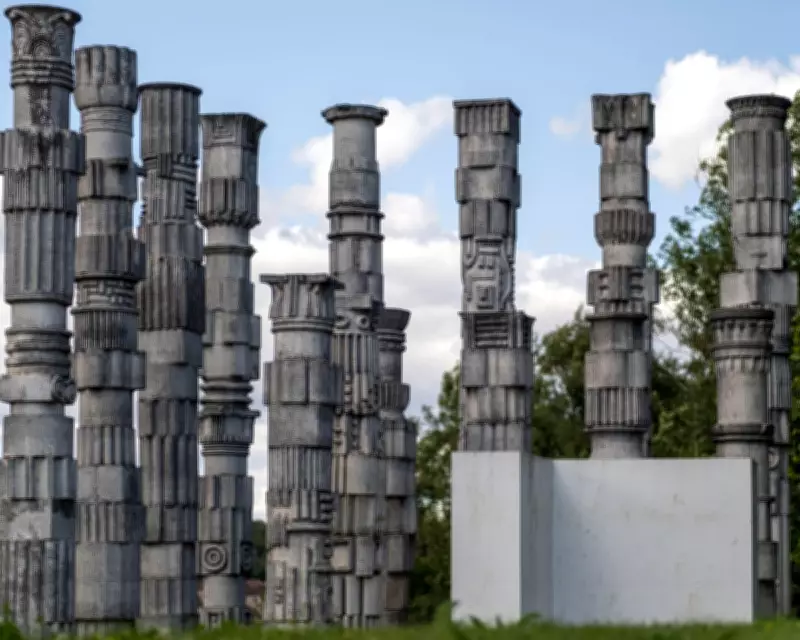
His approach transformed public space into artistic argument rather than mere ornament. Notable works included Henge, a spiral of cast concrete slabs that appeared to rise naturally from the ground, and Industry, a mural in an underpass that translated West African patterns into relief surfaces capturing Scottish light. The sombre Dugs Cemetery in Pitteuchar and ten poetry slabs set into bus stops and phone boxes further demonstrated his conviction that language and sculpture could interrupt routine journeys.

Harding treated the entire town as both studio and source material, binding his interventions inseparably to their sites. Henge and Industry have since become listed structures, testament to the durability of work conceived for everyday passage rather than ceremonial display.
Educational Legacy at Glasgow School of Art
Harding carried these revolutionary ideas into his leadership of the environmental art department at the Glasgow School of Art from the mid-1980s. There, he encouraged students to move beyond the studio, engaging institutions, communities, and landscapes as collaborators rather than mere backdrops.
The department's guiding principle – "context is half the work" – embodied Harding's belief that meaning arises as much from circumstance as from the object itself. This mantra drew inspiration from the Artist Placement Group initiated by Barbara Steveni and John Latham in 1966.
Under Harding's guidance, the course produced numerous Turner prize-winning and nominated artists including Douglas Gordon, Christine Borland, Jim Lambie, Nathan Coley, Lucy Skaer, Martin Boyce, and David Shrigley. Equally important to Harding were those graduates who entered fields of community and social engagement, working beyond traditional gallery and museum walls.
Formative Years and International Influence
Born in Leith in 1937 to Alfred Harding, a ship's plumber, and Kathleen (née Murray), Harding attended Holy Cross Academy in Edinburgh before studying at Edinburgh College of Art from 1955 to 1959. He concentrated on sculptural uses of glass, concrete, and ceramics – materials then marginal to fine art but central to construction and daily life.
After teacher training at Moray House College of Education, Harding met Frances McKechnie during his first teaching term at Holy Cross in 1961. They married in 1962 and moved to Lafia, Nigeria the following year, where Harding led the art department of a rural teacher-training college until 1967.
This Nigerian experience proved transformative. Harding encouraged students to develop artistic language drawing on Nigerian culture rather than western principles, and built a pottery workshop under potter Michael Cardew's guidance. His encounter with West African architectural traditions, communal labour, and pattern-making broadened his understanding of how art could be embedded in lived structures.
Later Career and Collaborations
After returning to Scotland aged 30, Harding left school teaching to pursue sculpture independently. The Glenrothes appointment provided the civic scale his ideas required. From 1978 to 1985, he lectured in the department of art and social context at Dartington College of Arts in Devon, developing a curriculum placing artistic production within social and political frameworks.

In 1985, he returned to Scotland to establish Glasgow School of Art's environmental art department alongside Sam Ainsley, with support from Brian Kelly. Harding eventually became head of SEA (sculpture and environmental art) until his retirement in 2001, working closely with Sandy Moffat, head of painting and printmaking, and Ainsley to shape what became recognized as a distinctive Glasgow approach: outward-looking, critically alert, and embedded in place.
After retirement, the trio continued collaborating as AHM, exhibiting together and creating new work through residencies. Harding also maintained a significant creative partnership with artist Ross Birrell, producing films including Port Bou: 18 Fragments for Walter Benjamin (2006) and Symphony of Sorrowful Songs (2017), which commissioned the Syrian Expat Philharmonic Orchestra to perform at Documenta 14.
Recognition and Personal Life
Harding was made OBE in 2002, and in 2018 received an honorary doctorate from the University of Glasgow along with Ainsley and Moffat. He and Frances separated in 1989, after which Frances took a teaching post at what was then the School of Oriental and African Studies in London.
David Harding is survived by his children Damien, Ninian, Donald, Martha, Abigail, and Benedict, eleven grandchildren, and one great-grandson. His legacy endures not only in the physical sculptures embedded in Glenrothes and beyond, but in the generations of artists he taught to see context as inseparable from artistic creation.