Dóra Maurer: Hungarian Avant-Garde Artist Who Defied Communism Dies at 88
Dóra Maurer, the Hungarian artist whose avant-garde practice flourished despite decades of communist suppression, has died at the age of 88. Her remarkable career, which encompassed painting, photography, performance, and printmaking, only gained international recognition in her later years, following exhibitions at prestigious institutions like Tate Modern and White Cube.
A Life Shaped by Political Constraints
Maurer's artistic journey was profoundly influenced by Hungary's communist regime, which ruled from 1949 to 1989. In a 2019 interview with the Art Newspaper, she made the surprising assertion that her work actually benefited "from a lack of market." This statement reflects the unique circumstances of her development, as she spent most of her career creating experimental works that were largely unseen in her own country due to political restrictions.
Trained as a graphic artist at the Hungarian Academy of Fine Arts from 1956 to 1961, Maurer navigated an artistic double life common among avant-garde creators under communism. Publicly, she adhered to official expectations, becoming a significant figure in Hungarian art education and working as a graphic designer. Privately, she produced groundbreaking works that pushed creative boundaries.

Groundbreaking Artistic Contributions
Maurer's diverse body of work includes several notable series that demonstrate her innovative approach. In the 1960s and early 1970s, she created experimental prints, such as Traces of a Circle (1974), which involved pulling multiple proofs of the same image to create layered palimpsests. This work referenced her earlier pedotypes, where she walked over canvases with paint-covered feet, blending influences from Yves Klein and Richard Long.
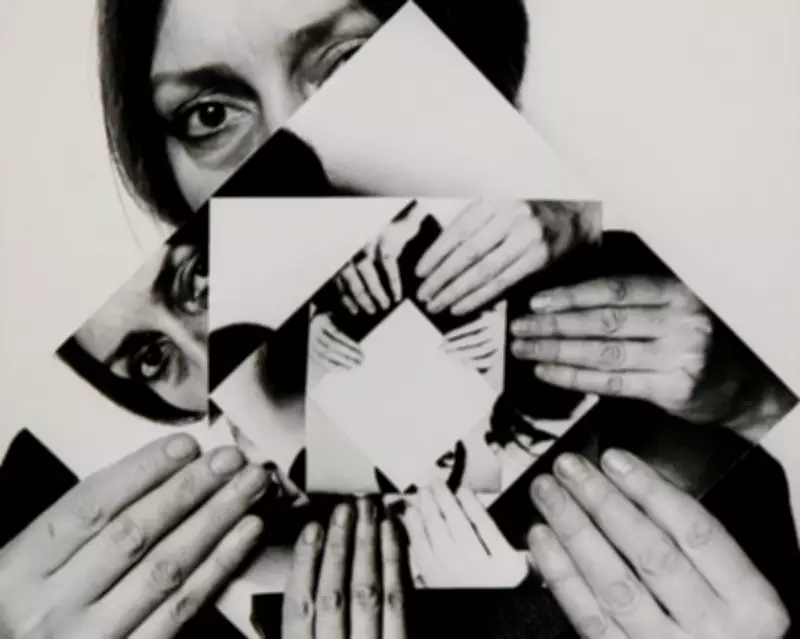
Her photographic work produced what is perhaps her most famous image, Seven Twists (1979). In this surreal collage, Maurer folded and refolded black-and-white photographs of herself, then photographed the result, creating a complex interplay of faces and hands. The Tate Modern holds a version titled Seven Twists V, printed in 2011.
During the 1980s, Maurer transitioned to painting, producing richly saturated, geometric abstract works like Stage II (2016), created with acrylic on PVC panels. These paintings often reflected her connection to Budapest's geography, particularly the Danube River, which she described as "especially important to me." Her geometric forms seemed perpetually in flux, suggesting movement between states.
Overcoming Early Obstacles
Maurer's path to becoming an artist was fraught with challenges from childhood. Born in Budapest in 1937, she never knew her father, an officer in the Hungarian army who died five months before her birth. After the communist takeover, her mother lost her widow's pension due to their bourgeois background, forcing her to work shifts in a bandage factory to support herself and her daughter.
This middle-class stigma nearly prevented Maurer from pursuing art education. When she applied to Budapest's Secondary School of Visual Arts, her application was quietly lost, but her determined mother confronted the school's principal, who eventually granted her a place. Later, despite expecting rejection, Maurer was accepted to the Hungarian Academy of Fine Arts.
Her time at the academy was difficult. "The models we drew were boring," she recalled. "Retired female acrobats. They had hard, muscular bodies, but were not men." She supported her family by doing portraits, and when she exhibited experimental work in her final year, the academy refused to award her a diploma.
International Recognition and Legacy
Maurer's fortunes began to change after 1963, when foreign travel restrictions eased. In 1966, she had her first exhibition in Vienna and returned the following year as a Rockefeller scholar. There, she met fellow Hungarian artist Tibor Gáyor, whom she married in 1968. The couple divided their time between Vienna and Budapest for three decades, participating in an independent scene of artists, poets, and musicians.

After receiving a professorship at the Hungarian Academy of Applied Arts in 1987, Maurer settled in Budapest and finally gained recognition as a major artist. From the 2000s onward, her work achieved international prominence, featuring in group exhibitions at the Centre Pompidou in Paris and MoMA in New York.
Her market value remained modest for years, with one painting selling at Sotheby's for just £8,000 in 2016. However, this changed dramatically with her 2016 exhibition at White Cube in London, coinciding with a year-long showcase at Tate Modern that presented 35 works spanning her half-century career. British critics responded with baffled admiration to this comprehensive presentation of her diverse practice.
Despite her Hungarian identity, Maurer resisted being pigeonholed as a specifically Hungarian artist. In 2012, she told Art Review magazine, "Hungarian art has no special character. It was and is European."
Maurer is survived by her legacy of innovative work that transcended political boundaries. Her husband Tibor died in 2023. Dóra Maurer, born June 11, 1937, died February 14, 2026, leaves behind a body of work that continues to inspire and challenge audiences worldwide.