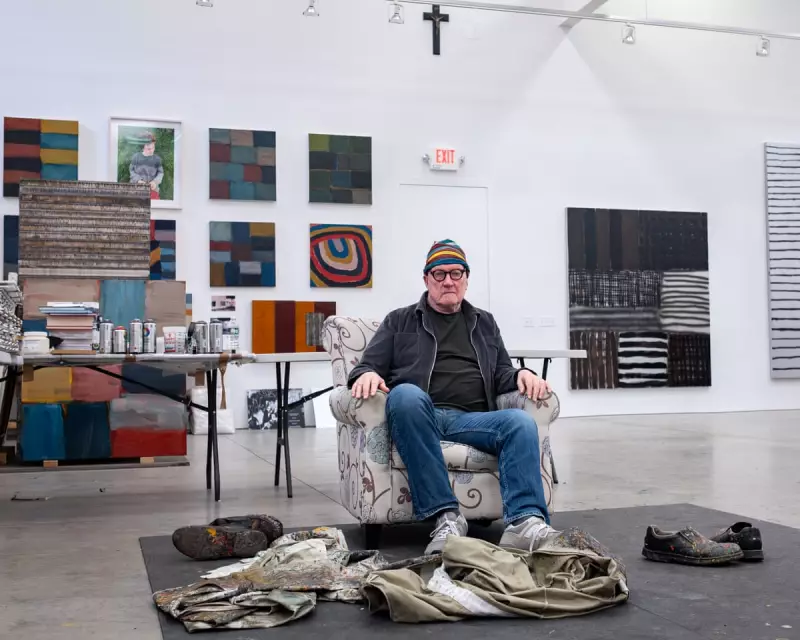
For Sean Scully, widely regarded as the greatest abstract painter alive, art is a form of music without words. Now 80, the Irish-born, US-based artist is presenting a deeply personal symphony in blue at the Thaddaeus Ropac Gallery in Paris, a show that channels a lifetime of anguish into mesmerising, textured canvases.
The Blues in Paint: A Lifelong Soundtrack
When asked to define the power of abstraction, Scully turns to jazz. "What's Miles Davis got over the Beatles?" he muses. "Doesn't have any words in it." His own work, composed of abutted rectangles and bands of colour, operates on a similar, wordless frequency. His latest series, simply titled 'Blue', resonates with the smoky, melancholic notes of a midnight saxophone, echoing classic albums like Coltrane's 'Blue Train'.
The choice of blue is no aesthetic accident. "I got interested in blue because I had the blues," Scully confesses. The artist, who still harbours a fear of the dark, explains that the pain driving his work stems from a fractured childhood. Born in Dublin in 1945, he moved to London as a young boy, named after a grandfather who died by suicide in a British military prison. "I'm the product of a completely smashed-up family, an Irish family," he states, describing an internal, endless tug-of-war between order and abandon that defines his Anglo-Irish identity.

From Broken Faith to Artistic Salvation
Scully's early world was shaped by a "hurricane" of a mother and a brutal clash with the "scary nuns" of his Catholic school. When his mother removed him from their influence at age seven, he suffered a nervous breakdown. "I lost my religion, and I've never been able to put it back together again," he says. "I've tried to put it back together with art."
This search for spiritual meaning underpins his entire practice. While sceptical of the "pure pomposity" he finds in some abstract expressionists like Barnett Newman, and even underwhelmed by the revered Rothko Chapel, Scully believes in art's soul-deep power. "Abstract painting goes straight into your soul... It goes bang, straight inside," he asserts.
His journey took him from figurative training in England to New York in 1975, where he forged a unique path. He infused the cool, regular patterns of minimalism with a raw, romantic spirituality absent from the work of his American predecessors. Tragedy struck in 1983 when his 18-year-old son, Paul, died in a car accident, grief that further "fed on itself" within his art.
Intimate Scale, Universal Emotions
Despite their emotional weight, the paintings in his Paris exhibition are notably intimate in scale. "The fact that they're so small I think makes them vulnerable," Scully notes. "They're not heroic." Within these modest frames, he orchestrates difficult unions of colour that reflect human relationships and shared existence. "I try to make abutments and unions... that are difficult, strange, tender, poetic," he explains.
Now dividing his time between New York, London, and Dublin, Scully remains devoted to family life with his teenage son, Oisin. Though he cannot reclaim his childhood faith, he attends church for his son and surrounds himself with symbols of spirituality, from a Buddha statue to an angel in his garden.
His ultimate goal for his abstract art is profound yet simple, again framed through music: "When you listen to Nessun Dorma, it makes you cry – but you don't know what the words are. That's what I'm trying to do. I'm trying to break people's hearts." With the 'Blue' series in Paris, running until 17 January, Sean Scully continues his lifelong mission to make powerful, soul-stirring abstraction resonate with everyone.