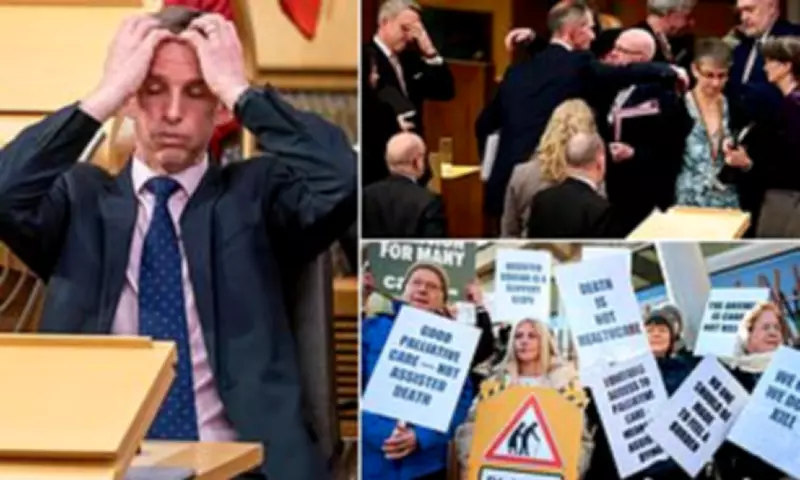
Scottish Parliament Rejects Assisted Dying Legislation in Landmark Vote
Controversial proposals to legalise assisted dying in Scotland were decisively rejected by MSPs in a crucial Holyrood vote on Tuesday night. A bill that would have allowed terminally ill adults to request assistance in ending their lives was defeated after Members of the Scottish Parliament voted 69 to 57 against it.
Third Defeat for Assisted Dying Proposals
This represents the third time that proposed legislation to legalise assisted dying or suicide has been voted down at Holyrood. The defeat has led to claims that the issue has now been settled for a generation. A series of MSPs who had initially backed Liberal Democrat MSP Liam McArthur's bill at stage one last year switched sides to defeat it in the final vote.
The legislation was defeated after MSPs voted 69 to 57 against Mr McArthur and cross-party MSPs who supported the bill. The vote followed major concerns about several critical issues:

- The legal risks of proceeding with such legislation
- Insufficient protection for healthcare workers
- Potential negative impacts on disabled people and other vulnerable groups
- The risk that individuals might feel coerced or pressured into ending their lives
Reactions from Campaign Groups
Following the historic vote, Alisdair Hungerford-Morgan, chief executive of the Right To Life UK charity, stated: This is a great victory for the most vulnerable in our society. They deserve protection and care, not a pathway to suicide.
He continued: If this legislation had passed, countless vulnerable people would have been pressured or coerced into ending their lives. A large number of MSPs from across the political spectrum came together today to recognise the dangers this Bill posed and have rightly rejected it.
The question of assisted suicide has dominated the five-year term of the current Scottish Parliament, with the issue now appearing settled for the foreseeable future.
Changing Positions Among MSPs
In the initial stage one vote last year, MSPs had voted 70 to 56 in favour of the bill's general principles. However, many of those supporting the bill at that stage had highlighted the need to address major concerns if they were to continue supporting it through to the final stage.
Scottish Conservative leader Russell Findlay and SNP MSPs Audrey Nicoll and Collette Stevenson, who all backed the bill at stage one, had announced publicly in recent weeks that they would vote against it in the final vote.
During Tuesday night's debate, SNP MSP Jamie Hepburn was the first to confirm he had dropped his support, followed by Labour's Daniel Johnson and Conservative Brian Whittle.
Passionate Speeches from Opponents
Among the most passionate speeches against the bill, independent MSP Pam Duncan-Glancy, who was the first permanent wheelchair user elected to Holyrood, argued that the legislation would put sick and disabled people at risk.
She told MSPs: I am one of the most empowered people in this country and I have been broken by how hard it is to get the help I need to get the support to live like the rest of you. When I have the support I need, when I am not fighting, I and people like me can live well. We can thrive.
She added: Disabled people don't have real choices in life. Crucially, there will be disabled people whose struggle is so hard that they have given up hope, given up fighting and will be considering tonight taking their own lives. I know this because I have been all of those people I have described.
In her final speech before standing down at May's elections, SNP MSP Ruth Maguire, who was diagnosed with cervical cancer in 2021, said her blood runs cold thinking about sitting in a room in a hospital and having a doctor raise assisted dying with her.

Explanations for Changing Votes
Explaining his decision to drop support, Mr Hepburn said he had been disappointed by the rejection of a series of amendments on issues like creating an institutional opt-out and protecting conscientious opt-outs for medical professionals. He stated: The inability to demonstrate how this area will work, along with those other areas I've highlighted leaves me at this time and with some sense of regret unable to support this bill.
Mr Findlay issued a late plea to MSPs, saying he had changed his mind and urging anyone else who was undecided that the responsible thing to do is to vote no.
Mr Johnson, who had pushed for a series of additional safeguards during stage three amendments, argued: Ultimately, it boils down to two doctors' opinions: doctors who can make mistakes, can make errors of judgement, and yes they may make referrals but no amount of referral will stop those errors or those mistakes.
Mr Whittle raised concerns about coercion and the lack of safeguards for medical professionals as he confirmed that he had concluded that if he had any doubts he cannot vote for the bill.
Arguments in Favour of the Bill
Among those who argued for the bill, Green MSP Lorna Slater said that everyone should have the right to choose as she recounted her father's assisted death in Canada in November 2025, describing it as beautiful.
She said: I got to hug him and he told us he loved us. He told us to look after my mum and he fell asleep. He did snore a bit, it was beautiful. I wish that death for myself, I wish it for anyone who wants it for themselves. I don't mind if you would never want this choice for yourself, but please, please, don't prevent other people from choosing it for themselves.
SNP MSP George Adam spoke of his wife Stacey, who lives with multiple sclerosis. He said: Stacey says smile though your heart is aching, and that is how so many people live their lives with courage, with resilience and the love for the people around them. But every life, no matter how rich, its soundtrack eventually reaches its final chapter.
Final Outcome and Government Response
Holyrood was gripped by frenzied speculation ahead of Tuesday night's vote about how many MSPs would switch their position having previously supported the general principles of the bill at stage one, and whether it would be enough to defeat the proposal.
In his final contribution, Mr McArthur said it was a decision many in the chamber will come to regret. He highlighted a series of painful deaths of individuals, and said people were dying in enduring agony and told MSPs that this issue isn't going away.
A Scottish Government spokesman said: The Scottish Government remains committed to ensuring that everyone in Scotland who needs it can access well-coordinated, compassionate and high-quality palliative and end of life care.