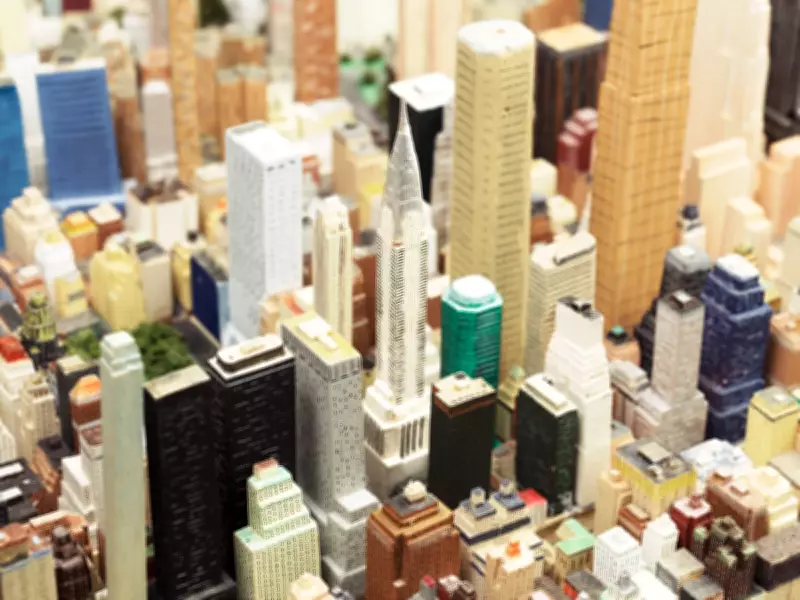
Joe Macken's Lifelong Dream: A Tiny Replica of New York City
In an extraordinary feat of dedication, Joe Macken, a 63-year-old former truck driver from Queens, has spent 23 years constructing a massive miniature model of New York City. His creation, titled He Built This City, measures an impressive 50 feet by 27 feet and is meticulously crafted from wood and cardboard, held together with glue and unwavering determination. This hyperrealistic artwork is now on public view at the Museum of the City of New York, offering visitors a unique perspective on the urban landscape.
From Popsicle Sticks to a Citywide Masterpiece
Macken's journey began in 2003 when he built a small bridge model from popsicle sticks, inspired by a hybrid of Brooklyn, Manhattan, and Williamsburg bridges. After moving his family over 160 miles upstate, the bridge was destroyed during transport. "It got destroyed, and I was kind of bummed," Macken recalled. "So I figured, let me build something better." This setback sparked a decades-long project that would become his life's work.
He started by carving a miniature replica of 30 Rockefeller Center, then expanded to include the surrounding Midtown neighborhood. Over time, his focus broadened to encompass all of Manhattan, and eventually, all five boroughs of New York City. "This is all about consistency," Macken explained. "I just started cutting one little house at a time." It took him 10 years to complete Manhattan and another decade to finish the rest of the city, block by block.

Personal Touches and Historical Significance
Growing up in Middle Village, Queens, Macken witnessed the construction of the original World Trade Center towers from his bedroom window in the late 1960s and early 1970s. "It was my favorite building," he said, which motivated him to include replicas of both the original towers and the new One World Trade Center in his model. "No matter what, the [former] World Trade Center was going to be in there. That was just a personal thing I wanted to do."
Before its museum debut, Macken stored the model in a unit near his home, carefully stacking the boards for transport to avoid damage. "You have a couple casualties here and there, but nothing that can't be fixed," he noted, emphasizing his cautious driving to prevent another mishap like the early bridge destruction.
Exhibition and Public Reception
The model is displayed in a large ground-floor gallery at the Museum of the City of New York, arranged from north to south. Interestingly, Manhattan is overshadowed by the outer boroughs, highlighting that much of the city's charm lies beyond tourist hotspots. Elisabeth Sherman, the museum's deputy director and chief curator, remarked, "I've been thinking a lot about how knowable and unknowable New York City is to all of us. It is both immediately resonant, and yet so hard to grasp. Joe did that in his own way, and now we all get to participate and appreciate it for ourselves."
Visitors can use binoculars placed around the model to examine specific sections in detail. Many locals have found their own neighborhoods, with one museum employee even pointing out their home near Brooklyn's Prospect Park. The model gained viral attention last summer on TikTok, where a video featuring Macken holding up downtown Manhattan amassed 8 million views—coincidentally matching New York's population. Macken admitted, "I'm totally clueless when it comes to that stuff. It took me longer to download the app than it did to build this whole thing," crediting his daughter for encouraging him to share his work online.
Sherman described the staff's initial reaction: "We were all standing around squealing, 'Look, there's our museum!' 'There's the Met, there's the Guggenheim.' It's this great act of recognition, and then it's also witnessing [Macken's] creativity, how he made this complex architecture out of very humble materials."
This remarkable project not only showcases Macken's artistic vision but also serves as a testament to patience and perseverance, transforming simple materials into a captivating representation of one of the world's most iconic cities.