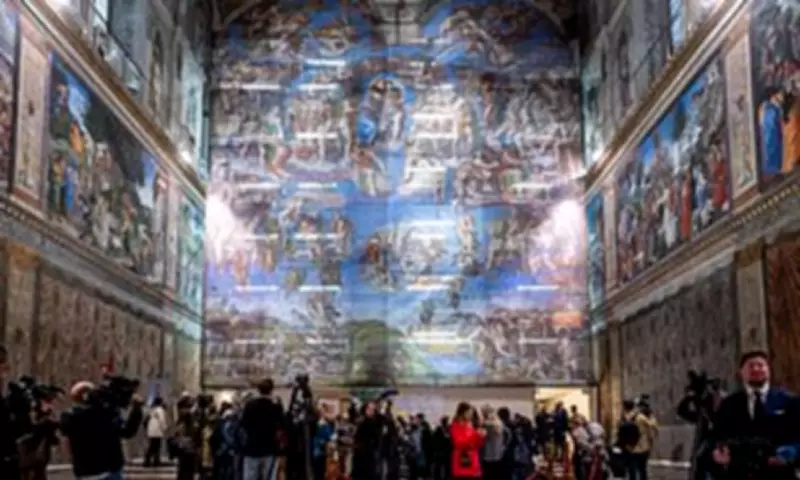
The Vatican has embarked on a meticulous restoration of Michelangelo's iconic fresco, 'The Last Judgement', within the Sistine Chapel, with the project scheduled for completion just in time for the Easter celebrations. This facelift aims to eradicate a chalky white salt film that has gradually accumulated over the Renaissance masterpiece since its last major renovation three decades ago.
Scaffolding and Visitor Experience
Currently, floor-to-ceiling scaffolding obscures the imposing fresco, which depicts vivid scenes of heaven and hell and dominates the chapel's altar wall. Despite this, visitors can still experience the artwork through a high-quality reproduction superimposed on a screen covering the scaffolding. This temporary display will remain in place until the restoration work concludes in the first week of April.
Causes of the Salt Buildup
Vatican Museum officials have clarified that the cleaning is essential due to the immense daily footfall. Approximately 25,000 people pass through the Vatican Museums each day, and their presence contributes to the problem. Fabio Moresi, head of the scientific research team overseeing the cleaning, explained, 'The salt is created because, above all, when we sweat, we emit lactic acid and unfortunately lactic acid reacts with the calcium carbonate present on the wall.' Museum chief Barbara Jatta likened the salty film to a 'cataract' that, while unsightly, is relatively straightforward to remove.

Restoration Techniques and Results
Restorers are employing a delicate method, dipping sheets of Japanese rice paper into distilled water and applying them to the fresco before carefully wiping away the white film. Early results have been striking, with cleaned sections appearing markedly more vibrant and colourful than untouched areas. For instance, on the central figure of Jesus, details such as his hair and the wounds from his crucifixion are now clearly visible, revealing Michelangelo's original artistry.
Historical Context of the Sistine Chapel
The Sistine Chapel, named after Pope Sixtus IV who oversaw its construction in the 15th century, is renowned for its artistic treasures. It was Pope Julius II who commissioned Michelangelo to paint the famous ceiling, including 'The Creation of Adam' with God's outstretched hand, between 1508 and 1512. Later, Pope Clement VII commissioned Michelangelo in 1533 to return and paint 'The Last Judgement'.
Ongoing Maintenance and Challenges
While other frescoes in the Sistine Chapel undergo annual cleaning using cherry-pickers that are removed each morning, 'The Last Judgement' presents unique challenges. Located behind the altar on raised marble steps, it is inaccessible to such machinery, necessitating fixed scaffolding for a comprehensive clean. The chapel previously underwent a complete restoration from 1979 to 1999, removing centuries of smoke, grime, and wax buildup. Small patches of the pre-restored fresco have been left intact on the upper scaffolding floors, showcasing a nearly blackened wall as a stark contrast to the cleaned areas.
Future Prevention Measures
Rather than drastically limiting visitor numbers, the Vatican is exploring technological solutions to mitigate humidity levels. Plans include implementing filtration systems and other advanced technologies to prevent the recurrence of the salty film, ensuring the preservation of this cultural treasure for future generations.