At the age of 15, I had never stepped foot inside a cinema or even watched a full movie. Growing up in a strictly Orthodox Charedi Jewish household in Glasgow, as the daughter of a rabbi, my world was confined to religious texts and Yiddish songs. Cultural influences beyond our faith were virtually nonexistent; the only glimpse of television came during visits to my less religious grandparents, where we might catch the end of a tennis match.
A Lonely and Abusive Situation
By my mid-teens, my parents had relocated to Jerusalem, sending me to live in Manchester with a scholar who would later become my abuser. For six months, the abuse occurred while his family slept or was away, leaving me isolated and without the words to describe my trauma. It was a complex and lonely period, devoid of trustworthy adults to confide in.
Discovering a New World Through Cinema
While attending a new school, two classmates invited me to see 8 Mile in town. The concept of a cinema was entirely foreign to me, and I had no knowledge of its star, Eminem, whose life story unfolds on screen. Yet, without supervision, my curiosity was piqued. We purchased tickets and entered the small, dark theater. For 110 minutes, I escaped my reality, overwhelmed by the sheer novelty of the experience, so much so that I barely absorbed the film itself.

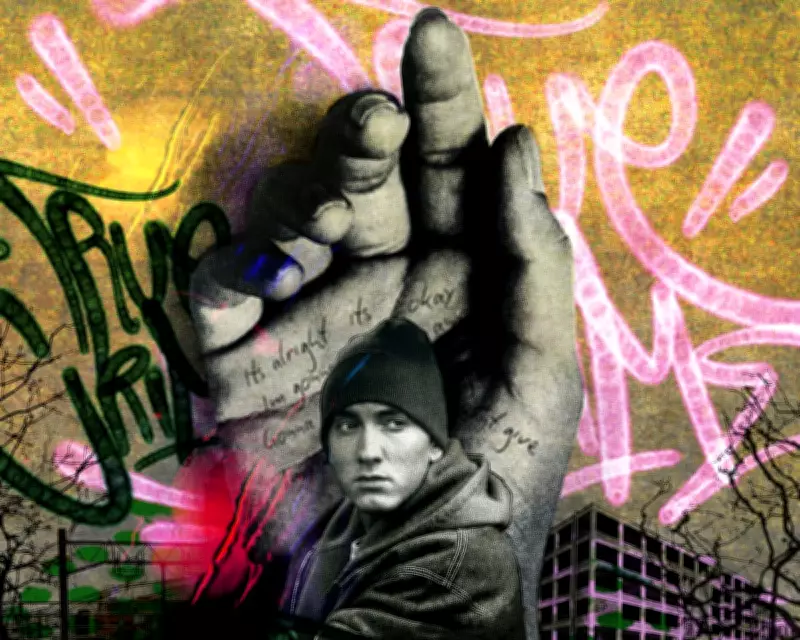
A couple of weeks later, I returned alone on a bus to watch it again. This time, I was captivated by Eminem's character, B-Rabbit. I saw parallels between us: he scribbled lyrics on scraps of paper and his hand, while I wrote rhythmic poetry in notebooks and on my own hand to process my life and survive. His moments of uncertainty, like leaning against a bus window, resonated deeply with my own feelings of directionlessness.
Embracing Art and Finding Voice
Afterwards, I sought out Eminem's music, borrowing CDs and an MP3 player to listen to tracks like Lose Yourself and Cleanin' Out My Closet. I even rapped the lyrics in Yiddish in my mind. A third cinema visit allowed me to immerse myself further, and upon exiting, I looked up at a billboard and thought, "There's my friend." This unlikely connection was transformative.
In my upbringing, art was only valued if it was ancient and presented by an authority figure. 8 Mile shattered that notion, showing me that art could originate from anyone, even an outsider like B-Rabbit, who created raw, unpolished music that resonated with crowds. This revelation empowered me to start an anonymous blog, addressing the challenges and hypocrisies I observed within the human-made aspects of my faith. It marked the beginning of externalizing my internal world, enabling me to educate myself and advocate for change.
A Path to Justice and Self-Discovery
Inspired by B-Rabbit's habit of writing on scraps, I documented each instance of abuse by the man I lived with. Years later, these records were instrumental in securing his imprisonment. Testifying at his trial expanded my world, granting me confidence and the power to make autonomous decisions. I continued writing poems and eventually authored a book, while developing a love for films, particularly biopics like Respect and Bohemian Rhapsody, which offered windows into the lives of others navigating marginalization.
Lasting Impact and Reflection
To this day, when overwhelmed, I retreat to the cinema alone, finding perspective in created worlds. Recently, I rewatched 8 Mile with my teenage son, gaining new insights as a parent into themes of drug use and neglect. It underscored how I was thrust into adulthood prematurely, contrasting with my own children's experiences. It was sheer chance that 8 Mile was my first film; had it been something like Legally Blonde, the impact would have differed. Discovering Eminem was precisely what I needed at that moment. Even now, while cleaning, I rap his music in my head, sometimes in Yiddish.
Chutzpah: A Memoir of Faith, Sexuality and Daring to Stay by Yehudis Fletcher is now available in paperback. Support for those affected by rape or sexual abuse is accessible through Rape Crisis on 0808 500 2222 in England and Wales, 0808 801 0302 in Scotland, or 0800 0246 991 in Northern Ireland.