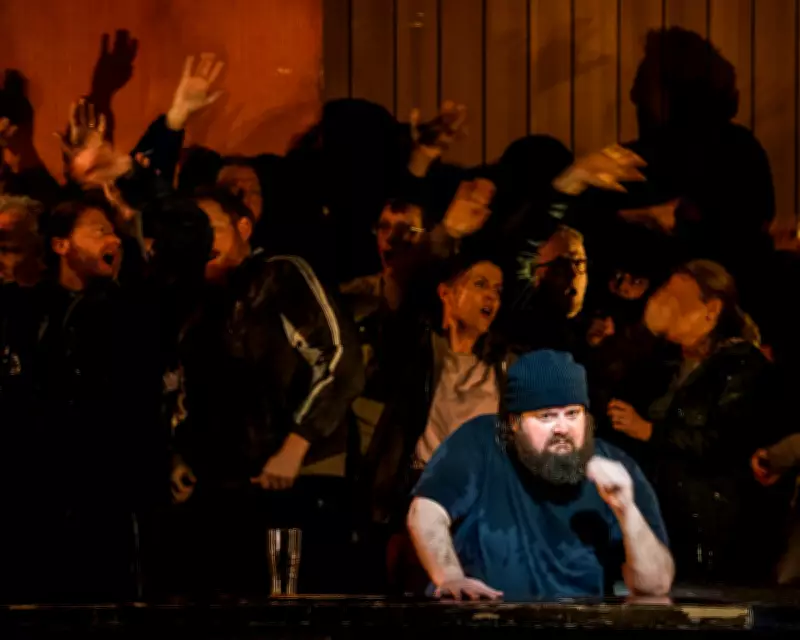
A man apart … Allan Clayton as Peter Grimes in Deborah Warner’s staging at the Royal Opera House, London. Photograph: Tristram Kenton/The Guardian
‘Who can turn skies back and begin again?” That’s the question the fisherman Peter Grimes asks the universe at the close of his brief aria in Act 1 of Britten’s opera – two and a half minutes of singular, breath-holding music, at the end of which the people around him all think he’s mad or drunk, but we the audience know he’s a man apart, who sees more clearly than any of them.
For someone who runs his life by watching those skies, the words are as succinct as they are beautiful – and there’s a simplicity to the way Allan Clayton sings them that encapsulates the balance of directness and poetry in his Grimes, a role in which he currently has few rivals. Perhaps it also sums up Deborah Warner’s staging, updated to a present-day, left-behind English coastal town, which has an almost workaday realism that feels like an invitation to take everything literally, and yet has touches of the fantastical right from the start. In the prologue, Grimes lies centre-stage reliving in his sleep the nightmare of his court appearance while a fishing boat, suspended from the flies, hangs like the sword of Damocles over his head; in the orchestral interlude that follows this scene, an aerialist tumbles slowly down to be caught by Grimes, again and again.

Warner’s production opened in Madrid in 2021 and first came to London the following year, when the thuggish villagers brandishing flags in the mob scene felt topical; they feel even more so now. But there’s a beauty to Michael Levine’s set, the back of which could be the tiled wall inside a harbour fish market but could equally be the wide-open sea, depending on Peter Mumford’s lighting. It’s in the contrast between the ordinariness of the plastic crates and fishing paraphernalia on stage and the grace of the aerialist’s movements, for example, that Warner finds insight. The anachronism in Grimes having a small boy as an apprentice, and the contradictions in the way the boy relates to him, with fear and yet occasionally with childlike tenderness, seem to matter less than the complexities of human nature that those contradictions suggest.
As well as Madrid and London the staging has been seen at co-producing theatres in Paris and Rome – always with Clayton in the title role, and with the rest of the cast staying largely the same, unusually so for an opera production. The result is an outstandingly taut ensemble, from Maria Bengtsson’s emotional yet practical Ellen Orford, and Bryn Terfel’s gruff Balstrode all the way to Barnaby Rea’s sneering Hobson. The single newcomer is Christine Rice, a vivid Mrs Sedley who makes a sparky double act with the no-nonsense Auntie of Catherine Wyn-Rogers. The conductor, also new to the team, is the Royal Opera’s music director Jakub Hrůša. There are some passages where he takes his time – Balstrode’s homilies in the pub, for example, which show us the precarious respect in which the old captain is held. For the most part, though, he drives his excellent orchestra relentlessly forwards, sending us headlong into this opera’s strange tragedy. Until 28 May