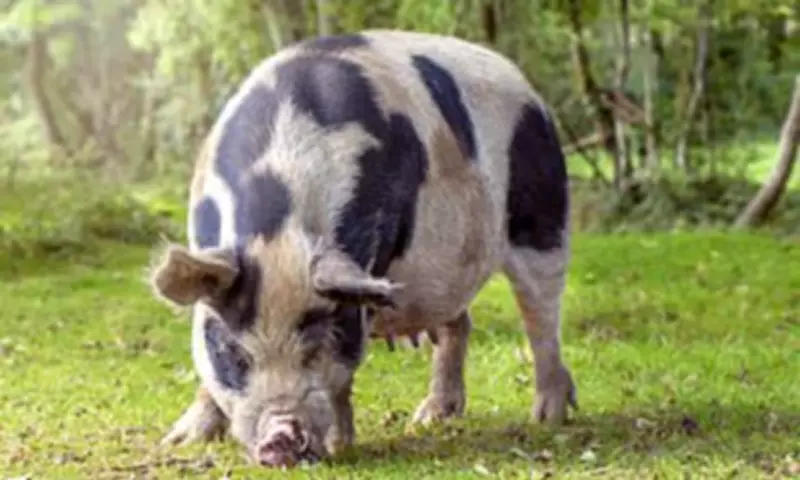
The Gloucestershire Old Spot pig, renowned for its distinctive black markings and premium pork sausages, is experiencing a dramatic population decline that has raised serious concerns among conservation experts. The Rare Breeds Survival Trust (RBST) has released its latest watchlist for the United Kingdom's native livestock and equine breeds, revealing troubling trends for several historic animals.
Precipitous Drop in Breeding Numbers
According to the updated RBST assessment, the Gloucestershire Old Spot remains categorised as 'at-risk,' but has suffered a significant 23 percent reduction in the number of dams producing offspring over the past year. The charity reports that fewer than one hundred females are currently producing registered piglets, indicating dangerously low population levels that threaten the breed's future viability.
Royal Patronage and Historical Significance
This large white pig, distinguished by at least one clear black spot and ears that nearly cover its face, holds particular affection within the Royal family. Princess Anne, the Princess Royal, has demonstrated passionate support for the breed, becoming patron of the Gloucestershire Old Spots Pig Breeders' Club in 2009. Her farming estate reportedly maintains a small herd of these pigs, though one was tragically killed by a wild boar intrusion in 2015.

The Old Spot, often called the 'Orchard Pig' for its traditional grazing in cider orchards, represents the world's oldest pedigree spotted pig breed. Its slightly higher fat content compared to commercial pork provides a more traditional flavour profile, making it a favoured choice for high-quality pork sausages commonly featured in gastro-pubs across Britain.
Broader Conservation Crisis
The RBST watchlist reveals concerning trends beyond the Gloucestershire Old Spot. Several other native breeds have been moved to the 'Priority' category, indicating urgent conservation needs:
- White Park cattle
- Lincoln Red cattle
- Boreray sheep
- Soay sheep
- Hackney horse
- Cleveland Bay horse
- Northern Dairy Shorthorn cattle
White Park Cattle in Peril
Particularly alarming is the situation facing White Park cattle, whose ancestors are believed to have accompanied Celtic peoples to Britain's northern and western regions. After nearly disappearing in the 1960s with only four herds remaining, the breed had recovered somewhat over five decades. However, new calf registrations have declined for three consecutive years, dropping 36 percent since 2022, raising concerns about inbreeding and genetic diversity loss.
Hackney Horse Decline
The Hackney horse, celebrated as the 'Ballerina of the show arena' for its distinctive high-step trot, has experienced a 41 percent reduction in females producing offspring during 2025, according to RBST data.
Historical Context and Modern Challenges
The British Pig Association reported in 2017 that only 709 breeding Old Spot females remained—less than half the 1,430 recorded in 2014. At that time, leading breeders attributed the decline partly to the soaring popularity of a rival breed featured prominently in the television series Downton Abbey.
Christopher Price, chief executive of the Rare Breeds Survival Trust, emphasised the gravity of the situation: 'The sharp fall in White Park cattle birth registrations is a major concern for the breed's future. These striking rare cattle are an irreplaceable part of the UK's heritage.'
Price further highlighted systemic challenges: 'Fantastic work by farmers and land managers is placing native livestock breeds at the heart of sustainable farming and nature restoration throughout the UK, but Government support is very limited and difficult to access.'
The RBST is calling for increased governmental incentives for choosing native breeds and collaboration with the Department for Environment, Food and Rural Affairs (Defra) to develop comprehensive breeding plans for all rare native livestock and equines.
This conservation crisis extends beyond individual breeds, representing a threat to Britain's agricultural heritage, genetic diversity, and traditional food production methods that have shaped the nation's culinary landscape for generations.