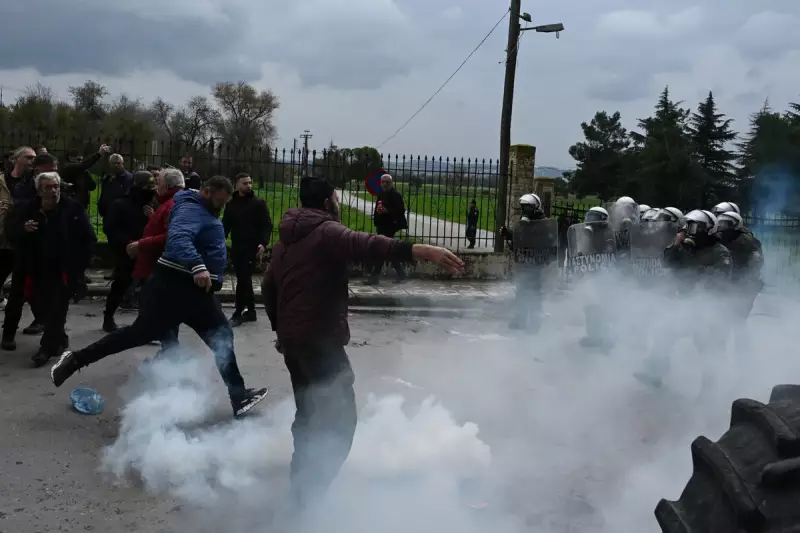
Riot police in Greece have fired tear gas at farmers who attempted to block the main access road to the international airport in Thessaloniki, the country's second-largest city. The dramatic escalation occurred on Friday 05 December 2025 as protests over significant delays in European Union agricultural subsidy payments intensified across the nation.
Nationwide Protests and Economic Desperation
Angry farmers have mobilised thousands of tractors and other farm vehicles, creating blockades at border crossings and key highway points. These actions are periodically halting traffic, with threats to completely shut down roads, ports, and airports. In northern and central Greece, police are enforcing traffic diversions to navigate around the protests. Farmer-led blockades at the borders with Bulgaria, Turkey, and North Macedonia have already severely hampered lorry traffic, leading to significant backups of freight vehicles.
The root cause of the unrest is the delayed payment of vital EU farm subsidies. Authorities are reviewing all claims following the discovery of a widespread fraudulent claims scheme. Protesters argue that the blanket delays constitute collective punishment, leaving legitimate farmers in crippling debt and unable to afford seeds and fertiliser for the upcoming planting season. This crisis is compounded by an outbreak of goat and sheep pox this year, which forced a mass cull of livestock.

"We're Bankrupt": Farmers' Plea for Survival
"We're out in the street protesting whereas we should be sowing. We're bankrupt," said farmer Vasilis Mavroskas. He warned that the inability to plant crops would have a direct knock-on effect on food supplies to urban centres. "It's a matter of survival at this point. If I stop producing, think of what will happen at the table of urban centres. We're appealing for society to join us."
In Thessaloniki, a group of 200-300 farmers with over 100 tractors blocked a road near the airport. A smaller faction tried to use their vehicles to break through a police cordon and seal the airport's primary access route, an action that would have stranded travellers. Christos Tsilias, vice president of the Thessaloniki farmers' union, highlighted the dire situation: "At this moment the plains of Thessaloniki and nearby Halkidiki are not planted. We don't have money to buy raw materials."
Government Stance and Subsidy Scandal Fallout
Michalis Chrisochoidis, the Minister for Public Order, stated this week that the government remains open to dialogue with protest leaders. However, he issued a firm warning that authorities would not tolerate the shutdown of major national transit points.
The current turmoil stems from a major scandal involving EU farm subsidies. The controversy led to the resignation of five senior government officials in June and the phased shutdown of the state agency handling the payments. Dozens of individuals have been arrested on suspicion of filing false claims, following an investigation led by the European Public Prosecutor's Office (EPPO).
In late October, the EPPO, the EU's independent financial crime body, stated its investigation was linked to "a systematic large-scale subsidy fraud scheme and money-laundering activities." Such protests are not uncommon in Greece; past blockades have sometimes severed all road traffic between the north and south of the country for weeks, underscoring the potential for prolonged disruption.