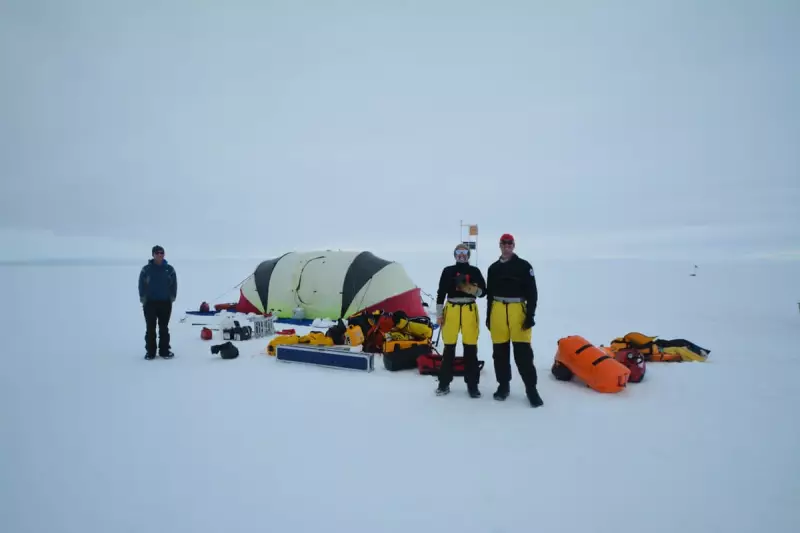
In the stark, flat whiteness of the Antarctic summer, where the sun and full moon can share the same frozen sky, scientists are racing to understand a hidden threat. Dr Ben Galton-Fenzi, a principal research scientist with the Australian Antarctic Division, recently led a critical international study that quantifies the alarming rate at which the continent's vast ice shelves are melting from beneath.
The Hidden Melt: A Gigantic Annual Loss
Galton-Fenzi and a global team of researchers have spent a decade consolidating data from nine different modelling groups. Their findings, published recently, estimate that Antarctica's ice shelves are losing approximately 843 billion tonnes of mass every year due to melting where the ocean meets their undersides.
To visualise this staggering figure, imagine 843 giant ice cubes, each one kilometre long, wide, and deep, melting into the ocean annually. This volume of meltwater is roughly equivalent to the total amount of water the River Nile discharges into the sea each year.

Why the Underside Matters
While ice shelves themselves float and do not directly contribute to sea level rise when they melt, they act as crucial buttresses, holding back the colossal ice sheets on land. "We need to know because the ocean-driven mass loss is one of the biggest uncertainties in Antarctica ice sheet projections and, therefore, in global sea level rise," explains Galton-Fenzi.
The concern is that as warming ocean waters erode these shelves from below, they can become unstable and thin. This could accelerate the flow of land-based ice into the ocean, a process that would directly and dramatically raise sea levels worldwide. Scientists warn that the most vulnerable regions of Antarctica alone contain enough ice to potentially push up global sea levels by about 15 metres if they were to melt entirely.
Exploring an Inaccessible, Freezing World
Gathering data from beneath ice shelves, some over two kilometres thick, presents a monumental challenge. "The coldest water anywhere in the ocean is beneath the Antarctic ice shelves," says Dr Steve Rintoul, an oceanographer at Australia's CSIRO. "Satellites can't see it, ships can't reach it, and drilling holes is exceptionally difficult."
In a stroke of luck, an autonomous Argo float deployed by Rintoul's team under the Totten Ice Shelf drifted and spent nine months under the Denman Ice Shelf instead. Its data revealed that the Denman, which holds ice equivalent to 1.5 metres of global sea level rise, is being exposed to warm water melting it from below. This configuration makes it particularly vulnerable to unstable, irreversible retreat.
The research highlights significant uncertainties. While satellite data suggests Antarctica lost 93 billion tonnes of ice between 1992 and 2020 overall, the processes driving this loss are complex. Increased snowfall from a warming atmosphere can temporarily add mass, even as the ocean eats away at the foundations.
Dr Sue Cook, a glaciologist at the University of Tasmania, points to another urgent question: the potential for vast amounts of Antarctic meltwater to disrupt major global ocean currents. "This ocean conveyor belt is what helps the climate to stay relatively stable. If it gets disrupted, then the consequences could be dramatic," she states.
The consensus is clear, however. "We do know with very high confidence what the sign of the change will be. The ice sheets will keep losing mass," Galton-Fenzi concludes. "It is how fast and how much is where the uncertainty is." The race to refine these projections continues, as the fate of the planet's coastlines hinges on the stability of Antarctica's frozen frontiers.